Every life is slated for a non-zero amount of suffering. Much of it is banal (a wounded knee or mild social rejection) but some is deeply painful and, in many cases, irreversible, like the loss of a loved one. But in the midst of that suffering, the relationships we have with other people can soften its impact, providing a kind of “social buffering” that reduces the intensity of our distress. The persistence of consolatory behaviors, like a mother tending to a distressed child, across cultures and even species suggests deeply conserved biological systems that promote affiliation and, ultimately, survival. I’m Nilaja Grant, an undergraduate researcher in the Hammock Lab at Florida State University, where we study one of these systems: the oxytocin system, which is the focus of my Honors in the Major and IDEA Grant project.

Oxytocin (OXT) is a neurotransmitter and hormone first implicated in maternal behavior, which has since been shown to play a role in social bonding, empathy, and prosocial behavior. Although the OXT system is highly conserved, with homologs like mesotocin and isotocin playing similar roles in birds and fish, specific mammalian model organisms have shaped our understanding of the hormone and its various functions. For example, a paper published in Science a few years ago showed that oxytocin modulates the consolation response in prairie voles, a socially monogamous rodent species, following the distress of a cagemate. Here, consolation is defined as affiliative behavior directed at a distressed conspecific and operationalized as grooming directed from one animal to another (for example, animal A licks stressed animal B). Further research in mandarin voles has clarified the specific receptor systems implicated in this relationship, and many studies have been done showing that intranasal oxytocin administration increases empathy and in-group altruismin human beings.
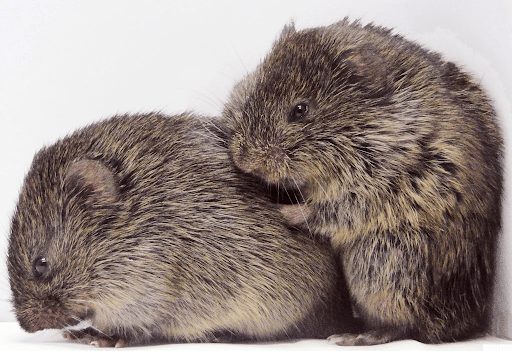
My current work aims to further explore these findings to discover the developmental stage at which this response emerges, and how the onset of this response might be shaped by sex and the postnatal environment. This project uses mice, another social rodent species, with alterations to their OXT and OXTR gene (which produce oxytocin and its receptor, respectively). Oxytocin must bind to its receptor in order to have an impact, and OXTR influences the amount of OXT produced in an organism. Recordings of mice during a mild stressor are scored to quantify various behaviors, including allogrooming, which are then analyzed to identify differences between sexes and genotypes. Using this data, I hope to contribute to our understanding of how oxytocin and its receptor influence prosocial behavior, with potential significance for our understanding of developmental conditions like autism and other disorders with social deficit components.

After completing this project, I hope to pursue a career in research as a PhD in Neuroscience or a closely related field. In the more immediate future, I’m looking forward to defending my thesis and doing more interesting work under the guidance of Dr. Hammock, my research mentor and supervisor.

