By Talia Holzman, William & Mary
Though I was a teacher in Bosnia, I have never felt a stronger student. I spent everyday learning new parts of Bosnian culture, new ways to teach, and new things about each of my students. Each day was equal parts a challenge and an exciting adventure, entering a classroom not knowing what would be thrown my way. Global research means adapting to anything, no matter how unexpected. It also means gaining the skills to engage with a foreign culture, and build a profound community. Without taking the time to live and work on the ground, the insights into the intricacies of Bosnian culture and its education system would not have been possible.
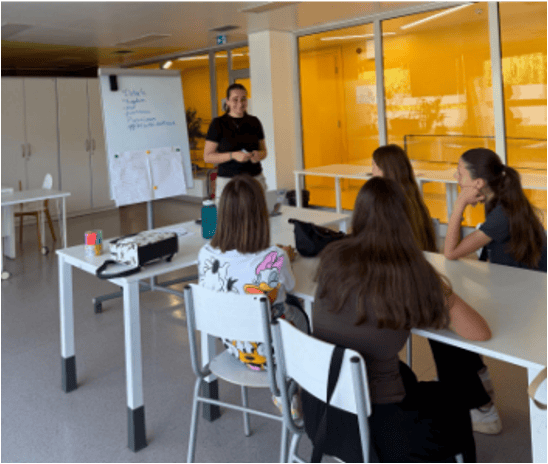
As a student, I learned to slow down, listen, and embrace improv. My instinct to plan absolutely every lesson in advance was met with a room full of teenagers with varying English and Intercultural Communicative Competency skills. The anticipated effects of the lessons looked so different for each of my students, and needed to be changed in order to effectively engage them as best possible. This was also done in collaboration with my Bosnian co-teacher, Šejla. The two of us learned to communicate with eachother while we learned to lead our classroom. The simultaneous effort was not easy, but was well worth the community we created. I learned that sometimes the best way to teach is to throw the lesson plan out the window, and listen to what my students are willing to share with me. I would listen to them talk about tv shows, friend drama, and their favorite fashion brands during our breaks, which built trust between us. Trust strong enough for them to then share their personal experiences with prejudice, the legacy Bosnian war, and their passions and interests.
On the first day of teaching, one of my students said to me ‘I don’t care about your culture as long as you don’t hurt mine’. Most of my students didn’t see the value in learning about other cultures or people different from themselves, because how could that impact them? The activities I led with Šejla were focused on hope, ICC principles (non-violent communication, empathy, etc) and the book the Freedom Writers Diary. As my students read the stories of students from LA in the 90s, they began to see how connecting with others different from them could help them to understand themselves and their community better. My students’ lives and struggles are different from those of the Freedom Writers, but they could find connecting themes, displaying the power of learning of others’ stories and cultures.
Of course, there were difficult moments in my classroom. Teenage boys wreaking havoc, but also students responding in discussions with hurtful comments or racist jokes. I found that the best response to moments like this was to simply ask the student why they felt the need to say what they did, or where they learned their response. Never once did a student truly believe or fully understand the hate or prejudice behind their comment. No one is born hateful, but we are all born ignorant. Our ignorance is combatted by the information provided to us by our communities. For my students, this meant communities that primarily focused on their own culture and society, not often seeking to understand differences with others. Bosnian culture is now forever impacted by the legacy of the war and genocide, and the trauma that comes with that impacts the worldview of surviving and future generations.
I am not the first to say that education is the key to changing the world. Neither the hatred nor peace that exists in the world appeared from thin air. As humans, the way we see the world and how we behave is shaped by the tools we are given by others. I am proud that I equipped my students with more tools to navigate the world with more empathy, understanding, and desire to engage with their curiosities, and every moment in our classroom gave me the same skills as well. I believe that it is our jobs as members of society to constantly be re-examining our toolboxes and adding to those of others. Our communities are only as successful as our participation in them, and education is an integral aspect of this.
This experience has reinforced my desire to promote systems that encourage dialogue across differences. Though, I want to push the organizations I have worked with and will hopefully work with in the future to focus less on outcomes, and more on processes. One of the main things I learned from ABC is that a deliverable is just that—a deliverable. I loved watching my students’ final presentations on initiatives to improve issues in Bosnian sociey, and it truly did demonstrate their growth over the course of the project. But, one performance or presentation can never truly encapsulate the intricacies and nuances of the growth I was privileged enough to witness in our classroom, small moments that add up. I hope that I remember this lesson, and carry it forward in the change I hope to affect, that an outcome is nothing without its process.
My students taught me to be a better collaborator, listener, teacher, and human. I learned to lean into the chaos instead of working against it, and by doing so created a community that was immensely difficult to say goodbye to. I am privileged that they have become a part of my story just as the American Bosnian Collaboration Project has become a part of theirs.
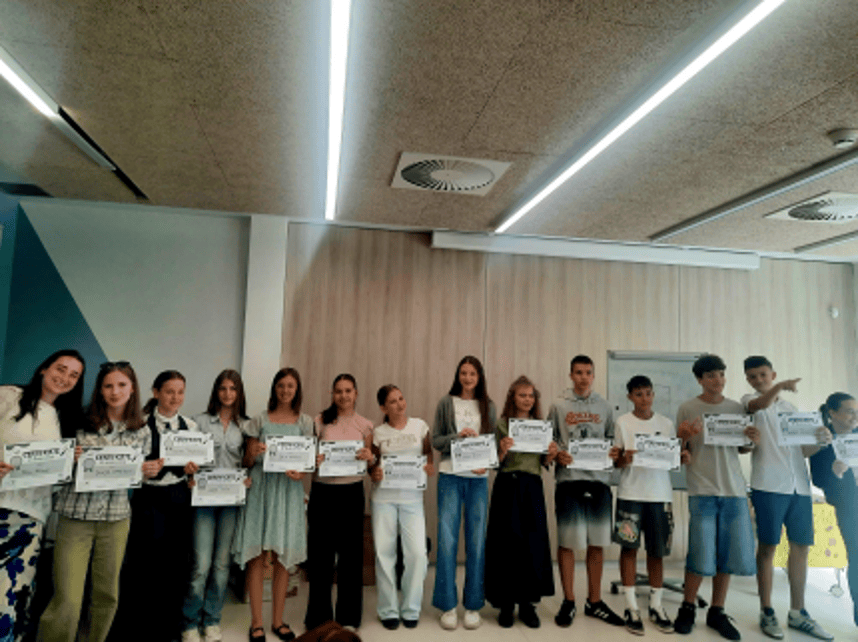
My class on the final day!

