By Alana Mitchell, Syracuse University
In approaching my final year of architecture school, I spent a lot of my time questioning things. What I learned, what I did not learn, what I like, and what I want to do. Within these questions lay my thesis for architecture, which will take place throughout the coming spring semester. My research this summer is the foundation for this thesis, one that is not only personal to myself and my family, but also applicable across multiple disciplines and contexts globally. I’ve spent a lot of time expanding my research question and then reigning it back in, but through this research in Jamaica, I’ve really learned how difficult it is to remain in one research question. My view on architecture and infrastructure were able to develop a sharper focus, one that was informed by the survey of people and their homes who were affected by a natural disaster. As an architecture student, many things are theoretical until you begin working in the field. This makes it difficult to understand the actual scale of certain aspects of a real building. Knowing how a wall connects to the floor and the roof can seem both simple and complicated, and being able to physically engage with this connection is valuable. With my research this summer, my desire to center people in architecture came into question. How exactly do culture and the built environment engage with each other? What does this mean within Jamaica, post hurricane where rebuilding needs to happen quickly and in hard to reach areas. This summer, delving into these questions has really pushed me to consider my interests and intentions equally with architecture and as I approach graduation and the rest of my career, I have really been able to take the time to sit with these many considerations.
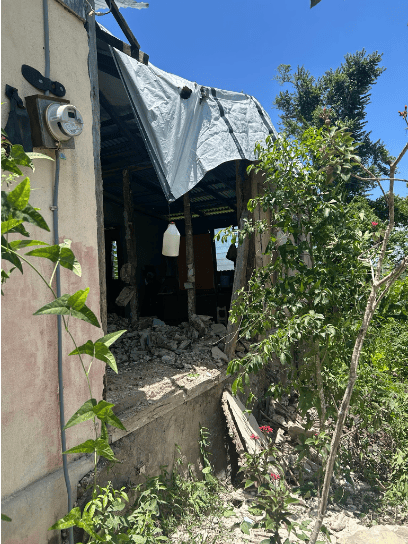
Photo of construction for an elderly resident in Bounty Hall, Jamaica. Large amounts of rubble created hazardous conditions for the 81 year old resident.
On the topic of global research, I have found it most valuable to be able to view certain research questions through multiple lenses. For example the question of “how do communities rebuild after natural disasters” is something that is global. Narrowing those disasters down to hurricanes still leaves a major area to investigate. Despite my location of interest being Jamaica and the Caribbean, I took many branches of hurricane research, tropical building methods, and engineering innovations as valuable to my research question. Being open to all of these different points of research enabled me to create further branches that ultimately informed my main focus. In a way, I felt like I had to occasionally flip my question around and treat it like a 3D model. Tying back to global research, as someone raised in the United States my understanding of Jamaica is at times limited to my own experience and times spent with family. However, in research I cannot remain fixed and I have ensured that I am open and engaged to thinking outside of my own understanding. By asking people in Jamaica the questions that I have and by being aware of my knowledge gaps, global research pushes me to be outwardly searching in my questions.
With architecture being something I’ve wanted to study for so many years, I’ve had a lot of shifts in what interests me and what I want to do. As I went to Jamaica this summer, I felt like I was really able to connect again with an early motivation of mine: to use architecture to connect with people and their daily lives. It doesn’t always need to be the most complex or flashiest in the design, but the one that leaves a positive impact for those who need it. This research really brought me into this frame of mind even stronger than before and the additional connection to culture is one that is also a large personal interest. Music, art, and literature are very culturally important and are also incredibly valuable to me so I am always seeking to connect these areas to architecture. At times, making the connections can be difficult but I often find myself insisting on including this interest even in my design courses. Moving forward in this final year, I’ve once again found a way to work in music and architecture through research that interests me and the field that I am in. As I approach graduation, I hope to enter into architectural practice where I am able to continue growing a practical understanding of architecture. I hope that through the practical, I am able to strengthen the analytical research and theoretical application of architecture as well.
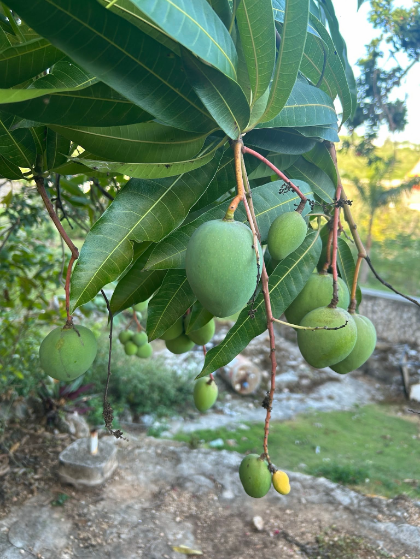
Image of a mango tree. Many trees lost their fruits and were damaged as a result of the hurricane which left lasting impacts on the fruit industry in Jamaica in the following 9 months after the hurricane.

