By Catherine Thompson, Johns Hopkins University
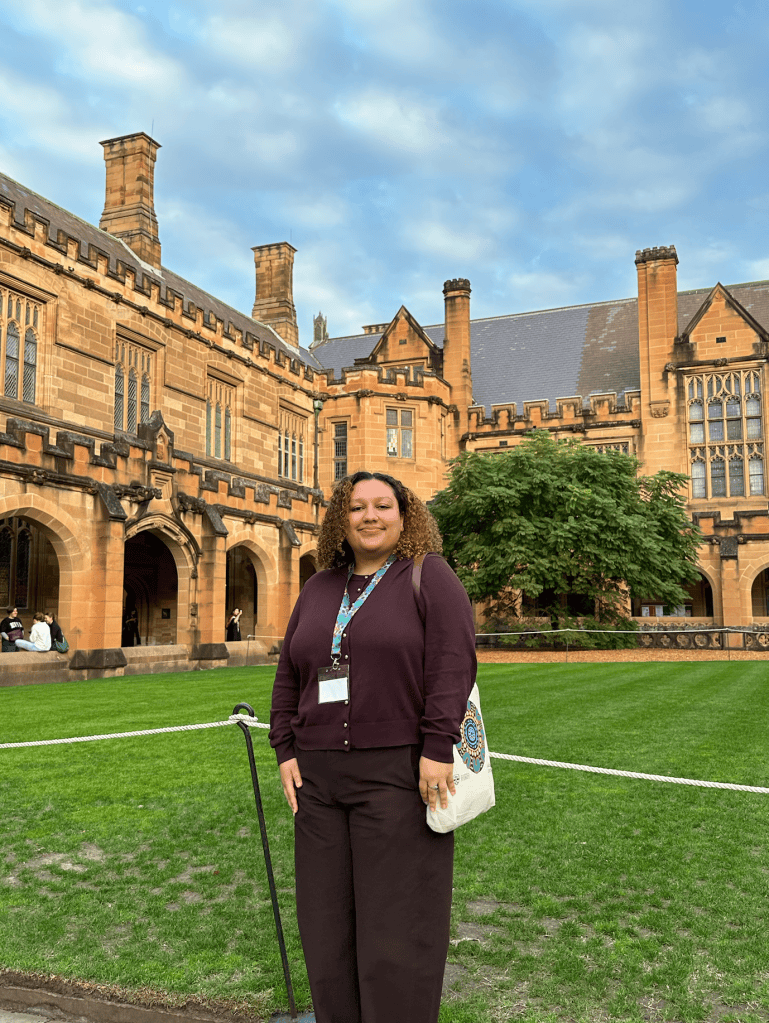
Hello! I’m Catherine, and I’m back to provide an update on my archival summer research project! Again, as I am double majoring in Political Science and Africana Studies, so much of my passion and interests are invested in the sector of Black politics. Studying abroad in Melbourne, Australia for a semester ultimately expanded my field of study. By gaining an intricate perspective of the Australian youth justice system through Victorian state government websites, Ombudsman reports, Royal Commission reports, newspaper clippings, and academic literature, I have been exposed to Australian legislation, the history of Melbourne’s gaols, architectural and design features of the facilities over time, youth justice detention rates, and welfare institutionalization.
To provide better insight to any audience, here is my current thesis: “The Victorian State Government declares that the state ‘has one of the most successful and effective youth justice systems in Australia,’ which may hold true in comparison to other territories and states, but from a bird’s eye view, it is difficult to sustain. By focusing on Victoria’s contemporary youth justice facilities, Parkville Youth Justice Precinct and Cherry Creek Youth Justice Centre, I argue that evolution in the design, location, and administration of Victoria’s youth justice facilities does not reflect linear progression from punishment to rehabilitation. Instead, reforms, perceived as progressive, consistently reconfigure the mechanisms through which the state governs young people, fluctuating from welfare intervention and institutional classification to restorative justice, community supervision, and securitized rehabilitation, while preserving the disproportionate regulation of Indigenous youth. From Turana Youth Training Centre to the present-day youth custodial settings, rather than the intended goal of diverting youth and reducing criminalization, the transformation of rhetoric, architecture, legislation, and administration has ultimately altered the avenues through which supervision, control, and governing bodies are employed. What remains continual is that the Allan Labor Government’s responses are largely reactive rather than proactive, contributing to the persistent disproportionate overrepresentation of Aboriginal and Torres Strait Islander youth while positioning youth resistance as primary catalysts for institutional change.”
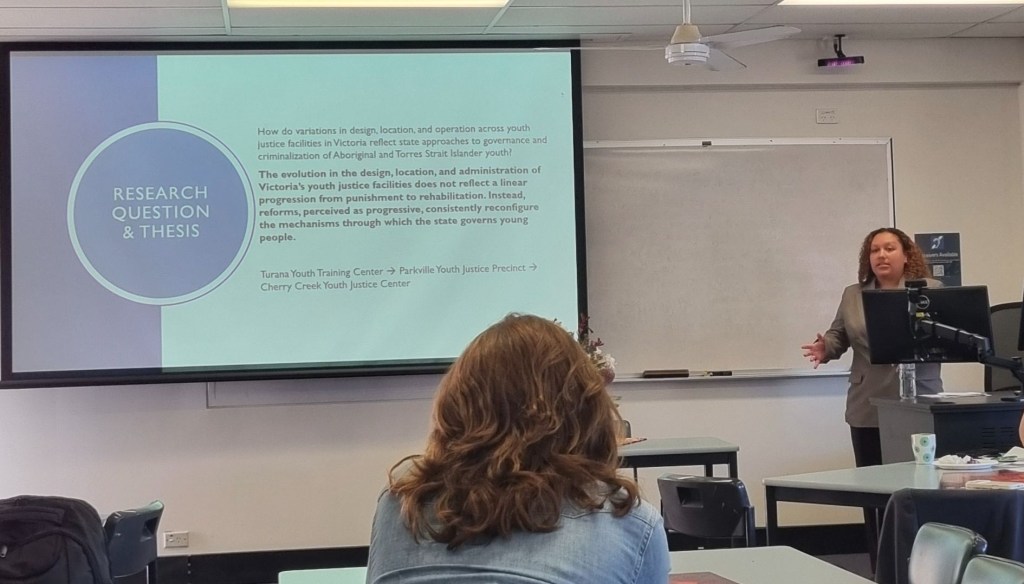
Providing a paper presentation in Sydney, Australia, at the Aboriginal and Torres Strait Islander Focused Initiatives in Education and Social Work Conference was a great highlight of my research experience. Many people were unaware of the opening/closures/redevelopment of youth justice systems occurring on Country and the various legislation put forth recently, such as Adult Time for Violent Crime and strict new bail laws. I engaged in deep political discourse with other educators, scholars, and academics about Indigenous communities, and learned about high suicide rates, incarceration, social work, and decolonial initiatives within these communities. Along with this, I got the chance to explore the Sydney Opera House and Harbour Bridge :)!
One salient message I want to always remember as I walk away from this and into my senior thesis is that a huge aspect of independent research is discipline. But, when you sustain curiosity through uncertainty and unknowing, that discipline becomes independence. A reality I faced throughout my research was learning that site visits to the three youth justice facilities I studied, Malmsbury, Cherry Creek, and Parkville Youth Justice Center, would not be possible within the time frame of travel. At this point, my research heavily relied on visual cues and infrastructure of the facilities such as fencing, cameras, security, and signage. But I was forced to pivot, search, and be led to a new but similar research question. As unfortunate as it was at the time, this kind of thing tends to happen, especially in archival research; you hit a wall and must choose a new pathway. I learned that accepting that path creates more freedom and a thirst for knowledge, almost like adrenaline. I thought this might be nice for some to hear because hitting that wall is rough and can be unmotivational, but I think reminding oneself of this message in the future may be helpful.
Not only did I take away lifelong academic lessons, but I also enhanced and acquired academic and professional skills. A pattern I notice throughout my research is the intersectionalities in synthesizing different disciplines. From history, criminology, Indigenous studies, geography, and architecture, these bodies of knowledge speak to one another rather than being isolated. A skill I investigated more was understanding my intellectual interpretation. As this is the first independent research completed, I introduce the concept of the ‘carceral eclipse.’ Proof of valuable interpretation and interest, I communicated complex research to a variety of audiences through the 20-minute paper presentation at the conference, a 5000-word academic paper, and various mediums of personal reflection, requiring transformation, fluidity, and expertise.
I would like this project to demonstrate that I am interested in looking beneath institutional narratives, beyond the implicit and explicit, and asking how systems physically and structurally operate. Rather than accepting claims of “progress,” I began to ask myself, what even is progress?
I’m hoping to finalize my paper and potentially apply for publication. Ahead of me comes my senior year, where I will return to the Johns Hopkins Sheridan Libraries’ Black Panther Party newspapers and archives. This fall I will begin my Political Science thesis, and I want to carry this structural and interdisciplinary approach with even more physical and experiential components. This project continued to show me how much I value archival and policy research, but made me realize how much I also would love to engage more directly with people and environments through fieldwork, interviews, and archival visits.
 HSF House Blogs