By Aryeh tenBroek, University of Hawaiʻi Mānoa
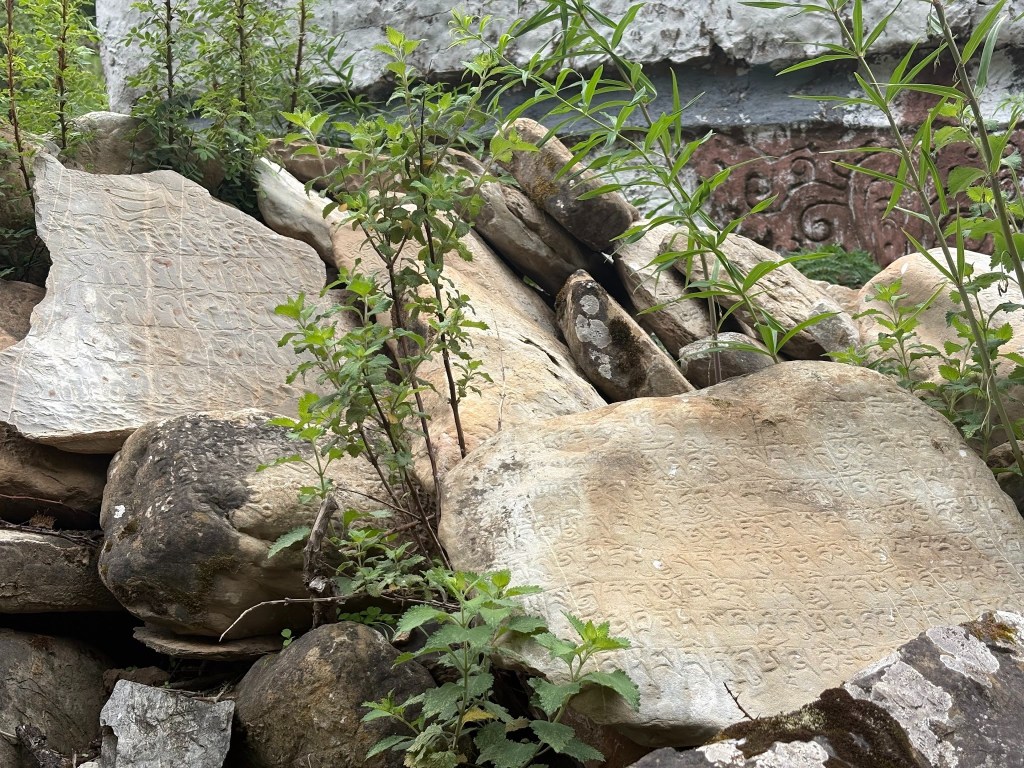
Bon mantras carved on stones near Pungmo, Dolpa District, Nepal
On the evening of July 6th, in the company of the interdisciplinary research team from the University of Hawai’i at Mānoa, I left Kathmandu, Nepal’s capital where our team had all gathered just a couple of days prior, on an overnight bus bound for the city of Nepalgunj in the country’s southwest. After sleeping through a winding and bumpy ride, interrupted by a late-night stop for dal bhat, we woke up to see through the bus windows the sun rising over the expansive plains and rice paddies of the savanna-like Terai region. Arriving in the city around mid day, we took that afternoon and evening to rest at a hotel, sheltering from the humid, subtropical heat outdoors. Early the next morning, we crammed into a jeep and headed north, following the Karnali river upstream, then its tributary, the Bheri river, along its course higher and higher through the hilly Pahad region. After a full day’s drive, including switching jeeps twice at points on our route where the monsoon-season river had made the road impassible, and had to be crossed on foot, we made it to the town of Dunai, headquarters of Dolpa district and gateway to the region of Dolpo.
Dunai, although much more closely linked culturally and economically with the rest of modern Nepal than anywhere else in Dolpo, nonetheless proved to be a fruitful starting point for my research, as I had the opportunity to visit a boarding school for local Bonpo children, and met with the school’s director who showed me around. But, there was still much more to come. With full backpacks we left Dunai on foot and entered Shey Phoksundo National Park. Two days of walking upriver brought us to the village of Pungmo, located in the back of a lush, misty valley. We visited the village’s community Bon temple, Namgyal Lhakhang, and spoke to the lama who is the temple’s current caretaker. Another day, we hiked around two hours away from the village to a remote cluster of monasteries, where the high lama of Pungmo resides. We toured his private temple, perched on a steep hillside. After another day in Pungmo, we left and resumed our walk up the valley, passing an incredible waterfall along the way, and arrived in Ringmo village on the shores of Phoksundo lake.
My main point of interest in Ringmo was actually located about a 15 minute walk along the lakeshore from the village itself: the Thasung Tsoling Bon monastery complex. I visited the monastery several times during our week-long stay in Ringmo, and had a few conversations with the very knowledgeable geshe there. Ringmo though is a majority Bonpo village, like Pungmo, so even outside of the monastery there were many stupas decorated with Bon symbols, and stones carved with Bon mantras.
It took a journey of three days, on foot and on horseback, to get from Ringmo to our next destination. On the way we crossed two 17,000 foot mountain passes, in between which we spent the night in a yak herder’s camp. We then descended into the Dho Tarap valley, and arrived in the village of Dho, where we would spend the next 10 days. Unlike the villages where we spent the first leg of our trip, the majority of the inhabitants of the Dho Tarap valley are Buddhists, but there is one Bonpo village, called Shipchok, also home to an ancient Bon monastery. I visited the Shipchok monastery a couple times, and observed the over 600 year old wall paintings there, and also had a fascinating and enlightening interview with the lama there.
I’m writing this blog on the last day of our stay in Dho. Tomorrow, we will leave for the last leg of our trip, a 10 day journey through the more remote and wild Upper Dolpo region. So far, everyone I’ve met along the way around Dolpo has been exceptionally friendly and welcoming, and the Bonpo lamas I’ve interviewed have generously shared their extensive knowledge of their religion and culture. One thread which has become apparent has been that much of the knowledge of the language of Zhangzhung that exists among Bonpos in Dolpo seems to have been brought in from outside the region, especially from the large Bon monastic and academic institutions in Dolanji, Varanasi, and Kathmandu. This is an aspect that I am especially excited to explore in the future.
 HSF House Blogs