By Meika Tomita, University of California – San Diego
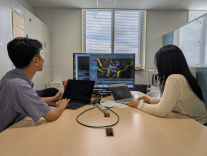
When I look back on these past few weeks, I realize I’ve become both a more independent and a more collaborative researcher which sounds like a contradiction, but it isn’t. I learned the technical side of things: cell culturing, working confidently on confocal microscopes and imaging platforms, dipping into molecular dynamics simulations, and running the wet lab work behind our transcriptomic data. But the skill that mattered most wasn’t technical. It was learning how to ask for more.
For a while, I felt like an intruder in my PI’s lab. He was investing his time and money in training me with, realistically, no benefit to himself but just because he believed in me. Once I understood that, I felt more comfortable asking questions, rather than trying to quietly stay out of the way. Working in a global research setting also made me hyperaware of cultural expectations I needed to respect: how to address a professor or a senior lab member, what to say at the end of a workday, how to engage with people outside my mentor’s circle. Doing research across cultures isn’t just about acknowledging differences but it’s about finding the shared curiosity underneath them.
Independence and asking for clarity are skills I could have built anywhere. What made this experience different was doing it entirely in Japanese and getting comfortable being uncomfortable, clarifying my role, setting boundaries around my research goals, and staying on top of my own learning, all in a second language. It was hard, but worth it. My mentor constantly pushed me to reach out to his colleagues, to learn about their work, and to see how it might connect to my own project.
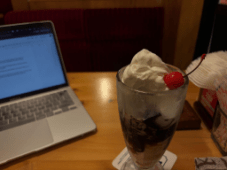
If there’s one theme I keep coming back to, it’s this: live in the moment. For a lot of my time abroad, my mind kept drifting back to the stress waiting for me in my San Diego lab. But I made a real effort to say yes to new things, going out of my way to meet people, to find myself outside of my research. Without classes or much built-in structure, I was on my own a lot, and I actually found peace in that solitude. But I also wanted this experience to be more than something just for myself, so I pushed myself to talk to strangers, many of them became my genuine friends.
That solitude also made me grateful for the people around me now, and for my community back home, which I think I’d started to take for granted. Being displaced from everything familiar is something I know well, but it’s easy to get comfortable after a few years somewhere. Starting over is daunting, but exciting too. I felt an unexpected wave of gratitude for my parents on this trip, maybe because I missed them more than I expected to. Being given the chance to live somewhere as special as Tsukuba, even briefly, was a privilege I don’t take lightly. I know I’ll be back one day.
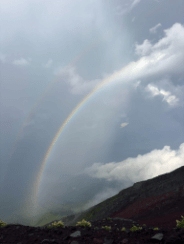
This feels worth sharing because it’s so easy, once you’re locked into a goal or a rhythm, to lose sight of the people right in front of you and then one day you look back and realize you missed most of it. I don’t want to feel that way again. I still want to work hard toward my goals; I just don’t want to sacrifice my life to do it. So I’m treating this as a kind of promise to myself: to bring pieces of my life in Tsukuba back to San Diego. Talking to strangers at events, ice cream at the park, reading on the train with music playing. The simplicity of life in Japan is bittersweet, but it’s a sense of peace I want to hold onto.
This project was exciting and frustrating in equal measure. Cancer biology is fascinating. Not because cancer itself is something to admire, but because of how persistent and adaptable it is. In the classroom, we learn about the hallmarks of cancer: senescence, angiogenesis, metastasis. But cancer research is its own world, because so many factors shape a single malignancy, and no two look quite the same. Drug-tolerant persister cells interested me most precisely because so little is known about them. I’d bring my PI genuine questions, and often his honest answer was, “That’s just the best we can do right now.” It was frustrating, but I used it as fuel, hoping that someday, some student researcher in a lab in Japan, wrestling with the same question, will have an answer because of work like ours.
It’s strange how much is still unknown about cancer and cell biology, something you don’t really sit with in a classroom, where you’re mostly focused on the known facts because you’re just trying to get the grade (not unlike a cancer cell trying to proliferate). In a research setting, everything flips. You become deeply invested in your question, chasing it from every angle, and every unknown branches into a hundred new ones. I could stay in that lab for the rest of my life and still not have every answer which is seemingly exhausting, but also exactly why I want to keep doing this.
I’m heading back to my research in San Diego. I spent a lot of this trip anxious about the work waiting there, but I’m honestly relieved to get back to it. The distance gave me real clarity about what I want to do next with my project, and I’m hoping to carry some of the soft skills I built in Japan back with me. I’ll be prepping for the MCAT, running EMT calls, and working on my personal statement as I get ready to apply to medical school, while still making time for the park, a kombini ice cream, and good music along the way. Thank you, Tyler Center, for an experience I won’t forget!

