Marina Kenzy, University of Texas – Austin
Hi again! I’m happy to report that my research trip was an amazing success. I successfully visited all the cities of interest on my list and was able to speak to many locals, experts at museums, and gain better insight on the cultural context surrounding my research proposal, which I’ve copied here from my first blog for reference:
I will examine some of the most notable urban damages from the Yugoslavian collapse across Bosnia, Croatia, and Serbia using comparative analysis to their pre-war, mid-war, and post-war states, as well as historical documentation of construction and reconstruction and personal anecdotal interviews of locals when applicable. After a thorough analysis of each, I will compare the different approaches of each city and nation— how do these various approaches differ, and what can that tell us about the cultural direction of each individual country and the region as a whole?
In doing architectural and cultural analysis like this, it’s important to define all involved terms clearly and also to note that this sort of analysis is far more subjective than more qualitative research. For that reason, until my paper is written with all of my qualitative sources, historical sources, and other information to back up my analysis, I’ll try to stay pretty objective in this blog in terms of my experience in information-gathering on the trip.
Dubrovnik was by far the most tourist-filled destination in the places I visited. I wasn’t totally surprised by this— Croatia, of all the countries I visited, is the only one within the EU and is therefore easier to travel to by EU citizens. Dubrovnik was also the site where much of the hit TV series Game of Thrones was filmed, so many tourists I met were there for that reason. I found it harder to find actual local cuisine not just within the old town but also in the surrounding areas, as compared to other places I travelled to. The old town was beautiful, and notably, very beautifully repaired. Despite the sheer destruction that followed the siege of the old town 30 or so years ago, the city looks pristine. As I predicted, some of the older online sources available about evidence of past damage to the old town are no longer accurate, so I took many pictures of what I saw now. The war museum discussing the siege was also very hard to access from the old town, being an hour-long hike up a mountain from the central area, not accessible through standard public transport but instead through a 30 euro lift.
This was in stark contrast to both Mostar and Sarajevo. Both were similar in approach, although separately very different in many aspects which will be better detailed in the paper, in that they retained much of the damage they experienced from the Bosnian war and genocide. While some of the private property retains this damage for financial reasons, much of this damage has been chosen to be intentionally retained to reflect the recent history. War museums, galleries of pictures from the war, and information about the repairs done on churches, the famous Mostar bridge, and other sites were all widely available and easy to access.
Belgrade’s General Army Headquarters, the Generalštab, is similar in the sense that it intentionally displays damage from effects of the war, but it is by contrast not a traversable space. The building is completely blocked off, a noticeable cut in the fabric of urban life, where the damage can be viewed from a far. Interestingly, recent controversy surrounding demolishing
the building to construct a luxury hotel encouraged many to participate in ongoing protests against the Vucić administration. This connection to critical modern events exists in all of the cities I visited, but it perhaps most obvious in Belgrade where protest-tagging and stickers encrust the entire surrounding area of the building.
Obviously, I have a lot to write about. I gained valuable access to hard-to-find information in museums and galleries, as well as interviews with many locals which directed my search for sources, and I overall had a very successful research experience. I can’t wait to write the paper and share it with everyone who made it possible. Until then!
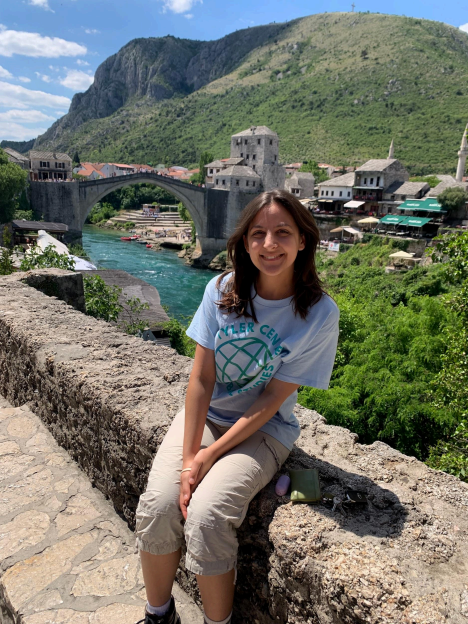
[Me, in a Tyler Center T-Shirt in Mostar, summer of 2026.]

