By Lila Alvarado, University of Missouri–Kansas City
My summer research experience was challenging in multiple ways. I am grateful for the experience, as I saw incredible geologic landscapes, including an active volcano, got to laugh with and hear the stories of some incredibly kind people, and learned my Spanish comprehension is better than I previously thought, but came away with questions about the impact of my research project.
The historic site research we conducted was supported by a Memorandum of Understanding with a local preservation organization. We used their archives, had access to their protected sites, and drew on the knowledge of their architects and preservation workers at no cost. I acted as a technician for much of the fieldwork, which I found enjoyable, as I quite like equipment operation and troubleshooting machinery, and the Tromino seismometer I collected data with was graciously lent to us by a local professional, who also provided transportation for free.
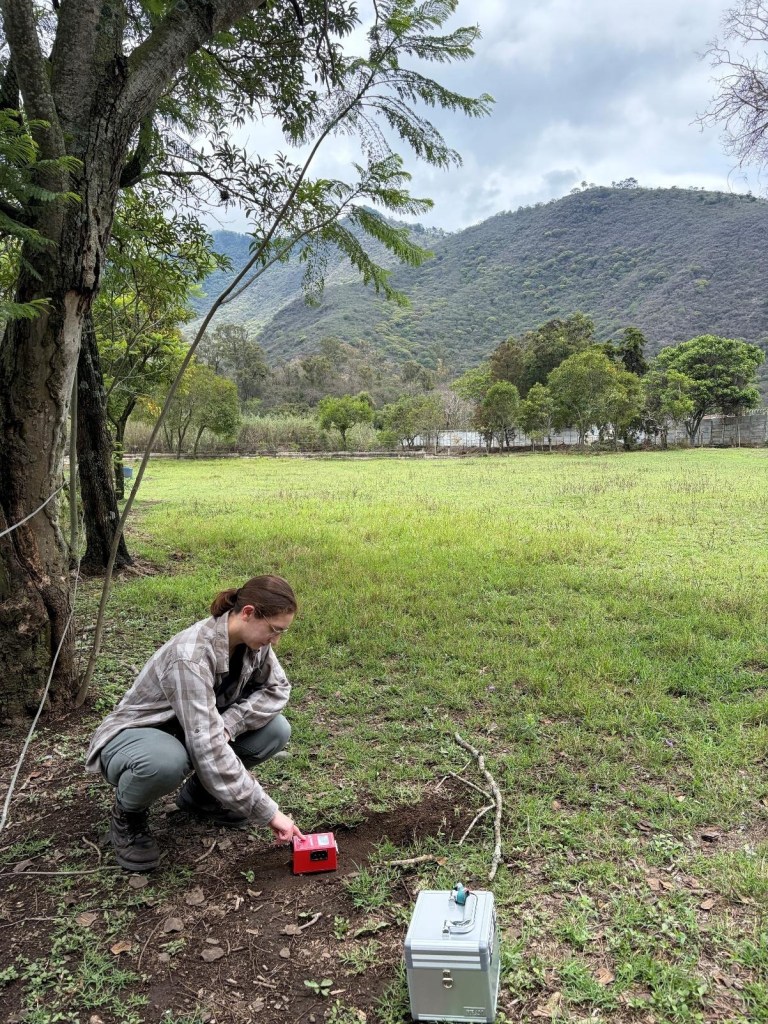
Photo caption: Preparing the Tromino seismometer for data collection.
I am informed it is not unusual for academics to maximize connections and try to cut costs on research endeavors, but I felt that I was leaning heavily on the knowledge and resources of subject matter experts and professionals in Guatemala for little in return except perhaps a line in the ‘Acknowledgments’ section of a report. There is perhaps some grace given to students, who are still learning their field, and there is value in students learning to navigate the process of accessing resources and contacting professionals who can help move a project forward, but at some point there must be a question of tangible value-add to the hosts.
After I returned from my research trip, I did some reading, and there is body of academic discourse surrounding the disparity of research from the global North, elsewhere referred to as the “West,” usually in reference to the United States and Western Europe, and the global South, or low-income or developing countries, usually with a legacy of colonialism. This disparity includes cases when researchers from high-income countries come to low-income countries to do research and publish their results back home. I learned from Nature’s Global Code (link to article: https://www.nature.com/articles/d41586-023-04022-1) that it is a positive our research involved local collaboration at all, but I feel the topic could have more comprehensively been explored by a local professional with the knowledge and cultural perspective, but perhaps not the funding or access to the American publishing machine, for the equivalent of cost of our research team’s flights from Kansas City to Guatemala.
I am a newcomer to the world of research and publication, as I come from work in the service industry and education at a community college. Engaging with research in a global context for the first time put into sharp relief for me some disparities that exist in access to academic funding and the publishing machine which American and Western European academics dominate, and brings to mind more questions I would like to explore: How might it be possible to more equitably distribute research funds and publishing opportunities to historically underrepresented countries in science fields? What are the responsibilities of individual scientists in wealthy countries to uphold moral commitments when collaborating across international borders?
As the United States Senate considers a proposed rule by the Office of Management and Budget that would bring changes to the ability of U.S. scientists to collaborate with international partners, I think these questions are timely. In addition, I am troubled as a student of science by the loss of both quantity and quality of scientific perspectives caused by global inequity. We need as many minds as possible working on the scientific problems that face society today. When we exclude whole swaths of the global population from quality education, funding, and connections, we ultimately injure our progress as a species.
I had several discussions of this sort regarding research ethics and our values with my classmate who accompanied me. At one point she asked, “Don’t you have to take an ethics class for your degree program?” I don’t. She is a student of UMKC’s Urban Planning + Design program and informed me that most professional degree programs, especially those that require certification or licensure to practice, usually provide ethics training and standards for professional conduct in their given industry. Indeed, she will take an ethics class for her program. I found that several professional organizations in the Geoscience field put forth guidelines for professional conduct in our field, which I will be reviewing this summer and hope to engage my classmates in discussion about this coming semester, as we prepare to enter the workforce ourselves and take on the responsibility of making ethical decisions in our field, even when no one is watching.
This experience was valuable to me as a lesson in making sure my values are aligned with endeavors I commit to be a part of, whether academic, professional, or personal. I was also challenged to think in a more clarifying way about what kind of professional I want to be and what kind of career I want to have.
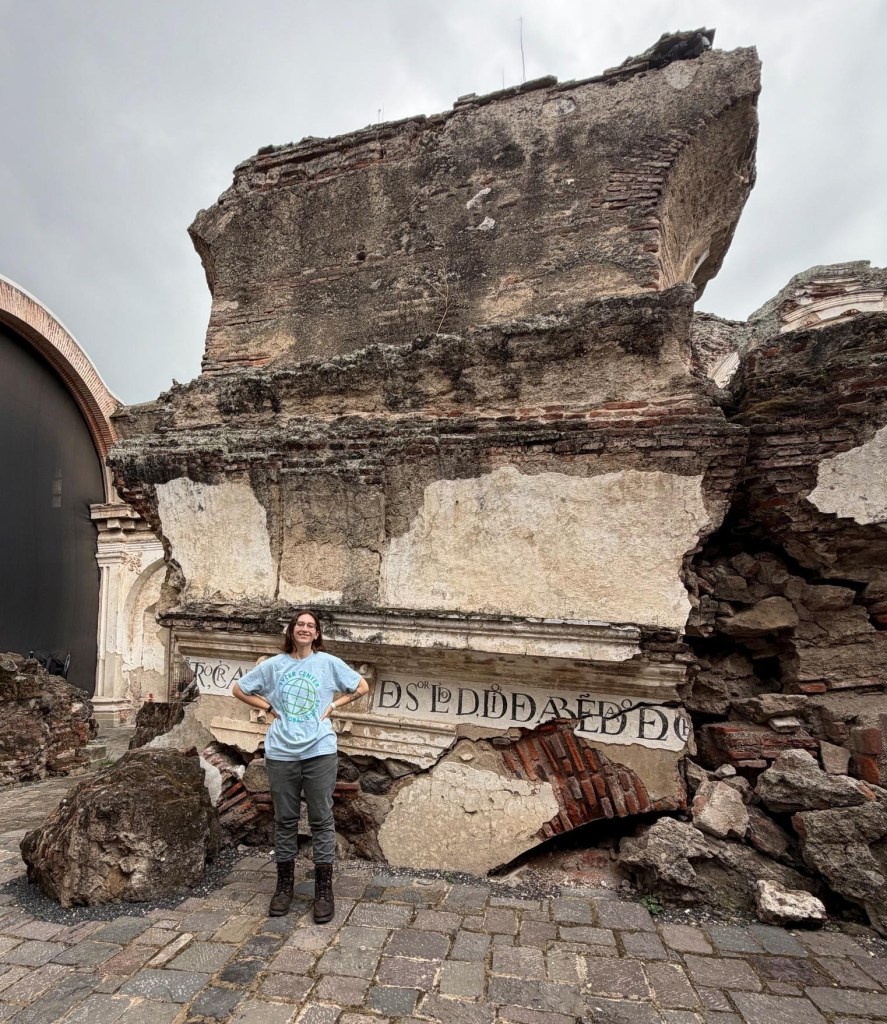
Photo caption: The author at Iglesia y Museo San Agustín.

