By Wren Atteberry, Austin Community College
Conducting research and surveying trails in the forests and wetlands of Costa Rica was a truly unique and transformative experience that showed me the side of science I have always dreamed of: one that you can’t attain in a classroom setting. Although things did not always go smoothly according to plan, it taught me to adapt my data collection methods to match the environment around me. In other words, field research tasked me with not only understanding the general process of data collection, but also engaging with the environment in order to produce the best results.
Upon arriving in Liberia, Costa Rica, I had very high expectations for everything I would experience, but I had no idea how amazing it would truly be. We began in the tropical dry forest and wetlands of Palo Verde National Park, where we stayed in cabins at the biological research station run by the Organization for Tropical Studies (OTS).
Although I was unable to conduct any research while our class was there, I learned an awful lot about the vast biodiversity and environment of the park, as well as about myself. For starters, the park consisted of six main trails, all of which were incredibly captivating, to the point that you could walk the same trail repeatedly and always identify something you had not yet seen. And, despite the thousands of mosquitoes that were very excited to greet us everywhere we went, that remained the case. They were definitely a surprise to our class, professor included, but I now have a new appreciation for dragonflies, which I did not know ate mosquitoes. Aside from that, Palo Verde was perfect. Our time there mainly consisted of early morning hikes, midday lectures, afternoon hikes, and then one final hike after sunset.
Unfortunately, we did not stay very long, but there was much more to come. On our fifth day in Costa Rica, we were on the bus to La Selva Biological Station, home to one of the most biodiverse environments on the planet: the lowland tropical rainforest.
When we arrived at La Selva, I immediately fell in love with the scenery and sounds of the rainforest that never ceased. The rainforest has always been something I’ve dreamed of so I could not have been any bit happier. Even so, I knew it was time to begin my research and get serious.
My research examines the calling characteristics of male strawberry dart frogs (Oophaga pumilio), the particular microclimate surrounding each male I observed, and the regulatory relationship between the two that potentially influences sexual selection and overall mating success. With that said, my research was feasible only at La Selva because strawberry dart frogs are abundant within the station’s lowland rainforest, while at Palo Verde, the humidity levels are too low to support the species. This is a crucial factor because it represents the importance of research across the globe. For instance, I could not conduct a study that correlates climate and strawberry dart frog reproduction within a laboratory back in Texas. Thus, by researching this species in their natural environment, I was able to build a firsthand understanding of the relationship between those factors and the sexual selection of strawberry dart frogs.
In order to collect the data I needed, I recorded audio samples from fifteen different males, all of which were about ten minutes long, and additionally, I used a hygrometer to measure temperature and humidity for each day I recorded audio. I then transferred the audio samples into a bioacoustics software to determine the characteristics of their calls, which I then matched up to the climate data I collected. In doing so, I could examine how temperature and humidity correspond with certain call characteristics, and whether those characteristics can be associated with female visitation or territorial defense.
When conducting this research and collecting data whilst abroad, I had to adapt my data collection methods to each distinct male dart frog because nature is extremely unpredictable. Specifically, individual males reacted differently to being recorded from a set distance, so I had to incorporate an equation that could identify the same call characteristics but at a set distance of 1 meter. This taught me that conducting field research requires far more adaptability than I had previously experienced in a classroom or laboratory setting. Instead of following a predetermined procedure, I had to recognize problems and determine how I could change my methods without compromising my data.
For others who might conduct research in a global context, I would advise always working with nature because there is never a guarantee that it will cooperate with you. Field research quickly made me realize that no matter the extent of your planning, the environment can always throw new variables into the equation that can knock you off track. Instead of viewing an unexpected change in circumstance as a failure of my research, I learned to treat it as part of the process and to adapt my methods as such. Therefore, successful research in the field does not rely solely on your preparation, but rather it requires adaptation through observation of your research environment.
This project was of significant value to me because it marked my first experience in scientific research, while also enabling me to investigate and produce data in a context that is aligned with my interests. In particular, I care deeply about understanding environmental conditions and how they affect the organisms within them, especially when that understanding results in better protection and conservation of vulnerable species. Moving forward, I will pursue more opportunities that allow me to explore my ideas through research, so I can contribute to knowledge that defines how we view and interact with our planet. Overall, my experience in Costa Rica served as a stepping stone toward pursuing my goals by furthering my understanding of how scientific research is conducted and data is produced, while also solidifying my passion for researching and contributing to the creation of new knowledge.
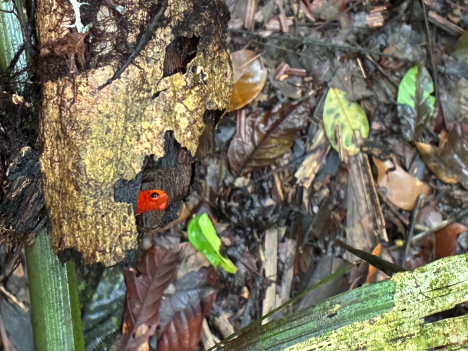
A seemingly nervous strawberry dart frog peering out from a broken branch. Photograph by author.
 HSF House Blogs