By Isabel Ball, University of Missouri–Kansas City
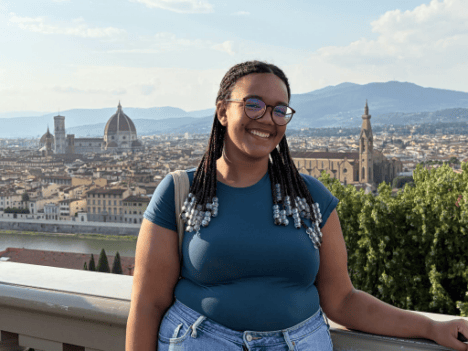
(Photo taken at Piazzale Michelangelo in Florence, Italy)
When I applied for funding to conduct research in Florence, Italy, I thought I knew exactly what I was signing up for. I was going to collect concert data, compare musical programming in Florence and Kansas City, write a research paper, and hopefully come home with some interesting conclusions.
Technically… that’s exactly what happened.
But somewhere between counting audience members, taking notes on applause etiquette, and accidentally becoming invested in whether Italian orchestras own trombones (they do… they just don’t always show up), the project became about something much bigger than my original research question.
It became about people.
When I first arrived in Florence, I’ll be honest… I was incredibly homesick. I had never been this far away from home for this long. I go to college in my hometown of Kansas City, so this was the first time I had ever been separated from my family, my friends, and every familiar routine all at once. To make matters even more intimidating, I arrived alone. Unlike many study abroad students, I didn’t already know anyone in my program. It was just me, a suitcase, and a lot of very questionable Italian.
Fast forward eight weeks, and suddenly leaving Florence was one of the hardest things I’ve ever done. Funny how life works like that.
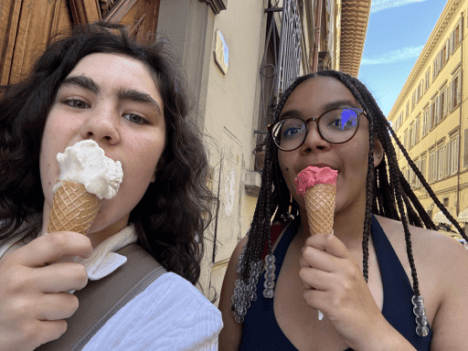
(My friend Erin, left, and me, right, eating gelato)
Academically, this experience challenged me in ways I never expected. My research isn’t even finished yet (I still have the Kansas City portion to complete), but already I can see how much my perspective has changed. I originally assumed I would hear a lot of Italian composers simply because I was in Italy. Instead, most of the professional concerts featured the same German, Austrian, and Russian composers that dominate concert halls in the United States. The only concert that featured exclusively Italian composers was intentionally marketed as an all-Baroque Italian program.
That observation reminded me of conversations we’ve had in musicology classes about programming. Does creating a concert of only women composers promote representation, or does it unintentionally isolate them from the broader canon? Seeing something similar happen
with Italian composers gave me an entirely new perspective on those discussions. Sometimes being somewhere else helps you ask better questions about your own culture.
Outside of my research, I also realized how much I had grown as a musician.
One of my favorite concerts was actually a community wind band. A year ago, I could have told you they weren’t a professional ensemble, but I wouldn’t have been able to explain why. This summer, I found myself noticing specific balance issues, identifying intonation problems, and even recognizing that one flute player was consistently playing sharp because of overblowing and excessive vibrato.
That realization wasn’t because of this research project itself; it was because of everything my professors at the UMKC Conservatory have poured into me over the past year. This experience simply gave me the opportunity to hear my own growth. Listening back to recordings of myself now, I can hear things I never would’ve noticed a year ago. I definitely don’t have my professors’ ears yet, but I’m a whole lot closer than I used to be.
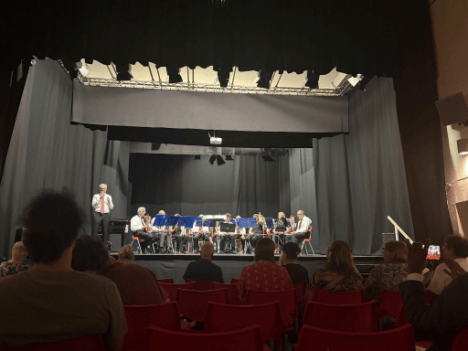
(My favorite concert: the community band)
The biggest lesson I learned, though, had very little to do with repertoire lists or audience demographics.
I made friends with students at the Luigi Cherubini Conservatory in Florence, including one trumpet player who absolutely loves John Philip Sousa marches. As someone who grew up playing those pieces in American school bands, I thought it was hilarious. Meanwhile, I spent years rolling my eyes whenever another march appeared on my music stand. Here was this Italian conservatory student who couldn’t believe I got to grow up playing Sousa, while I couldn’t believe he knew the music so well. Moments like that happened over and over again.
Even when we struggled to communicate because my Italian is… generously described as “developing,” and his English wasn’t perfect either, we still understood each other through music. We could both open the same score by Haydn or Mozart, recognize the same harmonic progressions, laugh about difficult excerpts, and talk about music theory, even if we occasionally needed Google Translate to finish the sentence. Music became our shared language.
As English speakers, we’re incredibly fortunate that English functions as today’s global lingua franca. But this summer also reminded me how much richer conversations become when you can speak someone else’s language. It’s one of the reasons I’ve started thinking seriously about continuing to study Italian, and even exploring opportunities like the U.S. Department of State’s Critical Language Scholarship to learn another language in the future. I want to communicate with people, not just be around them.
This experience also changed what I want for my future.
Before coming to Italy, I knew I loved traveling. Now I know I want to build a life where I continue seeing the world. I don’t need to become famous or have some glamorous international career; I just want to keep learning from people whose lives look different from mine. This summer opened a door I didn’t even know existed, and I don’t think it’s one that’s ever going to close.
Thankfully, this research project isn’t over yet. I still have concerts to observe back home in Kansas City, and I’m excited to compare the two musical cultures with fresh eyes. Ironically, I think traveling halfway around the world will help me understand my own community better.
If there’s one thing I hope people take away from my project, it’s this: music really is universal. I know that’s a cliché, but after spending a summer watching audiences clap at different times, hearing the same masterpieces performed an ocean away, and making friends with musicians despite a language barrier, I’ve realized clichés usually become clichés because they’re true.
At the end of the day, the only thing separating us was an ocean.
We’re all musicians trying to tell the same stories, studying the same scores, laughing at the same rehearsal jokes, and chasing the same beautiful moments that remind us why we fell in love with music in the first place. And that’s a pretty incredible thing to discover.

