By Elizabeth Feldkamp, University of Missouri-Kansas City
Traveling to Antigua Guatemala to research the reconstruction phases of the San Agustín ruins following major earthquakes was one of the most rewarding experiences of my academic career. As an Urban Planning and Design student, I often study how cities evolve in response to growth, policy, and redevelopment. However, this experience allowed me to examine a different aspect of planning: how communities rebuild after natural disasters while also preserving their cultural and historical identity. Seeing centuries of reconstruction firsthand gave me a new appreciation for the relationship between resilience, preservation, and urban development.
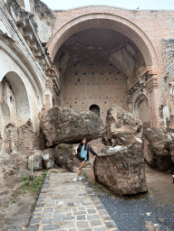
This research expanded my understanding of historic preservation beyond what can be learned in textbooks. Walking through the ruins of San Agustín, observing the remaining architectural features, and studying the evidence of multiple reconstruction phases helped me understand how natural disasters have continually reshaped Antigua. Rather than simply reading about the earthquakes that struck the city, I was able to see how each event influenced building techniques, restoration efforts, and decisions about what should be preserved or rebuilt. This field experience deepened my understanding of how planning, architecture, and history intersect, particularly in cities with significant cultural heritage.
The trip strengthened several skills that will benefit me throughout my career. Conducting research in an international setting required careful observation, documentation, and critical analysis. I learned how to interpret physical evidence within a historical landscape and connect those observations to broader planning concepts. Working alongside faculty and fellow researchers also improved my collaboration and communication skills, as we discussed findings, compared interpretations, and considered how different disciplines approach preservation. Perhaps most importantly, I became more adaptable as a researcher, learning to collect information in unfamiliar environments while remaining respectful of local history and culture.
One of the most meaningful themes I encountered during this project was that resilience is about preserving a community’s identity. The ruins of San Agustín illustrate that cities are shaped by both destruction and renewal. Each reconstruction phase tells a story about the people who chose to rebuild despite repeated earthquakes, balancing safety with the desire to preserve their architectural and cultural heritage. This message is especially important today as communities around the world face increasing natural disasters and climate-related challenges.
This project reflects my passion for understanding how historical preservation and urban planning can work together to create resilient communities. It demonstrates my curiosity, my commitment to research, and my interest in examining how cities respond to complex challenges over time. Rather than viewing historic sites as static monuments, I now see them as living records of adaptation, resilience, and thoughtful planning.
Looking ahead, I hope to continue pursuing opportunities that combine research, historic preservation, and urban planning. Whether through internships, graduate school, or professional practice, I want to contribute to projects that protect cultural heritage while preparing communities for future challenges. My research in Antigua, Guatemala has given me a broader perspective on the responsibilities of planners and preservationists. It has reinforced that understanding the past is essential to creating thoughtful, resilient cities for the future, making this experience an invaluable stepping stone toward my career in urban planning.

