By William Merrix, Florida State University
For my final blog post, I want to share with you some of the preliminary findings, impact, and conversational contributions of the data I collected this summer.
For seven weeks this summer, I collaborated with a Nouchi-speaking translator who tutored me in basic Nouchi before interviewing with Nouchi respondents. Nouchi is a street creole, a new language, which emerged in Abidjan, Côte d’Ivoire in the late 1970s and in the early 1980s. Its speakers included poor working-class youth and residents of the Abobo, Youpogun, and Adjamé neighborhoods. The word Nouchi itself is derived from the Malinké words nou (“nose”) and chi (“hair”), encoding in the word its origin as a language for the mustached poor working class. The language is made of words from “Standard” French, Ivorian French, local mother tongues, and borrowings from English, Spanish, Portuguese, and other languages. I conducted a total of thirteen semi-structured interviews with adult Nouchi speakers and former members of the Fédération estudiantine et scolaire de Côte d’Ivoire (FESCI), a former student union to protect the rights of Ivorian students at school and university. My Participants included students at Félix Houphouët-Boigny University (UFHB) and adults in the Adjame area. At the end of my work, I presented my preliminary findings to students and faculty from UFHB’s Department of Language Sciences. In my preliminary findings, I have drawn three major conclusions contributing to my field of pragmatics and discourse analysis.
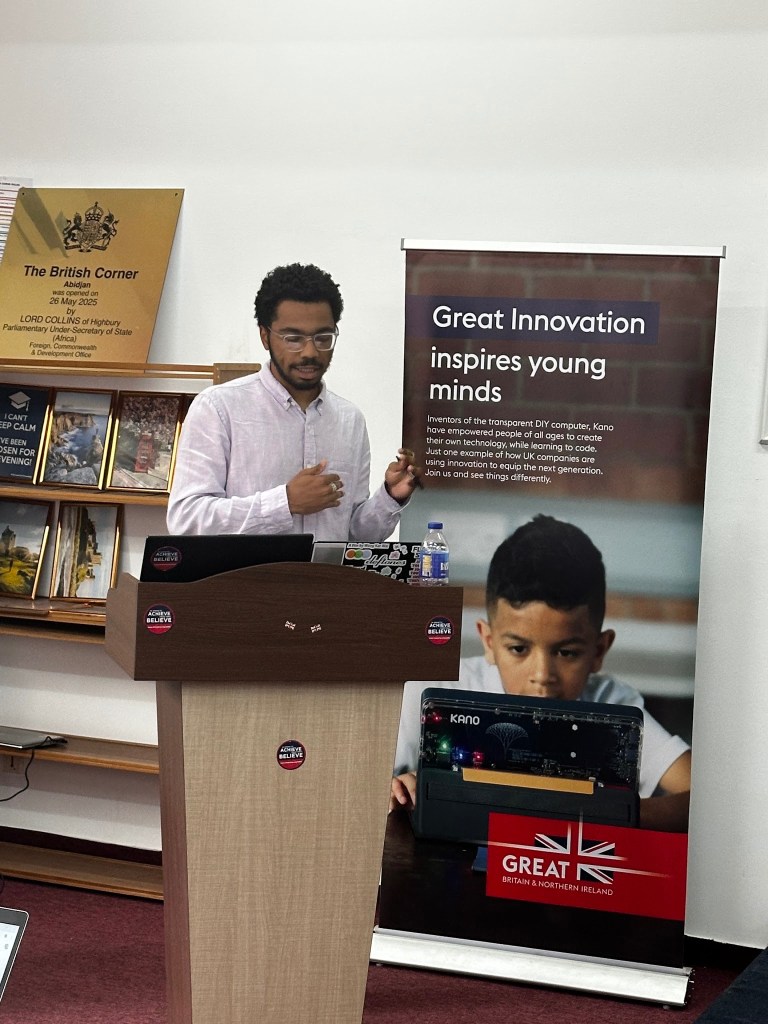
Me presenting my research to students and faculty from the Department of Languages Sciences at UFHB.
First, Nouchi functions as a language of meaning-making and contextually dependent usage, called neologistic pragmatics, which is used to carve out political agency and signal group membership. The use of Nouchi by young and traditionally disenfranchised populations of Abidjan presents a model of neologistic pragmatics which encourages the discussion of human rights and politics through socially “non-traditional” languages to properly account for the needs of minority populations. By using a creole language centered on meaning-making, underrepresented populations can carve out political space to express their political and human rights needs through discourse. At the same time, Nouchi and other collections of neologisms, such as the FESCI’s invented and portmanteau terms, serve as markers of membership categorisation in speech. For Nouchi, this membership categorization is revealed through proper intonation. My participants noted that the attention to intonation is what separated feelings of genuineness and empty pandering when different politicians attempted to use Nouchi to connect with populations. This categorization in turn impacts the power of the speaker and the ability of the listener to be engaged and feel heard in political discourse. The use of neologistic pragmatics by the FESCI, a quasi-political faction, to establish membership categorization in conversation shows that in multi-party, multi-lingual societies, language can serve as a marker of political affiliation. Discourse analysis paying attention to the use of neologisms can shed light on how participants themselves make categories relevant and which categories participants find relevant. In turn, this reveals the political affiliations, priorities, hopes, and criticisms of minority populations who can not find space to voice these ideas in conventional discourse frames or languages.
Second, most respondents reported frequently experiencing overt discrimination and fear of speaking freely or criticizing any government action. A common phrase respondents used was “Vous avez la liberté d’expression. Mais après la parole, serez-vous libre?” [“You have freedom of speech. But after the speech, will you be free?”] The limiting of access to discourse amongst respondents works to reproduce power and inequality by denying respondents a meaningful voice in political discussions. While respondents often cited a lack of free speech and the desire for greater free speech as politically important, they noted that not all dissenting speech was met with adverse consequences. Respondents noted that the two key factors of discourse that played a role in whether the discourse is seen as “threatening” are, first, the “personal nature” of the discourse and second, the “virality” of the discourse. Personal nature serves as my framework for respondents’ descriptions that discourse directly mentioning ministers or projects by name is more likely to undergo censorship than those that don’t. Virality serves as my framework for respondents’ descriptions that discourse that is seen by a lot of people will receive higher scrutiny no matter what. Online, respondents described virality as being measured by likes, comments, shares, and views, while in person it was measured by the number of people.
Finally, female respondents showed mixed responses across a wide range of topics. Some expressed surprise that I was soliciting their opinions on political topics, indicating that few people in their day-to-day lives solicit these opinions. In particular, they noted the lack of female representation in the current government or political spaces and that female political figures or candidates are often not taken seriously by the political establishment or the Ivorian people. Women respondents were also split when discussing whether Nouchi was a language that, when used in political discourse, was directed and intended to reach women. For the group of respondents who felt Nouchi use is not directed at them, it presents an additional hurdle to the participation of women in political discourse, as they would not enjoy the same ability to participate in the model of neologistic pragmatics which encourages the discussion of human rights and politics through socially “non-traditional” languages.
In the future, I am excited to dive deeper and perform rigorous analysis of all my interviews. I will have the opportunity to present my research at the Florida State University President’s Undergraduate Research Showcase. I will also pursue publication of my research results and discussion, helping me improve my resume and my goal of attending graduate school. This research is critical to those goals, and I plan to build on this research in graduate school by examining political rhetoric around the Ivorian Crisis of 2002 to 2011 and building computational models that can predict when and how speakers extend meanings to new contexts, better resolve linguistic phenomena in processing natural language, evaluate syntax-pragmatics interfaces and hypotheses, and apply these formal and computational methods to real-world speech.

