Wrapping up my time in Florence while looking ahead to the next chapter of my Capstone.
By: Madalynn Stackow
And just like that, my study abroad experience has come to a close! It is time for me to head back to the United States, rest, and prepare for the upcoming fall semester. As I scroll through my camera roll, I reflect on the experiences that shaped my six weeks in Florence. I am proud of myself for stepping outside of my comfort zone, embracing a new culture, and adapting to a different way of life. I spent my last weekend exploring the Tuscan countryside, where I had the opportunity to go horseback riding and take a Vespa tour through the rolling hills. It was the perfect way to end an unforgettable six weeks abroad.
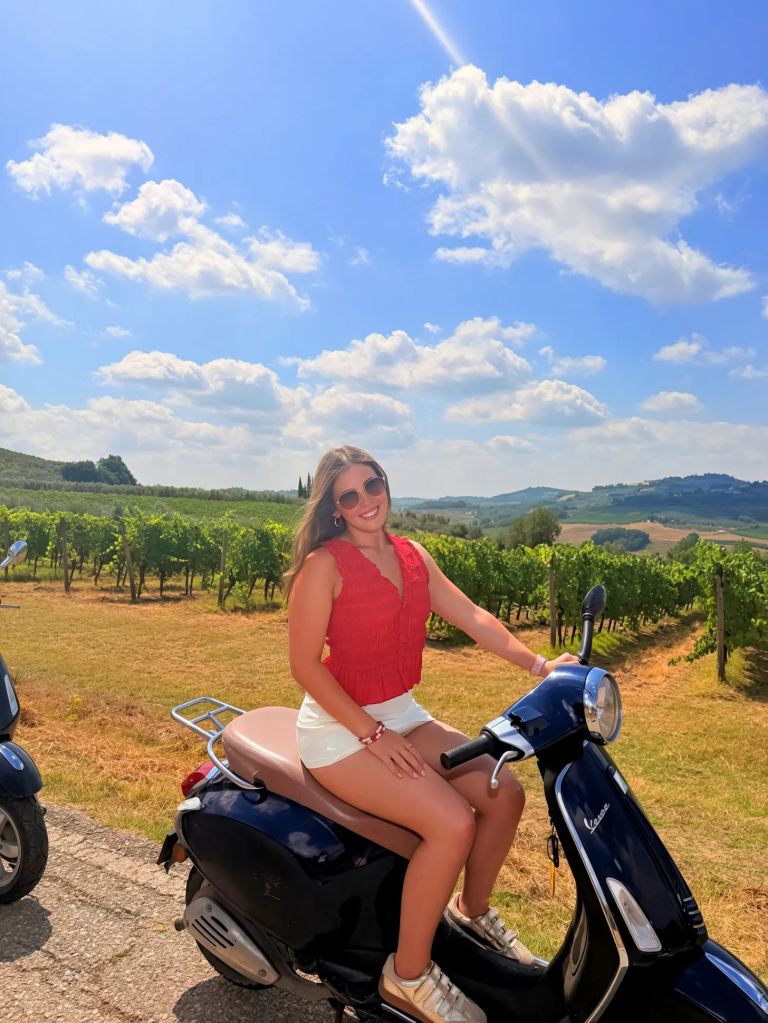
Vespa Tour in Tuscany
I’ve officially wrapped up my in-person data collection, and I’m incredibly grateful to all of the clinicians who took time out of their busy schedules to meet with me and share their perspectives on psychological services in Italy.
That said, my project isn’t over yet! I still have a few clinicians who have offered to meet with me via Zoom, and I’ve also been fortunate to receive additional interview contacts from the clinicians I’ve already spoken with. I’m excited to continue building on the relationships I’ve made and gather even more valuable perspectives as I move into the next stage of my research.
When I first started this project, the idea of reaching out to Italian clinicians felt intimidating. I found myself wondering whether anyone would want to talk to me, if they would even read my email, or if it would end up in their junk folder. Those thoughts kept running through my mind and made the process feel much more overwhelming than it probably needed to be. At the time, I honestly wasn’t even sure how I was going to carry out this project. I started considering backup options, but many of them no longer involved conducting my project in Italy. I was disappointed because I had envisioned this as an international research experience from the very beginning, and it felt like I might have to let go of that goal.
Then, I received my first response. “Hi Madalynn, I would be happy to participate!” Those words instantly lit up my screen. In that moment, all of the uncertainty and self-doubt I had been feeling started to fade. It gave me the confidence to keep reaching out, and before I knew it, one conversation turned into several meaningful interviews with clinicians who were genuinely willing to help me learn.
Before beginning this project, I assumed research was mostly about collecting information and reporting what I found. As I conducted interviews with clinicians throughout Italy, I realized that qualitative research involves much more than simply asking questions. Every conversation was shaped by the questions I asked, the follow-up questions I chose, and the way I interpreted each participant’s experiences. During these conversations, I found myself taking on an active role as a listener, carefully paying attention to what each clinician shared and asking follow-up questions that went beyond the questionnaire I had originally developed back in May. While I relied on my prompts to ensure consistency across participants, I also allowed the conversations to develop naturally. When a clinician shared an interesting perspective or introduced a topic I had not anticipated, I asked follow-up questions that went beyond my original questionnaire. While actively listening, I found myself actively learning, gaining a deeper understanding of the Italian mental healthcare system through each participant’s unique experiences. This flexibility allowed me to gather richer insights that I may not have uncovered had I followed my interview guide word for word.
As I reflected on these interviews, I began to notice differences between my own perspective, the experiences shared by the clinicians, and the themes presented throughout my literature review. Before conducting my interviews, my understanding of mental healthcare in Italy was largely shaped by journal articles, reports, and statistics. While those sources provided valuable background information, they could not fully capture the day-to-day experiences of the clinicians providing care. Speaking directly with psychologists allowed me to better understand how cultural values, stigma, and the structure of the Italian healthcare system influence the way psychological services are delivered.
One aspect that I found particularly interesting was how clinicians reacted to some of the statistics I shared from my literature review. Certain findings aligned with what they observed in their own practice and did not surprise them, while others sparked discussion or challenged their expectations. These conversations reminded me that while quantitative research provides valuable context, it does not always reflect the complexities and lived experiences that practitioners encounter every day.
After speaking with the clinicians, I realized there are still many aspects of psychological services in Italy that I want to explore further. Their insights sparked new questions and highlighted areas that I had not encountered in my literature review. As I continue this project, I hope to build on what I learned from these interviews and develop a more well-rounded understanding of psychological services in Italy.
As for my data collection process, I am applying many of the skills I have learned through my work in the Joiner Lab and UROP. During each interview, I keep my laptop open with my interview guide so I can take notes and record participants’ responses as we talk. With each clinician’s permission, I also use an audio recorder to capture the conversation so I can revisit the discussion later and ensure my notes are accurate.
Once I have completed all of my interviews, I plan to organize the data and conduct a thematic analysis to identify common patterns and themes across participants. I had the opportunity to conduct my first thematic analysis last spring while working with my graduate student mentor, and I really enjoyed the process. Having that experience has given me confidence as I prepare to analyze the data for my own Capstone project.
Even during the interviews, I have already started noticing recurring themes in participants’ responses. While I want to approach the analysis with an open mind and avoid jumping to conclusions, these repeated ideas have given me an initial sense of the patterns that may emerge once I begin formally coding the data.
All that being said, I am admittedly excited to head back to the United States. There are definitely a few things I have missed, most notably my daily Peach Vibe Celsius. I think six weeks without one deserves some sort of award. I have also missed being in a routine and having a little more structure to my days. As much as I have loved exploring Italy and making unforgettable memories, I am excited to return home and begin the next phase of this project. While my time abroad may be over, the work is just getting started!
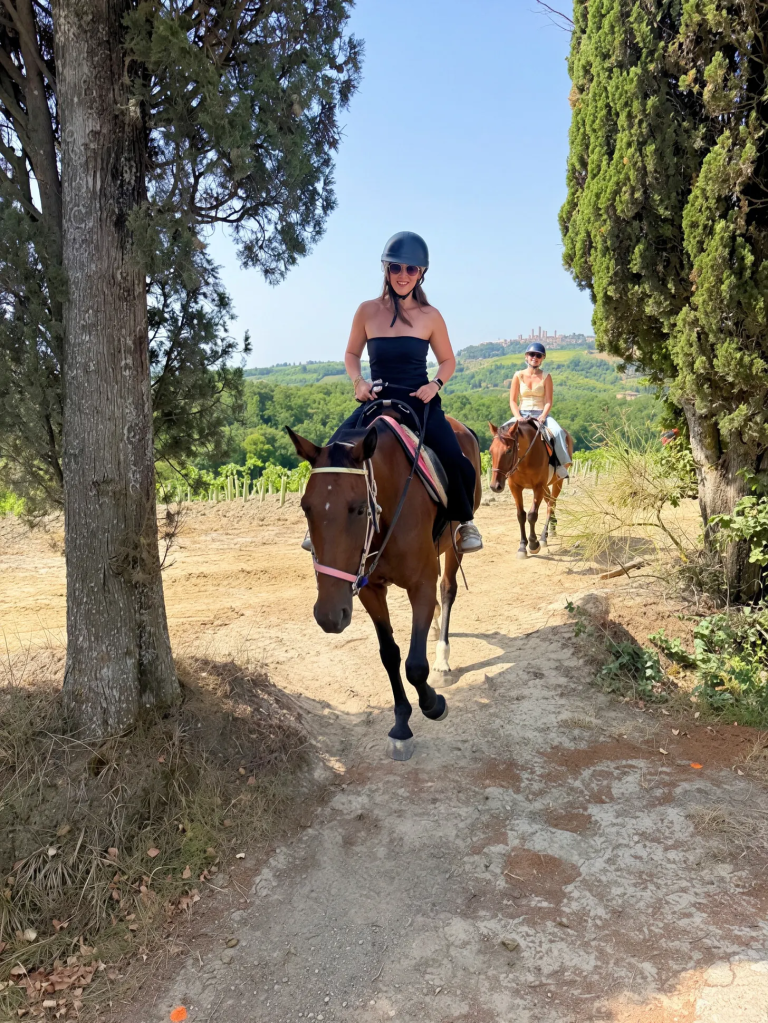
Horseback riding excursion in San Gimignano, Tuscany with FSU friends!

