Exploring how I have grown over my time with my global scholars experience
By: Parini Mehta
My first day coming into the office for my internship I thought I was relatively cognizant of certain nuances and social disparities outside of western culture. However, in my first week I was given readings and media to consume in order to better understand TIDE’s philosophy. Included in the preliminary work, I was told to watch a documentary called Schooling the World, and it was like being hit by a bus – I had an immediate realization that I truly don’t know anything.
In summary, the documentary critiques the globalization of western education due to its harmful effects on the preservation of culture as well as its glamorization of a fictional urban paradise. It features a well-meaning woman from Germany, who works to provide an education to people in the Himalayas, but is unknowingly perpetuating the idea that rural communities are ‘backwards and savage.’ The documentary highlights how western education leads to a loss of local culture and techniques – effectively alienating children from their environment and the knowledge of how to sustainably interact with their local ecosystems. In turn, it focuses on encouraging students to succeed and advance into a metropolitan lifestyle with glamour, wealth, and high-level education. The turning point is when students from rural backgrounds cannot get jobs in metropolitan cities due to structural setbacks and cannot return home due to their lack of knowledge of the land and local systems. Often resulting in people living in overcrowded metropolitan slums, unable to truly succeed in any space.
The documentary was incredibly eye opening, as it immediately unraveled so many of the notions I had in my head and dismantled many of my beliefs on education. I realized that my American background influenced me more than I thought, and my line of thinking inherently opposes the long-term goal of the foundation – which encourages students to learn to help improve their own environments. Directly after watching the film, I realized that I know nothing and I cannot claim to know more than anyone I worked with. I became much more inquisitory and as a result, I think I have learned a lot about humanity.
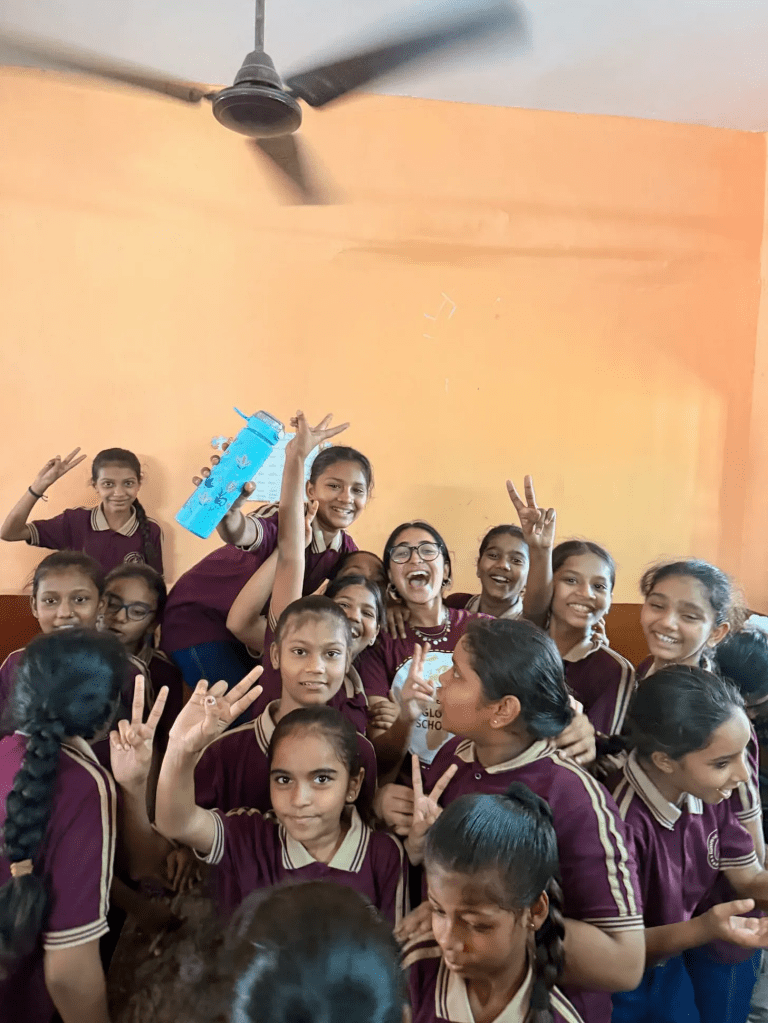
Furthermore, I conducted workshops called Design for Good which work in accordance to UN SDGs. The purpose of the workshop was to educate students in government schools on the harmful effects of plastic and pollution. Going into the workshop, I truly had no idea what to expect. I went in knowing the procedure, aware of certain nuances in society, and knew that I was there to learn. I did not expect to leave with new bonds, stories, and artwork as gifts from the kids.
Something that became abundantly clear in the classroom was that I was American. Because of that, children thought of me as better than them, the 7th grade class even asked me for my signature. Something that became incredibly important to me was that no kid should ever think they are less than due to their geographic or economic background – so I made many efforts to make that clear.
The significance of my work in the workshops on a personal level was pivotal. I had met people that I had simply heard of, and formed bonds with kids that I never truly thought I would meet. My line of thinking changed that day, when I stopped looking at underprivileged kids as poor souls that are negatively impacted by the system. I began to think of them as my friends. The difference is jarring, because one of them simply acknowledges that there is inequality, and as it is not the harmful mindset that actively reinforces injustice, it perpetuates the notion that they are not like us. Being present and working with these children taught me what true equality in an Indian setting looks like.