By Kristen Cavanagh, Florida State University
Throughout May and June, I travelled to England to interrogate the religious landscape at Oxford. My specific inquiry involved a reported increase in conversions to Catholicism. Through conversations with priests and converts, I hoped to understand the extent of this movement and the motivations underpinning the return to religion.
I began my journey in Oxford by attending religious services and events run by Catholic organizations throughout Oxford. While my initial method was designated to be qualitative research, I felt it would be a disservice to my inquiry process to negate my observations of
Mass attendance and the environment at these Catholic events. Therefore, the first choice I made upon arriving in the city was to incorporate an ethnographic angle to my analysis, even if my observations were somewhat informal. This, I hoped, would complement my primary qualitative approach along with providing me with another lens to interrogate this phenomenon.
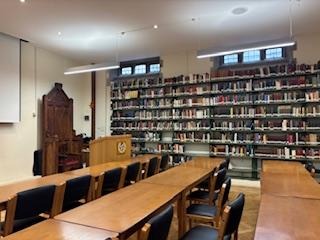
I found the informal conversations I had at the three events I attended over two weeks to be incredibly informative. For instance, the Black Friars—a long-standing Dominican community focused on research and academia—hosted the Thomistic institute, with the speaker being Dr. Rebekah Lamb. As a professor who studies theological aesthetics, Dr. Lamb discussed G.K. Chesterton’s perspective on the Pre-Raphaelites and Decadent movement. Chesterton was an English Catholic convert who contributed to the Catholic revival movement in the twentieth century. This was an ideal topic, allowing me to engage with the friars and Catholics on the current movement taking place in England.
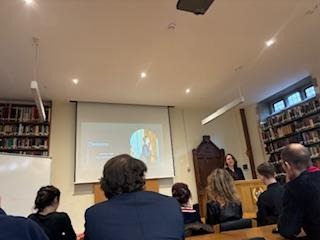
They had interesting opinions on the matter. Dr. Lamb agreed that some revival seemed to be occurring throughout the UK, claiming that the Catholic presence in St. Andrews was growing in its number of young converts as well. The friars were conflicted on the matter. While most agreed that there was an increase in interest, they were hesitant to term it a full-blown revival. After all, Catholics are still lapsing and agnosticism remains prevalent among youth. One friar was skeptical of the secular media representations of the faith, suggesting that they may be exaggerating to get a good story.
The political aspects of this movement troubled the Dominicans as well. He warned against allowing “the politicians to take all the good from this” movement. Instead, the friar hoped any political dissatisfactions would lead people to reconsider religion while not serving as the sole motivator or foundation of their conversion.
These meetings enabled me to meet converts and clerics who were well-versed in the religious landscape in Oxford and England. Many of my interviews are scheduled to be held in July while Oxford students complete their exams. However, I can sense that the cultural conversations around religion are changing in Oxford. G.K. Chesterton asserted that “religion is too often…dismissed as irrelevant”. It now seems that faith is becoming integral to the culture once again, finding its space in the secular age. I am eager to discover more about the movement in Oxford through my conversations with priests and converts, ultimately hoping to find out how religion is at work in this culture.

