By Aleksandra Woźniak, Johns Hopkins University
My name is Ola. That is short for Aleksandra. I am from Chicago, and I study in Baltimore. But my roots reach into Lesser Poland, just south of Kraków.
Over the past few years, the wind has blown, and I have swayed back and forth between the Great Lakes and the East Coast. Yet despite the rustling leaves and the shifting branches, the roots have stayed firm.
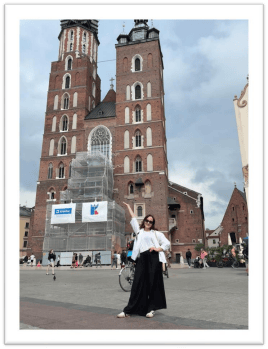
I am about to begin my fourth year at Johns Hopkins University, where I am enrolled in the dual-degree program between the university and the Peabody Institute. I study Art History and Music Composition, and I am always searching for ways to let the two disciplines inform one another through creative projects.
In the free time that I try to carve out for myself, I seek silence. Because so much of my work revolves around music, I find balance in activities that allow me to slow down and experience time differently. I enjoy reading, doing sudoku, and making art. I especially love working with paper, creating imagined landscapes through collage and building figures from traditional paper cutouts.
Nonetheless, music remains as the axis around which everything else revolves. It is the medium through which I express myself most naturally, and I continue to be fascinated by its complexity and abstraction. How does one write about music? That question is one of the reasons I was drawn to my other academic sphere: art history. It has taught me to synthesize my knowledge through formal analysis and a critical eye—skills that translate to every other aspect of my life.
Above all, I am passionate about life itself. I am endlessly fascinated by the connections between the things I study and the ways they illuminate one another. My ambition is not to choose between disciplines but to synthesize them. All for the ultimate goal of discovery and creation.
My Project
My research focuses on the Polish Brethren, a radical anti-Trinitarian movement that emerged in early modern Poland. I am conducting an extensive literature review of both Polish scholarship and adjacent philosophical and historical studies in order to understand the intellectual climate of the period. In particular, I am interested in the conspiratorial accusations directed toward religious minorities and the ways these narratives reflected broader anxieties surrounding the collapse of the medieval theological order.
Alongside this work, I am conducting archival research in parish collections, examining visitation reports, changes in parish administration, and shifting patterns of naming. Through a microhistorical study of churches in Lesser Poland, I hope to better understand how the Polish Reformation shaped the everyday lives of rural communities.
My interest in this project began long before I knew it could become academic research. I grew up in this region, and whenever I asked about its history, I was met with incomplete answers. I wanted to know what had happened on this land and why so much seemed to have been forgotten. For years, I searched for a reason to open the visitation reports preserved in local churches, hoping they might reveal stories that had quietly endured in the archives.
The specific focus on the Polish Brethren emerged from a course I took last year, along with a question that unexpectedly united all of my interests: music, history, theology, and art. That convergence transformed a childhood curiosity into a research project
This summer, I will be based in Kraków while traveling throughout Lesser Poland and Lithuania. My work will take me to parish archives across the region, as well as to larger archival collections in Warsaw and Vilnius. Conducting research in these places is invaluable—not only because the sources themselves are preserved there, but because history is experienced differently when encountered in the landscape where it unfolded.
Perhaps the most exciting part of this journey will be observing how historical memory changes from place to place. The archives preserve ink on paper, but local communities preserve memory in different ways. I look forward to seeing where those two histories converge and where they diverge.
Above all, I want to return to the questions that first captured my imagination as a child. This research is, at its heart, an attempt to satisfy a curiosity that has stayed with me for years. Along the way, I hope to situate my own family’s history within a broader and often overlooked story of the region.
This summer, I will listen to what the archives have to say.
The ink is still fresh.

