Violet Lorish, Florida State University
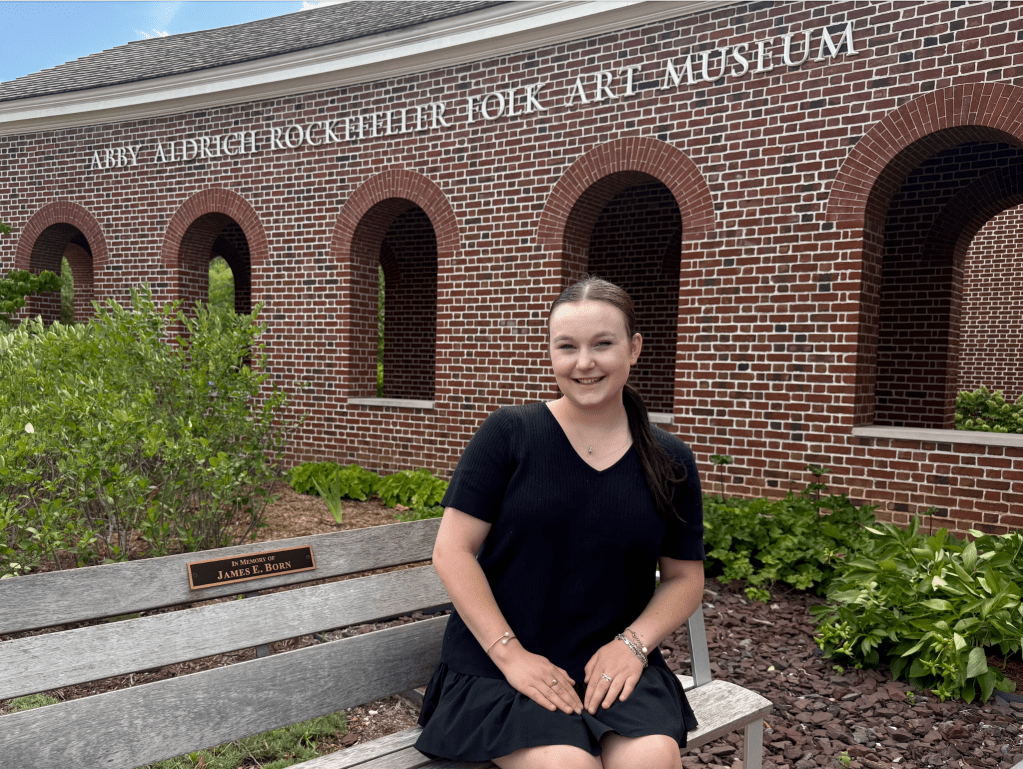
Violet Lorish at the Abby Aldrich Rockefeller Folk Art & DeWitt Wallace Decorative , Arts Museums, in Colonial WIlliamsburg,VA. Photo taken by Ann Lorish, June 19th, 2026
Hello! My name is Violet Lorish, and I am currently a rising third-year student at Florida State University studying in the College of Music and College of College of Arts and Sciences, where I am pursuing dual-degrees, a Bachelor of Arts in Music and a Bachelor of Arts in Editing, Writing, and Media, alongside a minor in Art History. My research this summer is being directed under the guidance of Art History Professor, Dr. Leitch, with the support of the Tyler Center for Global Studies. Since my last blog post, my research has continued to bring about new challenges, success, and of course creative ideas.
When studying objects which I cannot access or handle during appointment, it has become increasingly apparent to me how difficult documentation can become. Because my research requires documenting very historic textiles artifacts, when on display, they are most often behind glass, netting, or at a distance, and almost always in low lighting. Textile artifacts are displayed in public exhibits at a distance or behind glass to deter from physical human interaction, and its possible resulting damage. Limiting light exposure on textile artifacts is also very important, as prolonged light exposure can lead to fading and material degradation, resulting in the low lighting and netting utilized in item exhibition. While with purpose, the items’ distance, barriers, and lighting can lead to difficulties in photographing artifacts and studying the intricate delicacy of their needlework and ornamentation. Finding ways to document around these barriers is still a challenge, but I am enjoying experimenting with my documentation methods.
Since my last blog, I was able to travel to the Abby Aldrich Rockefeller Folk Art & DeWitt Wallace Decorative Arts Museums in Virginia’s Colonial Williamsburg, which was a highlight of my research here in the U.S. before travelling to England. Among its various exhibits highlighting the colonial lifestyle of the Americas, the museum currently houses a new exhibit titled: Stitched in Time, which follows the history of American needlework and its ties to English roots. The pieces on exhibition included historical framed needlework from England. One framed silk needlework was particularly notable to embroidery’s role in politics as it depicted a scene from the English Civil War. This scene depicts King Charles II hiding in an oak tree in hopes of hiding from the Parliamentary Forces, and displays the highlighted role which English politics often played in its early textile art forms. As one moved through the exhibit, viewers would find another special embroidery artifact, the fabric piece of an English sleeve ruffle and its corresponding paper pattern. Not often would these two pieces be found together as an unfinished pair, making this a unique visual to see. Upon closer inspection of the paper pattern, we can observe many small holes along its drawn out decorative pattern.Through this, we can understand that a Prick & Pounce technique was used to transfer the pattern onto the fabric prior to its embroidered embellishment, highlighting the traditional English techniques.
I am greatly enjoying this research and the adventures it continues to take me on. As I continue, I look forward to learning even more as I travel across the pond in July!

