By: Mari Kinzy, University of Texas at Austin
What do you think of when you picture the Balkans? For many people in the cultural west, it’s not much— the natural beauty of the Adriatic sea, or a vague perception of some threshold between eastern and western culture. For those historically inclined, they might think of the role of this seemingly small region in the first and second world wars, or perhaps Yugoslavia and its collapse. But to many children of the ex-Yugo diaspora community, like myself, the region is something loaded not just with family history and struggles, but also hidden beneath a haze of tenuous connection and disconnection. I knew the people, or at least those who had left, I knew the culture, or at least what I had experienced of it through food, weddings, and community, and I even knew the language fluently at one point in my life, or as fluently as a 10-year-old can manage. Time went on and these aspects of my upbringing fell away from me and then disappeared from my memory entirely— when I tried to reach for them again, they were gone. In college I discovered I was not the only one.
My name is Marina Petrovic-Kinzy, and I’m an LAH Urban Studies and Architecture double major with a minor in Bosnian-Croatian-Montengrin-Serbian (BCMS) language at the University of Texas. To very briefly introduce my interests, I have a fascination with history and culture and find myself exploring both through the lens of modern built environments (of which I’ve seen many as I’ve lived in dense and rural areas across the United States, and road-tripped across the entire lower 48). I hope to pursue a career in urban design, planning, architecture, or landscape architecture. In college I have been given the unique opportunity to reconnect with cultural aspects of my upbringing and my family through studying the language of the area, and beyond this through executive positions at the Balkan Student Union of UT. The experience of reconnection has illuminated, but not cleared, the haze I mentioned earlier— it’s become obvious to me that infinitely many layers exist between the first-generation Balkan-Americans and the Balkans themselves.
Culture and family history is, of course, what you make of it. To me, it is understanding the values and perspectives you are consciously and unconsciously given by your upbringing, putting those values and perspectives into the context of the struggles and triumphs from which they were formed, and then deciding for yourself what to do with them. But I’ve long felt a friction between this understanding I have of culture or family history, and my own experience of it. Even through layers of distance, it’s easy to know what foods are eaten, what slang is used, and what cities are beautiful or interesting— it’s another thing entirely to understand what those foods, slang, and cities mean to a people and why.
I’ve long been interested in the topic of how the ex-Yugoslavian countries have rebuilt urban life and identity after the collapse, especially as terms like ‘urbicide’ were popularized from the destruction following these wars. Even though researching and understanding how cities in the modern day rebuild after power-imbalanced, ethnic conflict is extremely relevant today, the reconstruction of the ex-Yugo Balkans is sorely understudied and lacks resources in English. I hope to, even in some small way, bridge this gap not only for the broader use of this knowledge
but also for other first-generation children of the ex-Yugo diaspora who feel an urge to know their families and the intangible cultural context they may feel but not understand.
My proposal is this: I will examine some of the most notable urban damages from the Yugoslavian collapse across Bosnia, Croatia, and Serbia using comparative analysis to their pre-war, mid-war, and post-war states, as well as historical documentation of construction and reconstruction and personal anecdotal interviews of locals when applicable. After a thorough analysis of each, I will compare the different approaches of each city and nation— how do these various approaches differ, and what can that tell us about the cultural direction of each individual country and the region as a whole? I will begin my trip in Dubrovnik, Croatia, then visit Mostar and Sarajevo in Bosnia, and finally end the trip in Belgrade, Serbia. Conducting this research abroad allows me to connect with local scholars, visit local archives and museums, and in general access information that isn’t currently available or documented online or in print.
Even though it’s perhaps the most daunting part of the trip, I’m hoping to utilize what I do know of the BCMS language to connect with locals and have conversations about what it means to live in their city, before, during, and after war. I feel this will be the best way to understand such complicated concepts on a deep level. I am so thankful for this opportunity and very excited to start the trip.
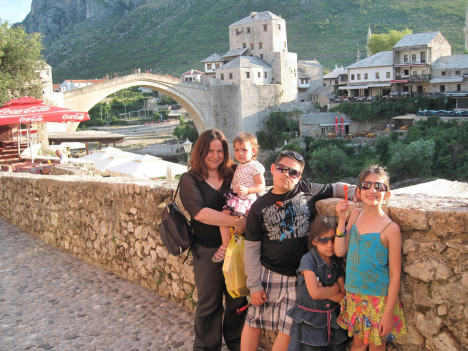
[My family in Mostar, summer of 2011.]

