By: Eleni Klissas, William & Mary
Hello everyone! My name is Eleni Klissas, and I am a rising senior at William and Mary. After the arduous process of changing majors (more than a few times) I discovered my passion for learning about the Mediterranean basin, and am now a history and Middle Eastern studies double major.
I spend my free time reading all kinds of novels in translation, and am currently working my way through the Three Body Problem series by Cixin Liu. When I’m not worrying about aliens taking over our planet (thanks, Cixin) I am experimenting with new dessert recipes to feed my unsuspecting friends and family. No one has suffered any major harm yet (except for the one niece I lost to a particularly gnarly red velvet).
Eventually, my goal is to transfer my energies towards more humanitarian efforts than bad cake. Using my Greek and Arabic language skills, I hope to work in law, representing clients whose first language is not English in family or divorce disputes.
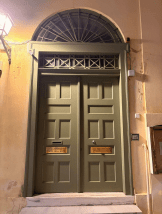
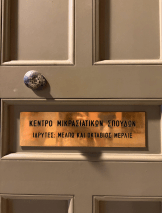
(Caption: The Centre for Asia Minor Studies, nestled in the heart of the Plaka neighborhood.)
This summer I will be cozying up in a little corner of a big city: the oral history archive in the Centre for Asia Minor Studies in Athens, Greece! Here, I will be researching the resettlement of Pontians in Greece following the 1920’s population exchange between the emergent Greek and Turkish states. Pontians are a Christian group indigenous to northeastern Anatolia, and the discrimination they faced upon their arrival in Greece offers a compelling look into the burgeoning ethnoracial discourses of the period. How were Pontians interacting with their oppression? How were they striking a balance between compliance and defiance of Greek social norms?
I came about this topic, first and foremost, by way of my own Pontian heritage. But it was truly my Middle Eastern studies major which introduced me to the idea of considering my heritage from a historically Ottoman perspective. What did my family’s identity look like before coming to Greece, when Asia Minor was still their home? What about after?
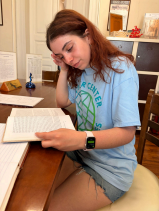
(Caption: My first visit to the Centre’s reading room, freddo espresso just out of frame.)
I will be spending the bulk of my time translating the oral histories of Pontian refugees recorded in the Centre for Asia Minor Studies archives, and compiling them into a primary-source data bank for my honors thesis. Although I am apprehensive about achieving effective and friendly cross-cultural communication with the staff at the Centre, I have a positive outlook on how this experience will impact my project. The academic literature in English on my topic is very limited. Yet upon my first visit to the Centre, their head archivist showed me five books on Pontos written in Greek which have been inaccessible to me online. The opportunity to be in such close contact with veritable experts in my field is a rare and wonderful one. I expect, and hope, that my exposure to both Greek scholars and Greek academic literature, will challenge the opinions I have formed in reading primarily English authors and translated sources. To make the most of my time here, I will seek out the content least available to American scholars, with the goal of centering it in my future thesis.
I am beyond excited to elevate my work with oral histories that are inaccessible from the other side of the Atlantic, and look forward to every moment here in the city of King Cecrops.
Τα λέμε!

