This summer I am spending my time working on an excavation site in the Tuscan regions of Italy, excavating Roman and Etruscan materials. Additionally, I will spend time researching the connection between religious arts and artifacts of the Roman and Byzantine times and the connections they hold with the Christian communities of Italy. Italy is a primarily catholic society many Roman and Byzantine artifacts are directly tied to these Catholic spaces. However, there is a community of protestant Christians in which many of these artifacts hold great significance. One major issue I am exploring is the lack of artistic and artifact representation in protestant Christian spaces of Italy, in association with excavation work. I also want to address the fact many Christian spaces now serve as museums more so than churches and how the Christian society of Italy reconciles this.
The connections I have to the issue are my major and my overall religious background. I have always loved art, especially artworks displayed in churches. As an Art History major, I spend a great deal of time studying artworks housed in churches and Italy probably has the most per capita. As a Christian, I have the connection of a long history of interacting in both protestant and catholic spaces and have seen even in the US the disparities between the two in terms of artistic and artifact representation. Artworks and relics are some of the major contributors to what draw flocks of people to these holy spaces. However not everyone entering these holy spaces enters to pray or meditate but to enjoy the artworks commissioned by officials hundreds of years ago. However, some individuals are there to pray. How does a primarily Christian society settle the problem of a space used for prayer and tourism?
I had the privilege of visiting St. Mark’s Basilica in both of the capacities it serves, a church and a museum. On a Saturday afternoon I visited the space when it served as a museum and observed the orientation of the room and how the artifacts were displayed. I took photos of the materials used in the decoration of the space because we had excavated some of those same type of materials that week. The next morning I visited the space for a mass service. While much of the the main room was the same the atmosphere felt significantly different. Security guards repeatedly asked all entering the space if they were there for the mass as to confirm that they were there to partake in this sacred ceremony. Yet even after the repeated questions of confirmation and the signs asking individuals to not take videos and pictures during the service, I saw people taking pictures and recordings. This initially upset me because the basilica is open to serve as a museum 6 out of the 7 days a week. What right do people feel they have to enter it as tourist attraction the one day it serves as a space opposite of tourism. If I, from the perspective of an american tourist, researcher, and christian can be upset by actions of those not respecting the space. I wonder how Italians who live and frequently attend services at these basilicas feel.
Perspectives I consider in my review of research are: the perspective of an American Archeologist working with Italians, an American tourist with no religious connection to Christianity but appreciates Italian artworks, and an Italian Christian. Perspectives of artists in Italy and Museum administrators exhibiting Christian artwork is a perspective missing from my current research sphere and one I hope to gain in the future. These perspectives are valuable because they provide context for how religious art is displayed outside of a church setting and how excavations contribute to religious art in secular spaces.
The role I play and how I fit into the picture is initially I want to act as an observer. A lot of my work involves handling artifacts but also logging where they may end up and in what context. I will spend time in the religious spaces where artworks like the ones being excavated this summer end up and individuals’ reactions and interactions with them mostly are observations. I plan to observe the various individuals involved in the project and then act as an advocate. Before I can advocate for anything I must observe first what the problem is not just my hypothesis of the problem—for instance, the Protestant churches of Italy. I may have an idea of what the problem is, but I won’t know for sure until I spend time in these spaces and observe. Once an observation is conducted then I will be able to perform steps towards advocacy.
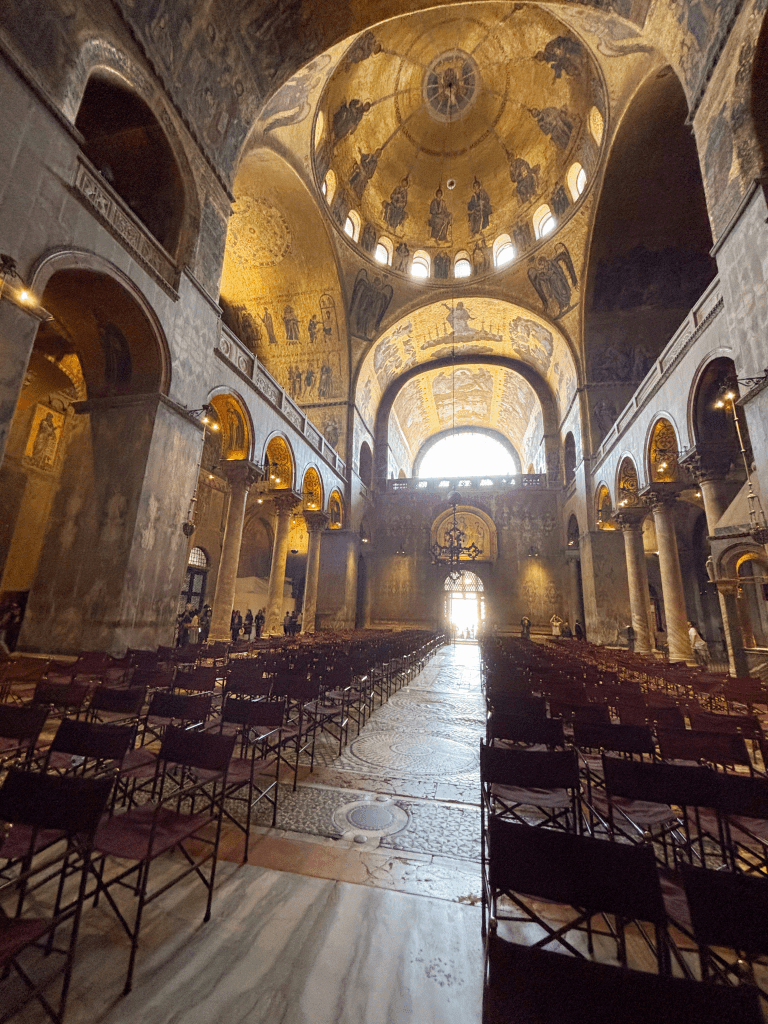
The picture above shows the chairs set for Sunday mass at St. Mark’s Basilica while the Basilica was serving as a museum. – Leasah Jean-Francois

