
Hi everyone! We have begun our second drying process for our Sargassum muticum specimens. We are using leftover specimens from a previous experiment that had been air dried for 1 week, although the algae needs to be further dried in order to be properly ground into the powder needed for refluxation.

The main objective of this month’s update is to cover the worldly impact of our research area. Of course, the original goal of my project is to extract, characterize, and study the use of CNFs for sustainable reinforcement of building materials. Cengiz et al., a 2017 paper, reports that addition of CNFs extracted from Cladophora freshwater algae to concrete improved the concrete’s flexural strength by a maximum factor of 2.7. On the other hand, adding standard commercial CNFs (derived from cotton) weakened the concrete. The researchers attributed the improved strength to the more intricate and fibrous structure of the algal CNFs.
Another research paper, Zhang et al. from 2022, covers how cotton-derived nanofibers improved many properties of pervious concrete, including its compressive, flexural, and freeze strength. I extrapolated that algal CNFs could provide yet better results. I hoped to reach the stage where I can test this hypothesis in my research project, although depending on the timing and success of the CNF extraction from Sargassum, I unfortunately may not get to this point.
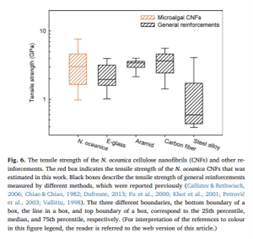
Finally, in the 2018 Zhai et al. paper, researchers extracted CNFs from marine microalgae (Nannochloropsis oceanica), using the recently discovered TEMPO-oxidation method covered in my previous blog post. They then used sonication-based scission method (essentially, using sound waves to measure the bending and tensile strength of fibers) to find that the fibers had a roughly similar strength to carbon fiber. Of course, we will need further research to determine the replicability of these results, although they do point to microalgae CNFs as a potentially revolutionary sustainable material.
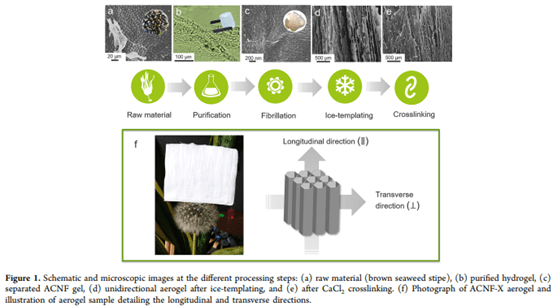
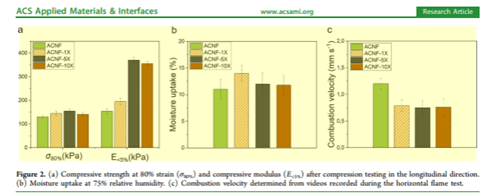
Berglund et al, a 2021 paper, additionally covered the insulative capabilities of CNF-based aerogels. Aerogels are synthetic ultralight materials, somewhat similar to styrofoam. Unfortunately, these CNF-based aerogels are highly flammable, although the researchers sought whether alginate-CNF-based aerogels (with CNFs remaining attached to alginate, a carbohydrate found in brown seaweed) could reduce the flammability while retaining strong insulation. The researchers used ice-templating and freeze-drying to assemble the aerogels, and then crosslinked the fibers to improve their durability. The following diagrams visually depict this process, including microscopic images.
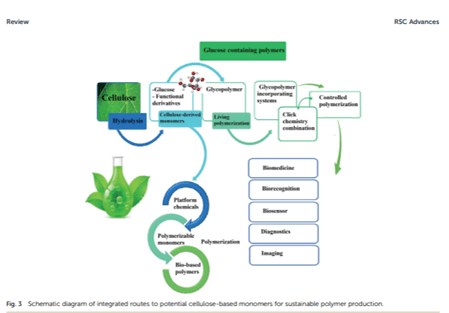
A 2018 study, Shagaleh et al, further studies how biological cellulose, including cellulose nanofibers, can be used to synthesize other carbohydrate-based polymers (polysaccharides) that can be used as medicines and health-screening devices.
The researchers include the list of characteristics and/or proposed uses for cellulose fibers (including non-nano fibers) as a polymer base. There are numerous noted benefits of using these polymers in composite materials, including improved strength, electric conductivity, thermal properties, antibacterial properties, and even UV-shielding capabilities.
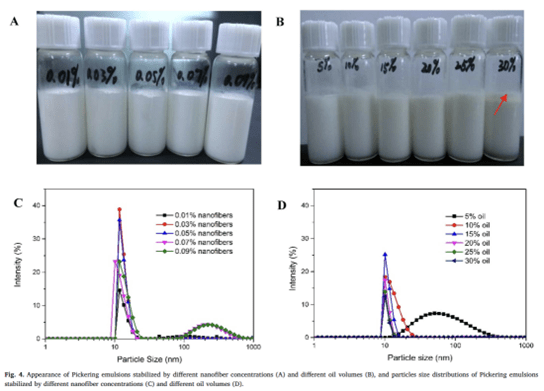
Finally, the Zhai et al. paper published in 2018 covers Pickering emulsions, or the tendency of oil and some other substances to not mix with water. The researchers extracted cellulose nanofibers from bacteria and found that these CNFs reduced the surface tension of oil and water droplets, and that they stabilized the Pickering emulsion tendencies in oil and water.
WORKS CITED:
Berglund, Linn, et al. “Seaweed-derived alginate–cellulose nanofiber aerogel for insulation applications.” ACS Applied Materials & Interfaces, vol. 13, no. 29, 13 July 2021, pp. 34899–34909, https://doi.org/10.1021/acsami.1c07954.
Cengiz, Ahmet, et al. “Flexural stress enhancement of concrete by incorporation of algal cellulose nanofibers.” Construction and Building Materials, vol. 149, Sept. 2017, pp. 289–295, https://doi.org/10.1016/j.conbuildmat.2017.05.104.
Lee, Hyun-Ro, et al. “A new method to produce cellulose nanofibrils from microalgae and the measurement of their mechanical strength.” Carbohydrate Polymers, vol. 180, Jan. 2018, pp. 276–285, https://doi.org/10.1016/j.carbpol.2017.09.104.
Shaghaleh, Hiba, et al. “Current progress in production of biopolymeric materials based on cellulose, cellulose nanofibers, and cellulose derivatives.” RSC Advances, vol. 8, no. 2, 2018, pp. 825–842, https://doi.org/10.1039/c7ra11157f.
Zhai, Xichuan, et al. “Emulsions stabilized by nanofibers from bacterial cellulose: New potential food-grade Pickering emulsions.” Food Research International, vol. 103, Jan. 2018, pp. 12–20, https://doi.org/10.1016/j.foodres.2017.10.030.
Zhang, Xu, et al. “Effect of cellulose nanofibrils on the physical properties and frost resistance of Pervious Concrete.” Materials, vol. 15, no. 22, 9 Nov. 2022, p. 7906, https://doi.org/10.3390/ma15227906.

