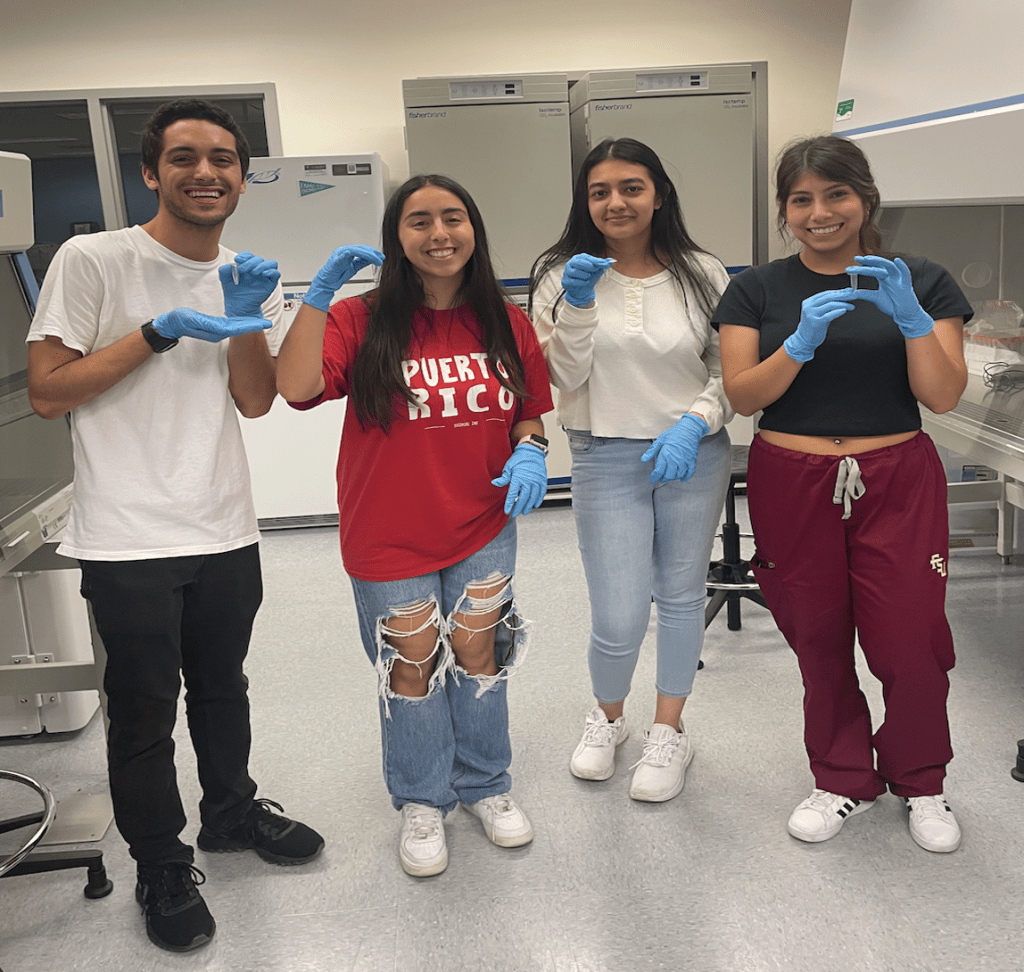
We are FSU’s iGEM Build Team, the team responsible for implementing designs in the lab to treat our disease of interest: trimethylaminuria. For the Spring of 2023, the Build Team has been responsible for documenting all laboratory supplies, managing a clean and orderly workspace, and starting the Contribution Project. The Contribution Project is a bronze medal requirement of iGEM where teams must contribute new documentation for existing information. The 2018 and 2020 iGEM teams developed various promoters and made them accessible for all iGEM teams to utilize. A promoter, or a sequence of DNA that turns on or off expression of a gene, can have vital applications to biological research. The stronger the promoter, the stronger the gene expression. This year’s team is focusing on the apFAB46, apFAB51, and apFAB98 promoters.
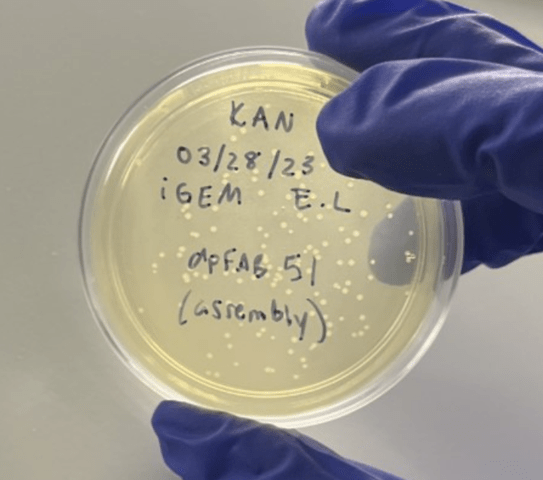
To give back, we are taking plasmids, or circular pieces of DNA, that contain these promoters and determining their expression by quantifying how intensely they fluoresce. The greater the plasmid glows, the greater its expression. Say a team designs a tomato variety with cold resistance from a deep-sea flounder gene to combat food insecurity. They will want a promoter that strongly expresses the cold resistance gene to ensure the tomatoes do not die in a cold snap. By quantifying the expression of these promoters, the Build Team can help other iGEM teams choose promoters strategically.
During the Summer of 2023, the Build Team is creating protocols for measuring the concentration of trimethylamine in the small intestinal fluid. Trimethylamine, or TMA, is the compound responsible for malodor. If the concentration of TMA drops from our treatment, people will exhibit less symptoms. By determining its concentration before and after ingestion of our pill, we can determine the treatment’s efficacy. The treatment will be in a pill form and is absorbed in the small intestine. We are currently developing procedures to simulate the environment of the small intestine: exceptionally low oxygen levels and a pH of six to seven. Our current findings indicate we will use an anaerobic chamber to simulate this environment. After having our treatment and TMA in the anaerobic chamber for some time, a sample can be isolated, and TMA can be analyzed. By marking TMA with a molecule that absorbs UV light, TMA can be visualized in machinery such as HPLC to determine its concentration. This experimental design process involves understanding the limitations of our available equipment, the properties of the molecule of interest, and more.
In theory, these protocols may be straightforward. But in application, things are more complicated than this. By understanding the sources of error and shortcomings of our experiment, the Build Team will test and design iterations of protocols until the experiment is effective. By learning what goes wrong and modifying our designs repeatedly, the Build Team is undergoing the engineering success cycle. This cycle is a crucial aspect of all iGEM projects and ensures continuous improvement and learning throughout the process. By the end of the summer, the Build Team should have meaningful results that can hopefully improve the lives of those suffering with trimethylaminuria and bring home another medal for the FSU iGEM team!
Featured Photo by Sangharsh Lohakare on Unsplash


What a joy this news, please inform us in the MEBO group we are thousands of people with this smell and bad breath
LikeLiked by 1 person
También estoy contenta solo q no sé si llegara a el salvador 🇸🇻 yo sufro de esta enfermedad
LikeLike
I cannot wait to go into a doctors office and they understand what I’m talking about , while they cover their nose and tell me it’s in my head . I am 63 but hope my daughter can benefit and be able to live a normal life.
LikeLike
I hope you find a solution to this terrible disease called trimethylaminuria. Because it turns the lives of everyone who has it into true hell. Good luck to you .
LikeLiked by 1 person
I hope you find a solution to this disease called trimethylaminuria. Because it disrupts the lives of everyone who has it. It impedes professional and personal life. If you need help, you can contact me and I will help as much as I can.
LikeLiked by 1 person
I suffer from Malodor and would like to offer myself for research
LikeLiked by 1 person
Have we looked into the source of the problem? Can the defective gene be activated? Can you “turn on” the gene. FMO3.
I see that CVD and tmau have a link. Could you collaborate with cardio researchers.
Grasping at straws here. My head is spinning looking for solutions. This is an awful condition where many of us are suicidal. Please help!
LikeLike
Also, my friend who suffers with tmau swears by this supplement she takes that activates the nrf1 and nrf2 pathways which stimulates improved funtion of the mitochondria. And her body odor is gone.
LikeLike