By Avery Peters, Austin Community College
When I first became interested in William Blake, I mostly knew him as a poet and artist whose work was strange, imaginative, and sometimes difficult to understand. My father introduced me to Blake, along with many of the writers and historical figures who eventually shaped my interests. Because of that, getting the opportunity to study Blake while traveling through England felt like more than completing an academic project. I could experience the places and art connected to the culture that surrounded him.
My research focused on one main question: How does William Blake use imagination to fight against social injustice? I became especially interested in Blake’s responses to slavery and child labor. In poems such as The Chimney Sweeper, Blake describes children suffering because they are forced into dangerous work. Instead of simply telling his audience that child labor is wrong, Blake uses poetry and powerful images to make readers imagine what those children experienced.
That became the biggest idea I took away from my research: art can be an outcry against injustice.
My time in England helped me understand this idea outside the pages of a book. At the National Gallery, I saw J.M.W. Turner’s The Fighting Temeraire. Turner was a generation younger than Blake, but seeing his work helped me think about how British artists responded to a changing society. The painting shows an old warship being pulled toward its final destination, and it made me think about how a single image can communicate ideas about history, change, and the passing of time.
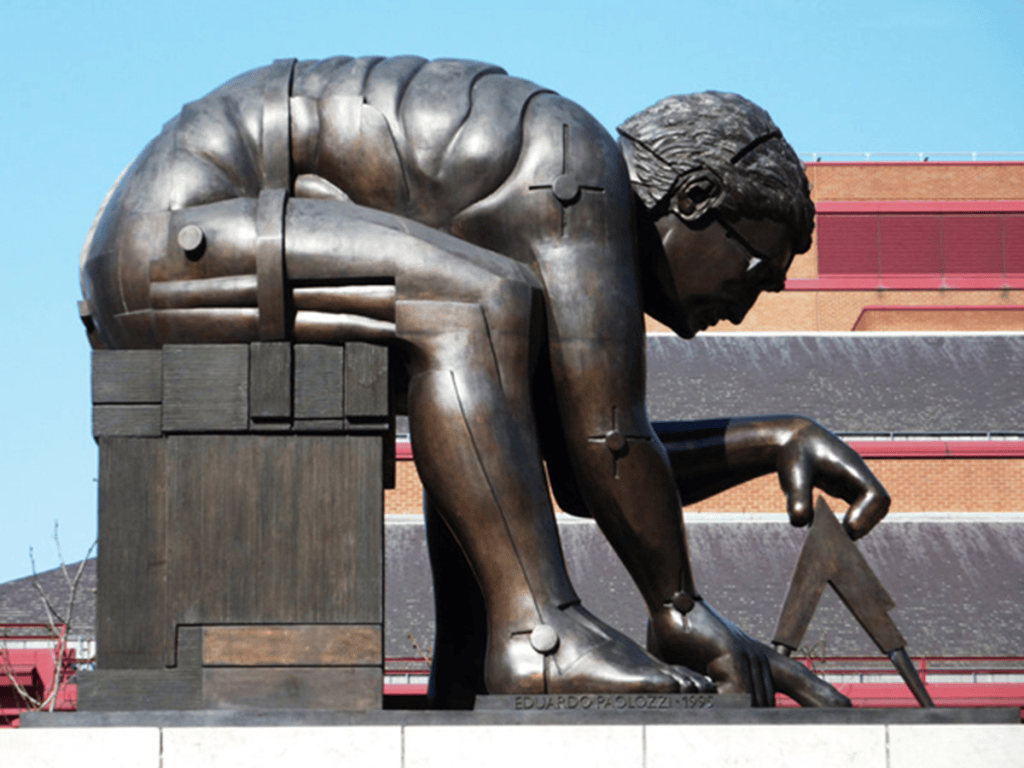
I also visited the British Library, where I saw the statue of Sir Isaac Newton outside the building. What made this especially interesting was learning that the statue is based on William Blake’s own depiction of Newton. The statue recreates the same seated pose from Blake’s artwork. Seeing something I had studied in a book become a physical statue right in front of me was one of the moments that made my research feel real. Blake’s Newton represents reason and scientific thinking, while Blake himself placed much more importance on imagination and spiritual vision. The connection made me think about how artists can influence the way we remember and understand historical figures.
At the British Museum, I was surrounded by objects from different cultures and periods of history. It made me think about how art can preserve ideas long after the people who created it are gone. That connected directly to Blake. His poems and artwork were created centuries ago, yet people are still reading, studying, preserving, and debating them today. Blake can be described as a visionary, which implies his works achieved a level of permanence.
This experience also helped me become a more independent researcher. I had to manage my time, navigate unfamiliar places, and connect what I was seeing to the questions behind my research. I learned that research does not always happen at a desk. Sometimes it happens while standing in front of a painting, walking through a museum, or discovering a connection between a statue and an artist’s work. Thank you all for reading. Blake inspires me creatively and even politically, and I hope this inspiration can reach others as well.

