By Alexa Lewandowski, William & Mary
My summer research examined transitional justice processes in Uganda, South Africa, Sierra Leone, and Sri Lanka. I was interested in a deceptively simple question: who has the authority to define what justice and peace should look like after conflict? International institutions often describe transitional justice programs as locally owned, but the results I studied never quite matched that perspective. My research showed that the language of “the local” can hide significant inequalities. Governments, traditional leaders, and survivors do not share equal influence over how justice is designed or implemented, and even within “affected communities,” that influence is stratified by gender, generation, and geography.
Before this summer, my research on peacebuilding took place through books, journal articles, and reports, studying post-conflict response mostly through assigned readings for class. Being in London placed me close to institutions, archives, and collections that encouraged me to look beyond the most easily accessible sources and to think more deliberately about where knowledge comes from. I spent countless hours in the British National Archive, sorting through policy reports and original government correspondence that told the stories I attempted to uncover. I saw the flow of money and resources alongside the thought processes and hidden priorities that exist in international peacebuilding, and ethnographic studies revealed the impacts of these international decisions. Learning to place these sources in conversation with one another helped me become a more careful and critical researcher.
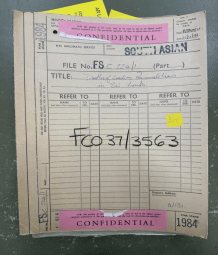
A file from the Foreign and Commonwealth Office about the deaths of leading personalities in Sri Lanka. Each file contains all archived documents related to the case. Seeing the “confidential” and “top-secret” labels was also quite cool.
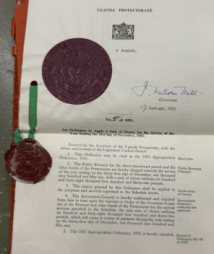
A Ugandan ordinance with the Governor’s signature and intact seal from 1951! Analyzing original documents and seeing behind-the-scenes conversations of peacebuilding was completely new to me.
This experience also reminded me of the value of conducting research in a global context. Global research involves recognizing that ideas, policies, and institutions move across borders, while their effects are
experienced differently in particular communities. This was the focus of my project, but also a dynamic I had to situate myself in as an international researcher from American and British universities. I worked to balance my perspective with that of the communities I studied, cautious to prevent my research from falling victim to the same universalizing assumptions I meant to break down. Managing a comparative project across four countries meant identifying patterns without flattening the historical and political differences between them.
I also learned to accept that meaningful research rarely produces simple answers. A justice mechanism can benefit one group while excluding another or achieving symbolic recognition without producing structural change. Do we classify this as a success or a failure? I struggled with the realization that I did not have the time or resources to fully break down the problems I identified, and learned to manage expectations around my results, accepting that further research is still needed and that is okay.
The project taught me that local participation does not automatically create local ownership. Communities can be consulted without having meaningful decision-making power. Governments or international actors can describe a process as community-based while selectively elevating certain leaders, customs, or narratives over others. This distinction matters because peacebuilding is not only about ending violence. It is also about deciding whose experiences count, whose knowledge is treated as legitimate, and who has the power to shape the future. A process can appear inclusive because many people attended meetings or gave testimony and still fail to redistribute authority. For me, this is an important message to share because the language used to describe peacebuilding can sometimes conceal the very inequalities that researchers and practitioners hope to address.
I want this project to communicate my interest in the relationship between international policy and lived experience. I am drawn to questions that complicate familiar measures of success and ask who benefits from political institutions, who remains excluded, and how those patterns might be changed. I also want the project to demonstrate my commitment to research that is critical without becoming dismissive. Transitional justice mechanisms can create meaningful opportunities for accountability, recognition, and reconciliation, but their design must be evaluated honestly and from multiple perspectives.
This experience has taught me that strong research begins with curiosity but also requires humility; the willingness to question dominant narratives, recognize the limits of one’s own perspective, and remain attentive to the people whose lives are represented in academic work. My research did not simply give me more information. It changed how I understand the responsibilities of being a researcher. This summer has inspired my next academic step: an honors thesis focusing on gender as a piece of the stratified local in transitional justice analysis, examining not whether women participate but whether they hold authority to define justice and revise the terms of reconciliation. I am eager to build on my research to investigate how appeals to “local culture” and tradition can conceal gendered power struggles over who gets to represent the community and interpret its needs.

