By: Molly Eldridge, SUNY Oneonta
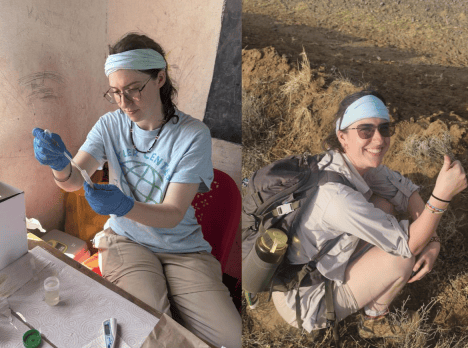
After spending a little over a month halfway across the world in a Kenyan desert, I am back in the United States of America, and able to reflect on my travels this summer. If you’ll indulge me, I’d love to take everyone on my journeys with me.
As we embark on my travels, I wanted to start us off the same way mornings do, with a sunrise.
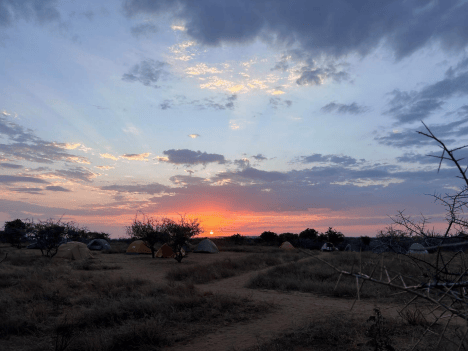
I can say with 100% confidence that I watched every single sunrise and every single sunset while I was in Kenya. This is just one of the 45 sunrises I had the pleasure of witnessing! This particular sunrise overlooks mine and the other students tents that we slept in every night at our main campsite base for 4 weeks.
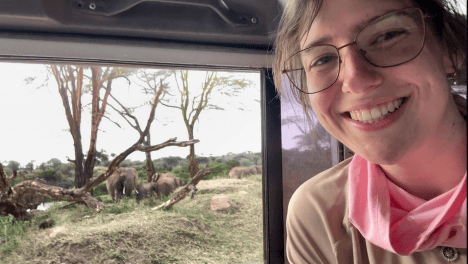
In my last blog post, I provided a map of the different sites I would be visiting during my research journey. The first stop on the map was to the Mpala Research Center, where I spent around a week learning all of the skills that I would need for the rest of the summer. Oh, and this is also where I got to go on “safari” and see all of the Big 5! Plus more!!! One of the game drives (safari), we got so close to some elephants that it looks like I’m zoomed in, but I promise that I’m not.
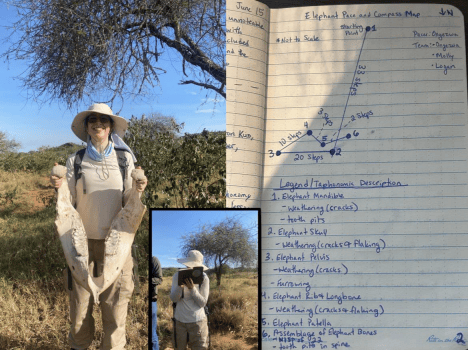
Mpala was not just for fun and games (by which I mean safaris), it is where I learned many paleoanthropology field research skills that will help me build my career. Below is a photo of me holding a baby elephant mandible (jaw). This was part of a “bone walk” activity where we learned the skill of scouting the ground for bones, as well as making what’s called a “pace and compass map” where you’re tracing your steps and roughly marking that walking path (photo also included).
My time in Mpala provided me with the necessary skills, and acclimation period, for when I reached Ileret (the very north-most star on my previous blog’s map), where I would spend most of my time in Kenya. Ileret is a special place because it is where the Koobi Fora formation is. Which is home to millions of years of geology that hold the secrets of human history and is the site of a significant number of discoveries in the field of human history and evolution.
Here, I started my main research project which was studying the modern sleep ecology at Koobi Fora, Kenya. In the field of paleoanthropology, often we are able to make assumptions about the past, by studying what things are like in the present. This concept is called “uniformitarianism,“ and is the principal basis for me attempting to understand human evolution by studying modern humans. Broadly, I am interested in understanding human behavior, and the behavior that I studied while in Kenya this summer was sleep. Specifically, the function of naps. This research will help us better understand a behavior that humans on average will spend 1/3 of their life doing, which is why it is so important to understand. Naps in particular are interesting because humans are diurnal, meaning we
are awake during the day, but sleep at night. However, we posess the capability to sleep during the day, often in the form of naps. So, what is the function? Well, my research did produce the finding of at least one significant reason for naps among the Daasanch. If that research interests you, be on the look-out in 2ish years for my publication on the data I collected this summer. In the meantime, I’ll (hopefully) be presenting my research at poster sessions and conferences in the near future. Such as the American Association of Biological Anthropologists (AABA) conference this upcoming April!
What does research studying sleep look like in the field? I’d love to show you! I was a part of the Human Bio Team, which was a group of multinational researchers who were all doing projects related to human biology. Everything was done as a team. We all collected the same data, entered the same data, and used the same data for our research. The Human Bio Team was actually the biggest team at the Koobi Fora Field school. Comprising of 25 individuals, 13 of which were Daasanach translators. The Daasanach are a semi-nomadic pastoralist group in Northern Kenya, whom were the participants in the Human Bio Team’s field research. We managed to collect data from 12 different communities in 22 days, hosting our research operations out of a central community building, often being schools, churches, or public office buildings.
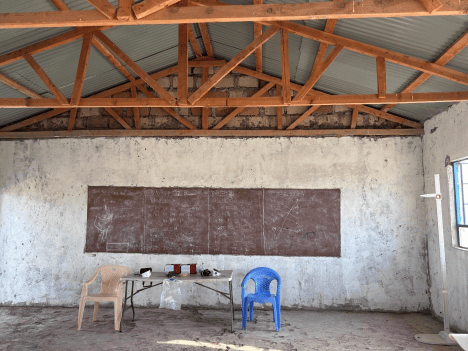
Here is a photo of one of our stations set up in a local school. On the school board you can see lessons to teach children the English language. Daasanach schools teach 3 languages to kids in attendance. Daasanach, Swahili, and English. In front of the school board, you can see one of our anthropometric stations. We would collect individual’s Blood Pressure, temperature, fingernails, height, weight, and skin folds at these stations. In addition to anthropometrics, every participant with the help of translators also completed a questionnaire survey. The survey questions are where most of the data that I personally used came from, as my project was interested in a behavior, and not a health metric. Both types of data were useful for all the projects conducted by Team Human Bio. It is important in anthropology, the study of humans, that we study all parts of humans. Both their biology, as well as understanding their daily lives, as it is all connected.
I ended the field season having composed an academic paper, and presentation to present my research to my peers. It was the perfect way to end my summer of research and skill building. Over the summer I learned skills for most of the subfields within paleoanthropology. I got to practice and learn 2 new languages (Swahili and Daasanach). I
had the opportunity to meet, connect, and work with leading experts in my field. Work on a multinational team of researchers. Experience an entire new continent and cultures. Finally, I got to conduct research and get the experience of everything from data collection, data entry, data analysis, academic writing, and presentation of research.
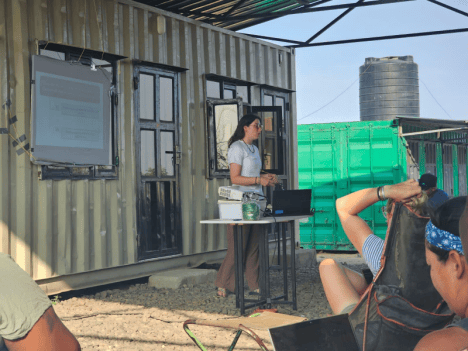
This experience has opened the doors that I will need to walk through for the rest of my career and I am incredibly grateful for that. Thank you to every person that has been a part of that, and thank you to the Tyler Fellowship for making this experience a reality for me.
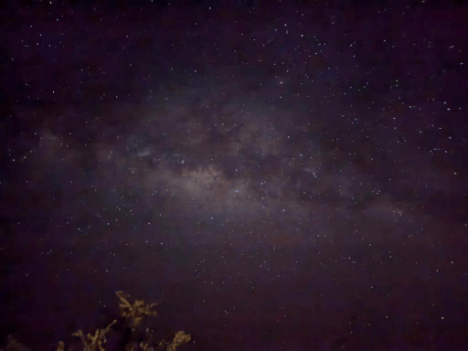
I know that this is just the beginning of my career, and I cannot think of a better way for it to have started! With that, I will leave you all off with two things. First, a picture of the milky way from the equator, which was the most beautiful thing I have witnessed in my life (I see it only fitting as I started with a picture of a sunrise). Second, with my promised research results that found that Grevy’s Zebra’s, in fact, are more beautiful.
Kwaheri Kenya, and Karibu to the future. Signing off and wishing everyone a good night’s sleep,
Molly Eldridge

