By Caleb Mulugeta, University of Texas at Austin
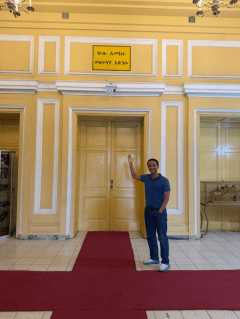
ኵሎ አመክሩ ወዘሠናየ አጽንዑ.
“Test everything; hold fast to that which is good.”
Emblazoned above the entrance to Ras Makonnen Hall at Addis Ababa University are these words from an old biblical verse. It is a fitting motto for a university with such a historic place in such an old country, but as I walked through the gates for the first time, I could not help but think that it was also a rather fitting instruction for me. After spending the better part of the past year examining Ethiopia from thousands of miles away, testing hypotheses with data and piecing together a story from what documents I could find online, I had finally come to Addis Ababa to do exactly what the inscription suggested. Test what I thought I knew. I found myself at the old imperial palace in hopes of doing just that. My stay in Addis has given me valuable documents and connections for my research, but perhaps more importantly, it has given me a chance to better understand the conditions of the country of my forefathers and the people who call it home.
At the heart of Addis Ababa University sits a storied old palace. Before students walked its grounds and researchers filled its rooms, Emperor Haile Selassie called it home. The palace survived the Italian occupation, witnessed the attempted coup d’état of 1960 that ended with government officials massacred inside its Green Room, and has since watched three very different iterations of Ethiopian governance come and go. Today, rather fittingly, it houses the
Institute of Ethiopian Studies, one of the premier places for the study of all things Ethiopia. Walking through its halls, surrounded by remnants of the imperial era, I was reminded constantly that I was trying to understand the country’s political history while quite literally sitting inside of it.
The archives did not disappoint. I came to Ethiopia hoping to better understand the puzzle at the center of my honors thesis, why infant mortality declined faster in Tigrai than in Amhara even though both regions operated under the same national government and, at least on paper, many of the same national health policies. In my first blog, I explained my suspicion that differences in state capacity may have mattered. Because the leading party within the EPRDF came from Tigrai, I wondered whether Tigrai had developed a stronger administrative apparatus than Amhara and was therefore better able to turn national health policy into actual services. What I found in the archives has not given me a neat answer. If anything, it has made the question considerably more interesting.
Among the materials I found were dozens of pages of complaints surrounding elections in Amhara, including complaints against the EPRDF and its regional affiliate, the ANDM. I also encountered documents that suggested the regional party had difficulties attracting professionals and building the cadre structure necessary to govern effectively. These records began to give substance to something that had previously existed mostly as a hypothesis on my laptop. The difference between Amhara and Tigrai may not simply have been a question of whether the government in one region possessed more resources or had more health posts. It may also have depended on who staffed the state, how those officials interacted with ordinary people, and whether those people trusted them enough to use the services the government was trying to provide.
That possibility became even more interesting after a conversation with a member of Ethiopia’s parliament from the political opposition. He reiterated something that had begun appearing in the documents I was reading: under the EPRDF, the line between the state and the party could become rather blurry at the local level. The same cadres tasked with helping deliver government policy, he told me, could also be expected to promote the governing party when election season came around. That arrangement mattered, he argued, because support for the EPRDF and its constituent parties was hardly uniform across Ethiopia. In places where the ruling party was unpopular, residents could become reluctant to work with the very cadres responsible for delivering government programs.
For my research, that raises a fairly simple question with potentially important consequences. What happens when a government has the capacity to provide a service, but the person receiving that service does not trust the person providing it? A health extension worker can be trained. A health post can be built. Medicine can be supplied. But none of that necessarily means very much if the people those programs are intended to reach are reluctant to interact with the state representatives delivering them. I still have research ahead of me at the time of writing, including meetings at Ethiopia’s Ministry of Health, so I am far from ready to give a definitive answer. Still, the time I have spent in the archives has already pushed my thesis beyond my original question of state capacity and toward another element I had perhaps underestimated: legitimacy.
Strangely enough, some of what has helped me understand that problem best has happened after I left the archive.
Lunch conversations with people at the Institute of Ethiopian Studies, rides through Addis with cab drivers, and conversations with relatives have offered a very different window into Ethiopia than anything I could have gotten from a government document. Obviously, a handful of conversations cannot tell me how an entire country feels. Ethiopia is far too large and complicated for that. Still, one sentiment has appeared often enough that it has become difficult for me to ignore: pessimism.
That feeling has been particularly striking among people around my own age. Many of my younger relatives did what they were told they were supposed to do. They went to university. They earned degrees in fields ranging from computer science to accounting. They found jobs. Yet when I talk to them about their futures, the conversation rarely seems to revolve around what life will look like five or ten years from now. Instead, there seems to be much more emphasis on winning today and figuring out tomorrow when tomorrow comes.
One of the more memorable versions of this conversation happened over dinner with one of my relatives at a restaurant rather aptly named Mitmita. For those unfamiliar with Ethiopian food, mitmita is an extremely spicy mixture of peppers and spices, which was appropriate because our conversation became a little spicy as well. I had repeatedly heard people complain about the rising cost of living in Addis, so I asked my relative whether it was really as bad as people made it sound. He has a computer science degree and what I would normally consider a good job, so I figured that if anyone our age should be relatively comfortable, it would be someone like him.
“Absolutely,” he told me.
He explained that without help from his parents, he would not be able to afford the small one person flat where he currently lives. Rent would consume essentially his entire monthly salary.
So I asked him what seemed like the natural follow-up question.
“If you can’t afford this economy, who can?”
His answer was half joke and half resignation. TikTokers, he said. Entrepreneurs with a Rolodex filled with “important” phone numbers. And a third group that, unfortunately, has escaped my memory.
We laughed, but the sentiment behind the joke was one that I encountered again and again. People spoke about the cost of living. They spoke about the lack of peace in parts of the country. They spoke about jobs that did not provide the standard of living they had expected their education to earn them. None of them struck me as people who had simply given up. Quite the opposite. They worked, went out with friends, joked, made plans, and found ways to enjoy themselves. Yet underneath those conversations was an uneasiness about what exactly they were building toward.
Perhaps the best way I can describe it is that the future seemed to have gotten shorter.
Five or ten years is a long time to plan for when you are unsure what the economy will look like next year, whether your salary will keep pace with your rent, or whether the country will finally find a lasting peace. So people take the victories that are available to them. A good day is a good
day. A night out with friends is something worth enjoying. You get through tomorrow and then worry about what comes after it. I do not want to turn a few weeks of conversations into some sweeping pronouncement about Ethiopian youth, but I would also be lying if I said the consistency of this sentiment did not affect me.
In my first blog, I asked how a country with such an illustrious past could continue to struggle with poverty, division, and conflict. I called it the Ethiopian enigma. I came here partly because I knew that those questions could not be answered entirely from a desk in Texas. What I did not fully appreciate was how quickly abstract questions about governance become concrete once you are here. State capacity is no longer simply a variable when you are sitting in an archive reading about the people expected to carry out government policy. Political legitimacy is no longer simply a concept when someone tells you that the official delivering a public service may also have been the person asking for your political support. Inflation is no longer simply an economic statistic when someone your own age tells you that a respectable job cannot pay for his apartment.
I certainly have not solved the Ethiopian enigma. In fact, my time here may have complicated it further. But perhaps that is what good research is supposed to do. The questions I arrived with have become better questions, and the Ethiopia I will leave is more complicated than the Ethiopia I thought I understood when I arrived.
Which brings me back to the words written above the entrance to the university: ኵሎ አመክሩ ወዘሠናየ አጽንዑ.
Test everything; hold fast to that which is good.
I came to Addis hoping to do a little of both.

