By Elyssa Nguyen, University of California, San Diego
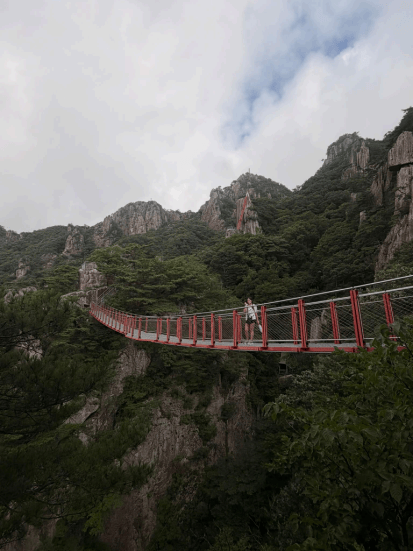
It’s crazy to think that I have only one month left in South Korea.
When I first arrived, I was mostly focused on getting through the basics: finding my way around Daejeon, figuring out the lab, trying not to accidentally embarrass myself, and convincing myself that I would eventually stop feeling like a stranger. Now, somehow, I have a routine here. I know
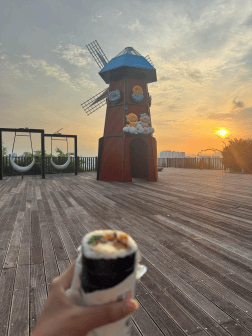
where I like to eat after work (steamed hard-boiled eggs ��), I have friends I can text to make plans with, and I’ve become comfortable enough in the lab to forget that I’m technically thousands of miles away from home.
One of the strangest parts of this experience is realizing that I would have never met these people or even known about the research happening here if it weren’t for this program. I came to Korea expecting to learn research techniques and experience a different academic environment. I didn’t expect the people I met along the way to become such a meaningful part of the experience.
The project that kept changing
My research project has changed quite a bit since my first blog post.
I originally started working on a project looking at how midlife obesity might affect the brain’s metabolism and increase susceptibility to Alzheimer’s disease. It was a much broader question, almost approaching the problem from an epidemiological perspective: how might a major risk factor like obesity change the brain long before Alzheimer’s symptoms appear?
Since then, the direction of the project has shifted toward understanding the relationship between specific genes and Alzheimer’s disease, including connections to conditions like cancer and clonal hematopoiesis, a condition where blood stem cells acquire certain genetic mutations. Eventually, we narrowed our focus even further toward microglia, the immune cells of the brain, and how they interact with the amyloid plaques associated with Alzheimer’s disease.
That has meant a lot of gene-related work, reading papers, discussing experimental approaches, and trying to understand why certain questions are worth asking in the first place. Surprisingly, one of my favorite parts has been the literature review and discussions. I like being able to understand not just what we are doing, but why we are doing it and how our experiment fits into the much larger conversation happening in the field.
There is also something really exciting about working on a project where there is always something new happening. I don’t feel like I am just completing tasks assigned to me. I am learning how researchers actually think through a problem, change direction when the evidence calls for it, and figure out what question to ask next.
Learning to be wrong in real time
Of course, that process has not always been graceful.
I was used to working mostly with mice in my research at UC San Diego, so moving into cell culture was a completely different experience. I also tend to be more comfortable working independently, where if I make a mistake, I have time to figure it out before anyone sees it.
That is definitely not how research works here. I have made mistakes in real time. I accidentally killed a cell plate. I have used too much media. I have made incorrect calculations and had to go back and figure out where I went wrong. None of these mistakes were catastrophic, but they were embarrassing in the moment.
The important part is that I’m learning not to treat being wrong as proof that I don’t belong in a research environment. Instead, I’m trying to become more comfortable saying, “I don’t know,” asking questions, correcting myself, and trying again. I’ve also had to learn when to step back. Sometimes my mentor needs to perform something herself, either because materials are expensive or because she is working through a technique herself. At first, I interpreted not always being involved as something negative. Now, I’ve realized that observing carefully can also be part of learning.
My biggest wins have been becoming more assertive in the research process, developing new technical skills, and becoming more comfortable with the uncomfortable feeling of not knowing something yet. I’ve also been lucky to have a mentor who genuinely wants me to become a better scientist, not just a better technician. She pushes me to think independently, even when doing so sometimes means putting me in situations where I feel a little embarrassed. I think that is exactly the kind of mentorship I hope to provide to someone else someday.
Saying yes, even when I’m tired
Outside of the lab, I’ve been learning something similar.
I’m naturally pretty quiet, and being away from home has made me realize how much I sometimes hesitate to put myself out there. I’ve had days where I was exhausted after work and just wanted to go back to my room. I’ve also felt guilty for staying in, as if I wasn’t taking full advantage of being in another country.
One of my friends here told me something that stuck with me: they had never regretted saying no to going out, even when they dreaded getting started.
One evening, I was completely exhausted after work, but some friends invited me to a viewpoint to watch the sunset. It took about two hours to get there during rush hour. The subway was packed, I was still wearing my stuffy work clothes, and we had to walk through hilly neighborhoods before finally reaching the viewpoint.
It was worth it.

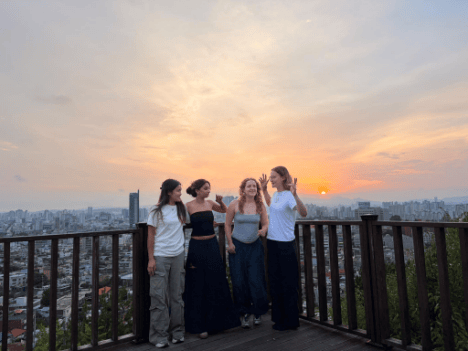
I think I needed to learn that resting and having quiet time alone are not things I should feel guilty about. But I also needed to be a little more honest with myself about when I was using tiredness or nervousness as an excuse not to participate. If I want to build relationships, experience new places, and eventually become the kind of researcher and physician I hope to be, sometimes I have to be the person who takes the first step.
What I’m taking home
There is still a lot I want to accomplish before I leave. I want to become more precise and consistent with cell culture, continue developing my technical skills, and understand more of the biological questions behind the project rather than simply knowing how to perform the experiments. I also want to become better at communicating my ideas and asking questions confidently.
More importantly, though, this experience has made research feel more like a possible career rather than simply an activity I am doing for medical school.
I came to Korea thinking I needed to figure out exactly what I wanted to do next. Instead, I think I’ve learned that I don’t need the entire answer yet. I just need to keep putting myself in rooms where I can learn something new.
I still miss home. I still have quiet days. I still get nervous speaking to people I don’t know. I still sometimes want to hide in my room after a long day.
But now I know that none of those things mean I have to stay there.
I have one month left. There is still a lot I want to see, a lot I want to learn, and probably a lot more mistakes waiting for me in the lab.
I’m trying to make sure I say yes to as many of them as I can.