By Saranna Shevalier, SUNY Oneonta
This summer I had the opportunity to return to the Koobi Fora Field School and interact with the program in a more dynamic way by mentoring incoming students. Because I was a student at Koobi Fora last year, I had the ability to help ease the anxieties of the students this year. This was incredibly cathartic to me, because I felt like I was incapable of even articulating my concerns last year. I was so occupied with trying to be my best academic self and performing highly that I almost forgot to enjoy the ride. Studying in Kenya has helped me to picture the landscape of human evolution and will guide my future research questions.
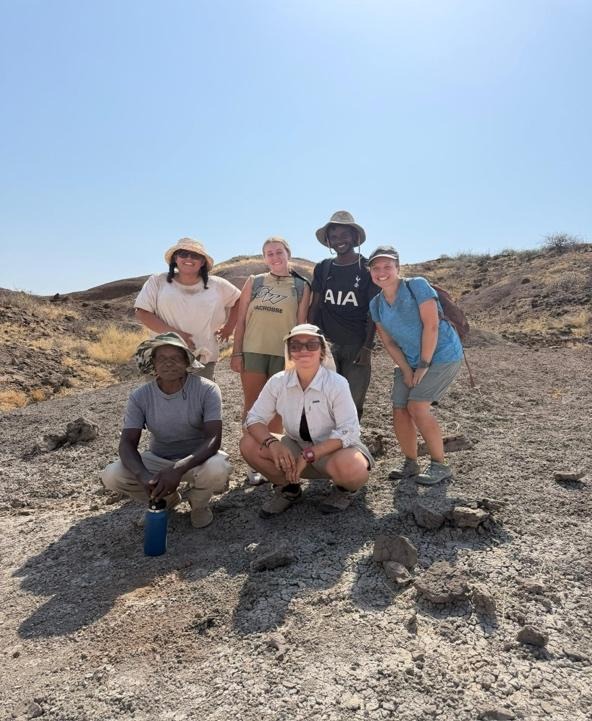
A photo from our 2026 Paleoecology team which explored concepts of hominin butchery and foraging opportunity with usage of multiple proxies this summer.
Our team includes staff that study the process of fossil deposition, the geology of the region, the archaeology and evolution of stone tool industries, and the welcoming local Daasnach tribe, which specializes in fossil identification and navigation of these complex sites. In addition to this dynamic team of professionals, we also had students from all over the globe, ranging from the US, Romania, Uganda, Kenya, South Africa, Ethiopia, and more, which allowed me to explore ways to communicate across cultural boundaries. Each one of our students showed me that the process of learning field data collection, scientific writing, and analysis is difficult but possible with proper guidance. Every day with this cohort was a new experience for me, and I reminded them that as they asked me questions about daily functions, schedules, due dates and expectations I was learning right along with them. I was consolidating the information that I had obtained last year, the training I received this year and distilling my thoughts into advice that could guide the next generation of students. I see now that good mentorship can lead new groups of scientists that the world needs so desperately.
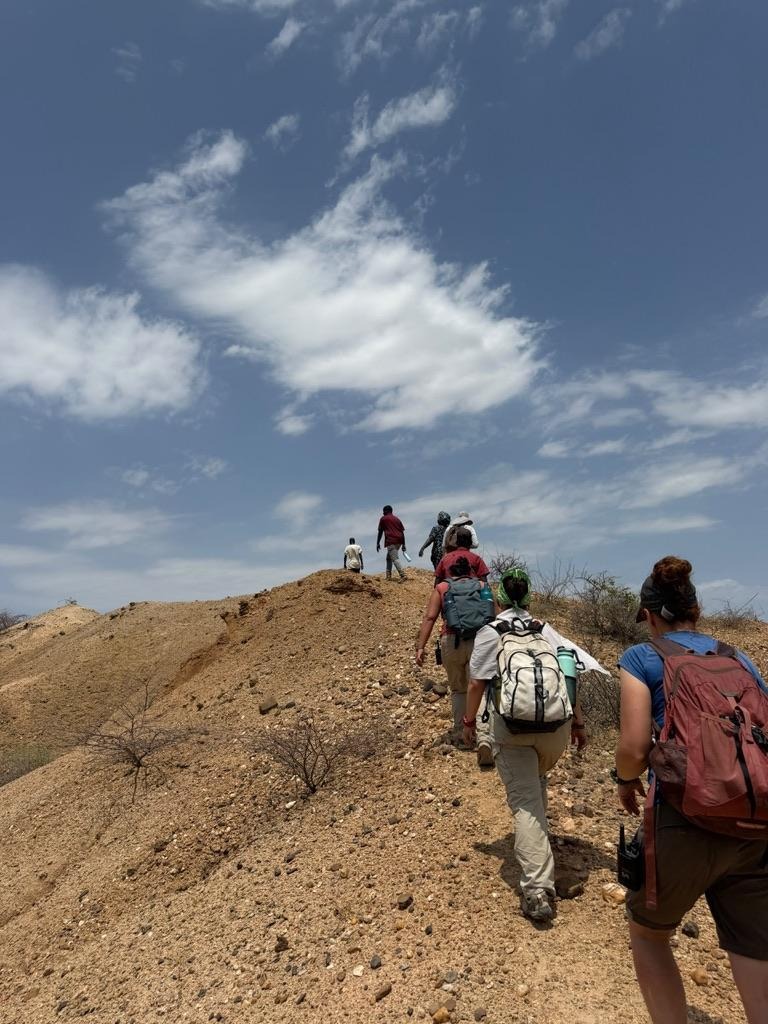
A photo taken by one of the students on the Paleoecology and Hominin Paleobiology groups on a hike through the outcroppings at Area 40 in the Koobi Fora Formation, East Turkana, Kenya.
One theme that remains present in my mind as I adjust to being home is the benefit of blending different ideas and methods, which is so fascinating to me. In my experiences with research in general, I try to remember the transient nature of knowledge, that every experience equips us with new skills with which to move forward. I have left Kenya this season with the knowledge that I will need to test multiple lines of evidence in order to get at these large-scale questions about humans’ deep past in Africa.
On one of the projects I helped to oversee this summer, we were focusing mostly on the exploratory nature of initial test pits and finding evidence to support our desire to continue excavating at a locality. This project came with difficulties as we did not have structured methodology or questions that could be tested empirically. In the realm of science and in the world we live in, I find it beneficial to acknowledge our limitations and find a way to work with uncertainties. Another one of our projects was rooted in the interaction between early humans and their fellow animal counterparts, such as antelopes and gazelles, as well as other carnivores. These methods included comparing data sets with modern ecological settings in the African continent, such as studies which detailed animal interactions in regions such as Etosha, Kruger and Serengeti National Parks. By considering these ecological dynamics, we sought to infer early human relationships with the landscape and foraging opportunities. Although this project was well planned, we still had a mixed bag when it came to our statistical results. One thing I learned in hindsight from that project was that sometimes modern analogs are not the best way to try to analyze ancient environments and has set me on a path to find additional ways to test our hypotheses.
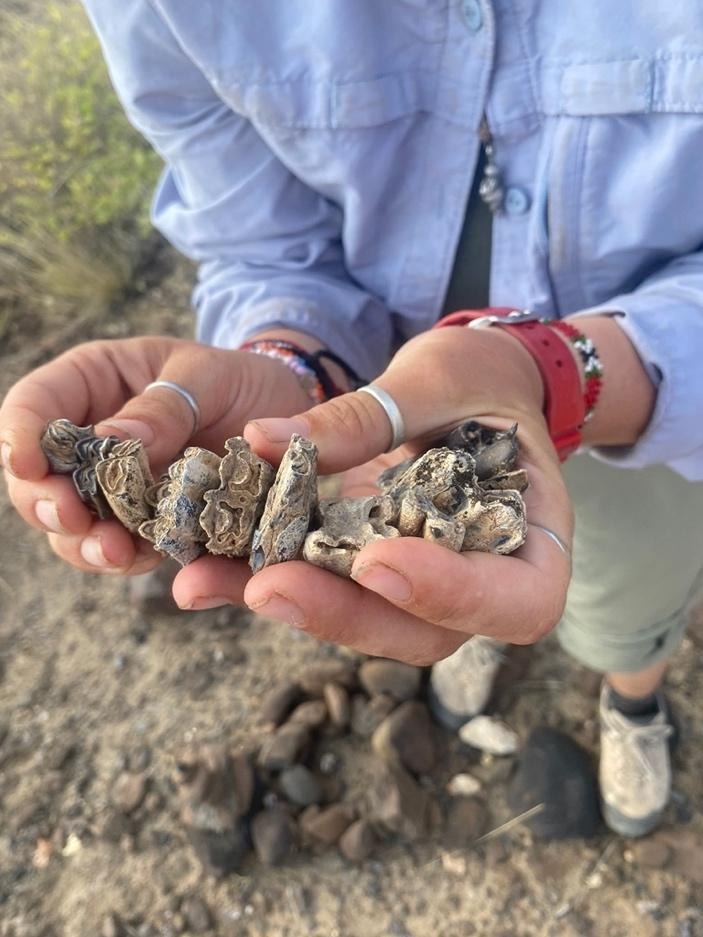
An assortment of Gazelle and Antelope molars that we collected this summer, which were used to infer environmental dynamics at 3.3-1.4 Million years ago in the Turkana Basin of Kenya.
These times in Kenya have changed the way I think about the world. I want my research to reflect my curious nature and my dedication to interdisciplinary studies. By entering the field school as an intern, I was expanding the kinds of questions I can ask, what kind of data we need to test these hypotheses and what that means in the grand scheme of human evolution. I am planning to pursue my Master’s Degree in Biology, and exploring modern ecological frameworks so that I can better understand the world we live in. One day, I will move onto a PhD program in which I can fortify the years of field work, questions asked, lessons learned, and connections made. When that time comes, I will create a research project that gets at my questions of our existence as animals, and how that influences the societies we live in today. I am endlessly grateful for these experiences and can feel it in the air, this is just the beginning!
 HSF House Blogs