By: KhaNy Sangasy, Monroe Community College
It has been a little over a month since I have come back from Indonesia! I am here to talk about my findings and dive into my research topic and the information I collected.
Before I start, I want to let you know that this blog will be going in depth about my experience and findings of Indonesia. I hope to make video essays that cover what my days looked like. This blog will be my analytical dissection of my research question. I also recommend reading my first blog post to understand the approach prior to the trip.
Arrival
As soon as I stepped off the plane in Jakarta, my research and data collection began. From the little things such as bathrooms to which side of the airport people walk on, or their form of transportation; I was storing these findings in my head.
On our way to the baggage claim, I immediately noticed there were prayer rooms scattered throughout the airport. Typically, they were by the bathrooms and baby changing stations. This confirmed my initial assumption that religion is intertwined with Asian culture but more specifically Indonesian culture. If you were to compare this to the United States or less religious countries, you see churches and such, but accessing a place to practice or pray isn’t always readily available like a bathroom. During my time there, musallas – the prayer rooms – are seen as often if not more often than bathrooms. Some of the reasons why musallas are readily available includes giving Muslims the option to pray where and whenever they’d like. Although Indonesian Islam is different in their own ways in comparison to Middle Eastern Islam, they still have 5 calls to prayer a day.
We made a quick stop to use the bathroom, and this was when I experienced my first small shock. Their bathrooms almost all have bidets or some sort of handles with harsher water pressure. Now you may be thinking, “we have bidets here in the US too; that’s nothing new”. You are correct. That is what I thought initially, but throughout my time there, I found that toilet paper isn’t always used, and that bidets or water hoses with a sprayer nozzle are used to clean yourself. Or for the bathrooms that did have toilet paper, there were still bidets and water hoses connected as an option. At this point, I didn’t know this was the case in almost all bathrooms, so I remembered to just note what I found in the back of my brain.
Quick funny story: After I used the bathroom, I needed to flush but I couldn’t find the button or handle and so instead I found this twisty knob and turned it. Turns out it was the bidet, so I got sprayed with toilet water on my shorts and legs after 30-35 hours of straight traveling. Nothing better to welcome you to Indonesia than that!
After baggage claim, we made our way to the exit to find a Gojek – basically the Indonesian version of Uber. The car that we got into immediately confused me. It was a van, but it was technologically advanced. The 2 middle seats had electronic reclining as well as a digital interface on the arm rests to move your chair to a preset position. There was also a mini-mini fridge in the middle between the driver and the passenger. I don’t know what I was expecting but to be in a fancy van definitely wasn’t one.
Since we arrived at nighttime, everything that I was exposed to I remember vividly because it truly was a shock. After we unpacked and settled, we walked to a nearby convenience store called “Indomaret”. We came to find out it was almost everywhere, similar to a 7/11.
Water in Indonesia is not safe to drink so we bought some bottled water and any snacks we might need for the time being. I bought 3 bottles of water, 2 RedBulls, an onigiri, a coconut water, and a pack of chocolate waffers; the total came out to about $6 USD. I immediately compared it to how much it would cost at a gas station in the US, and it would probably be at least $20 USD. From this moment forward, when it came to money, I was constantly comparing how much everything would cost back home.
Small street food vendors lined the roads that we walked, but not many were open late at night. We decided to use Gojek (the same app as before) to order food for the night. Gojek is the app you can use to call a scooter, a car, fast food, groceries, and more. It’s like if Uber, DoorDash, and Instacart combined. I’ll include a screenshot of the app below.
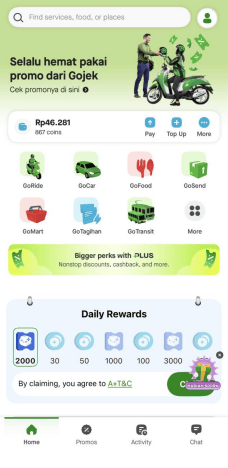
For 3 full meals from McDonald’s to feed 3 people, the total converted to USD was $16. This is when I really started to understand how fortunate I am to be here and to be able to immerse myself in their way of life.
Moving into the next few days spent in the city of Jakarta, I continued to ground myself and take into the culture around me. Jakarta is where all my initial assumptions and expectations began; setting up the groundwork for the rest of the trip.
Now, as I move forward with my findings, instead of going through day by day of what my trip entailed, I will be breaking it down by topic, whether it is food, transportation, religion, etc.
Clothing
There was a kindergarten graduation ceremony that was happening in a building we visited, I noticed the children were wearing their traditional clothing as they lined up. I wondered if this is similar to our caps and gowns we wear for our graduations as American’s.
I also noticed everywhere we went there were clothes available for purchase. Whether is was men’s tops or women’s pants, I could go anywhere knowing if I needed to buy clothes there would be some on any street.
Lastly, when it came to Muslim women, there were many of them, but not all covered their bodies fully. Considering a huge percentage of Indonesia is
Muslim, it was slightly surprising to see how different aspects of the religion is altered.
Religion
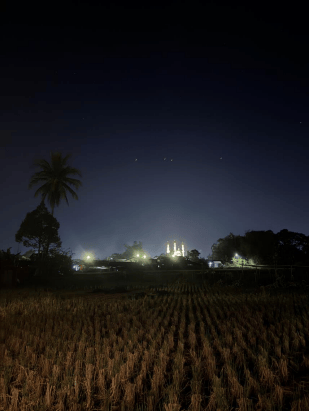
As I mentioned earlier, there are typically 5 calls to prayer a day. Every location we stayed at, there were multiple mosques nearby, it was never silent (which isn’t a bad thing). The closest thing I could compare this to is the Emergency Blue Lights on college campuses where the expectation is no matter where you are on campus you should always have sight of one. Everywhere I went, I think I either so a mosque or a musalla.
Food
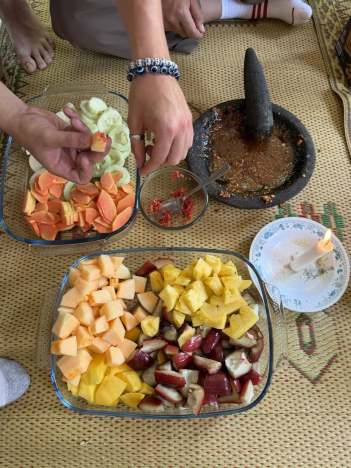
One of the days there, we had an amazing opportunity to spend a few hours with a family (our professor’s Indonesian professor’s family (wow a mouthful)). We had traditional snacks and meals while we sat and talked about what Indonesian life is like. Everyone was delicate when passing food, being respectful of not stepping over the food (we sat on the ground and ate).
Transportation
The first thing I immediately noticed was them driving on the left side of the road. Their main forms of transportation are scooters, mopeds, vespas, and cars. I noticed there were no car accidents or motor vehicle accidents. In my whole
time there, I only saw one gas station which I found interesting because all the scooters seem to be gas powered.
In a late car ride with two of my classmates, I asked a question. I said, “This may sound stupid but why are their models not the same as ours?” I felt so under educated asking that question, but one of them responded saying that they get their products like we do, but they might just use them and build something different. Like how everyone can be given the same Lego pieces, but they will all make their own project.
Weirdly enough, I believe that during the whole trip I saw a speed limit sign. One of my classmates brought up a point that it seems like you can’t really speed here. The population size seemed to be dense on the roads, leaving little room to speed.
Money
This experience made me realize how much American culture is based off capitalism. I took a step back to think about how much it would cost them, in their currency, to book a ticket to America. It made me sad because during my time there, people would tell me, “oh wow America, I would love to go there someday”.
Shopping
One of my classmates and I discussed the topic of Indonesian shopping culture. There were multiple locations where the “downtown” of a city would just be a huge shopping center. In Yogyakarta, the location Malioboro had both sides of the street’s lines with shops and clothing stores. Jakarta had Blok M, a hub for malls, shops, and even luxury brands.
Final Evaluation
During my time in Indonesia, there was a constant feeling of familiarity. Everywhere we went, there was rarely ever a time that I felt like an outsider. So many locals believed I was Indonesian and were shocked when I spoke English with a heavy American accent. Part of me felt home, like I was surrounded by my people. No, I am not Indonesian but being surrounded by fellow Asian’s I felt seen and didn’t feel like I stood out like I tend to feel in America. Growing up when I packed traditional Vietnamese food to school, I would get weird looks and comments on my meals. There is always this fear in the back of my mind when friends try my traditional food. But during meals and trying traditional Indonesian food, it was so comforting being able to try different unique foods that many people might not be interested in around the U.S. (the locations that are less diverse).
After this trip, it inspired me to try and immerse myself in other cultures that I never thought about. When I think about countries I want to visit and learn about, Indonesia was never on my list. Or nowadays many people only think of Bali. I found it incredibly important that we trekked all other parts of Indonesia other than Bali because truthfully there is so much more to Indonesia than Bali.

