By Devyn Gilbert, University of Washington
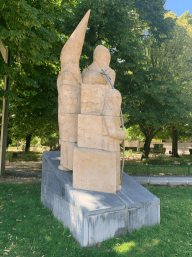
During my first week in Spain, the plan for my research has changed significantly. As I’ve learned about the history of the Spanish Inquisition in León, I have developed a desire to lean more strongly into how religion has influenced migration in Spain. I’ve written field notes at important sites in the city and gathered information regarding how the Catholic church has helped people migrate both to and away from Spain by providing financial, legal, and various other types of support. Simultaneously, the Catholic church has a highly visible legacy of tremendous violence which forced many to migrate out of Spain. This legacy is evidenced all over the city of León. For example, the building I study in, the Palacio del Conde Luna, was a court for the inquisition, and I frequently walk past a monument dedicated to the victims of the Spanish Inquisition, as is pictured below. In the next two weeks, I will continue to visit sites which will teach me more about the relationship between religious institutions and migration, and toward the end of my program I will synthesize this research into a digital essay for my final project in my program. While my research will now be less focused on art, I still intend to include analysis of works like this monument and other artwork I’ve seen throughout León.
During the process of reshaping my research plan, I’ve overcome many hurdles. Because my program has taken place during August, when many Spanish people go on vacation, we haven’t been able to meet with many of the migrant support organizations that we had planned to. This has meant that I haven’t had as much material from the modern day to draw from. Given my interest in history, however, I have taken this as an opportunity to more deeply consider the history of the Catholic Church in Spain and how it shifted from causing forced migration to facilitating migration and safely receiving forced migrants. One win that I’ve had has been that many of our visits have provided ample evidence for my research topic, even though I didn’t plan them. I won’t spoil too many details, but both of the excursions we’ve been on so far have been in one way or another related to the Catholic Church. This is very promising for my final project since it means I’ll have lots of material to draw from.
In terms of skill development, my Spanish has improved significantly since my arrival. I had grown a little rusty in recent years because I stopped taking Spanish classes during my freshman year of college, but since my first day here I’ve remembered a lot. However, I still need to work on my speaking and listening abilities, as well as my vocabulary. I believe that, by regularly talking with my host family and interacting with others in Spain, I will develop my conversational skills significantly over the next two weeks. Additionally, I’ve been taking notes on my observations here and synthesizing them into fieldnotes for my ethnography class, which has helped me build my reflection skills and my ability to stay present. For example, when I’m in a public space I take more time to think about the people around me, what their lives might be like, and how my behavior and presence might influence them. Given my desire to get a PhD and work as a professor in comparative politics, these skills are highly relevant to my career interests, especially since I intend to do mostly qualitative research involving people from other cultures. I took a class on methods in international studies in which I learned how to write interview
guidelines and conduct interviews, so it’s helpful that I now have experience with writing field notes.
Apart from these developments in my skills, I’ve also learned that people are often more willing to help you than you’d think. It’s tough to be fully prepared for every situation when living in a foreign country where you don’t speak the language fluently. As such, there have been times where I’ve had to rely on the kindness of strangers, much to my chagrin. However, instead of being ignored or quietly brushed off like I had feared, if people couldn’t help me they asked those around them to find someone who could. For example, because of the dry air in Spain, I got a nosebleed on my train ride to León and I hadn’t brought tissues for my journey. In a panic, I asked someone sitting near me in my American-tinted Spanish if they happened to have a kleenex. Unfortunately, they didn’t but they asked the people around them and, soon enough, I had five different people handing me kleenex. Sometimes the world can seem like a cruel place, but my experience in León has shown me that it’s always worth asking for help when you need it.