Thankfully this wasn’t an “Alice in Wonderland” kind of rabbit hole.
By: Kathryn O’Connor
Ciao tutti! As the fall semester draws ever nearer, I only have two more blogs to write for my summer experience (this being one of them). Things on my end have slowed down quite a bit, so I wanted to do something different and talk about an essay I read that led into a rabbit hole of sorts. So today I will be discussing what I took away from “The Museum “Alle origini del Chianti” in Gaiole in Chianti. Enhancing a territory through public-private collaboration.” a postgraduate thesis by Dr. Marta Ghigi. I believe that I will be considering this essay when we revise our annotated bibliographies in the fall, due to how insightful it was to the themes of my research. Okay, let’s dive in!
FSU and Florence
Perhaps one of the most unexpected parts of this research project has been diving into Florida State University’s history. With all of the questions I have asked myself, why do we run a field school? or how has FSU cultivated such a deep relationship with Italy what has always evaded me is the people who made these connections. In a singular paragraph on the 30th page of this essay, Dr. Ghigi gave me the leads I needed.
I feel it important to insert an aside into this, and I wish to preface these “discoveries” by explaining the nature of our field school. For many years the field school was a part of the FSU Florence study abroad program, where students would take a class and participate in excavation during the weekends- often camping out on site. Eventually our director, Dr. de Grummond, split it off in order for it to be its own program. I bring this up, as what I learned in this essay is probably nothing special to students who are familiar with the Florence program, as it is an important cornerstone to the program’s legacy. But as my program had looser connections with the study center, most of this was unknown to me. This may just be a lesson to dive deeper into my research (sigh).
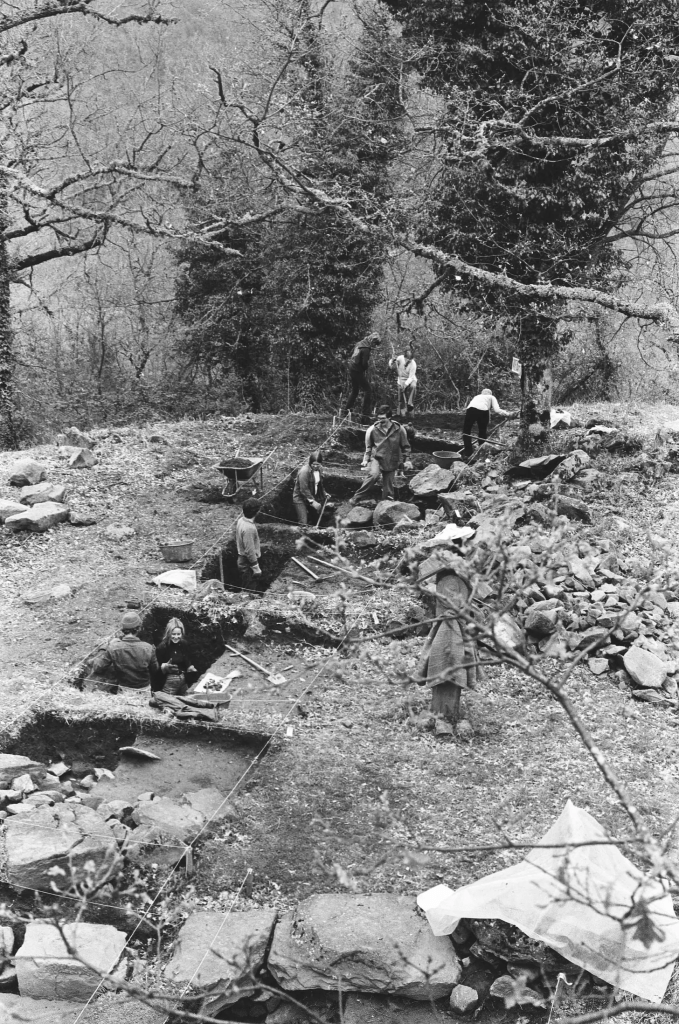
students excavating in the 1976 season
Carrying on now, among what Dr. Ghigi mentioned in that small paragraph, two things stood out to me the most: the date of 1966 and a man called Fred Licht. In order to set the scene chronologically I will approach the date first. 1966 was the year that the FSU Florence study center opened. I can only imagine how exciting it was for the first batch of students to settle in (the cynical part of me wonders if it was just as competitive back then as it is now) to their new home. The first few months must have been so exciting, making new friends, traveling, experiencing the world as a young adult. But things took a historical turn that November. Due to intense weather, the Arno river, one of the most iconic parts of the city, completely flooded and tried to take the city with it. Mud caked the buildings and choked the streets, cars were rendered useless, and most devastatingly of all countless first edition books, manuscripts, and art had sustained water damage.
The students and faculty of FSU were caught right in the middle of this, but rather than pack up and return home they stayed and volunteered with the clean up efforts of the city. They supported locals whose wares were completely damaged from the flood. They washed mud away, even as winter chills began to settle in the air. Judith Appleby, a student at the time remembers, “being in the human chain at the Uffizi and sadly handing so many original manuscripts down the line to the drying racks”. It was because of their efforts that they earned the title of angeli del fango or mud angels.
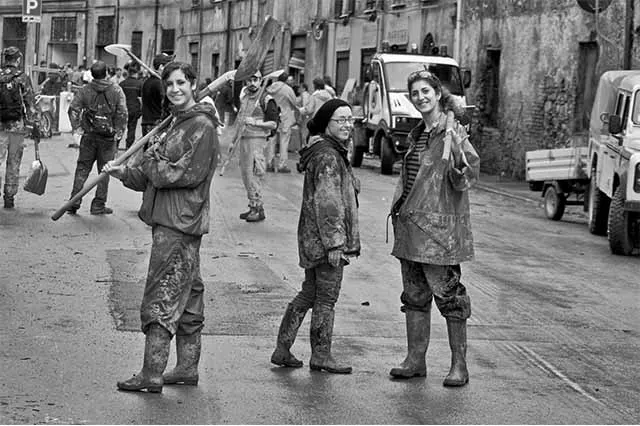
There were many universities that helped with the clean up process besides FSU, many of them American but many from across Europe and Asia as well.
Licht’s Legacy
The students were not the only ones who assisted with the clean up efforts, and countless art historians, conservators, and professionals flocked to Florence to recover the damaged items. Among them was Fred Licht, an art historian who specialized in Goya’s haunting works. He just so happened to be a professor at FSU during the flood and immediately sprung to action. Professor Licht, with one of his colleagues from Brown University, created the Committee to Rescue Italian Art (or CRIA) in order to encourage Americans to support the restoration efforts in Florence. This program began with Licht’s friends and colleagues, but soon grew to include Mrs. John F. Kennedy as their honorary president! This really jumped out at me because it shows the impact of people who move earnestly about things they are passionate about. The impact Licht and his colleagues were able to create made it so countless works would be rescued, not just for their careers as art historians, but for the good of Italy’s national pride.
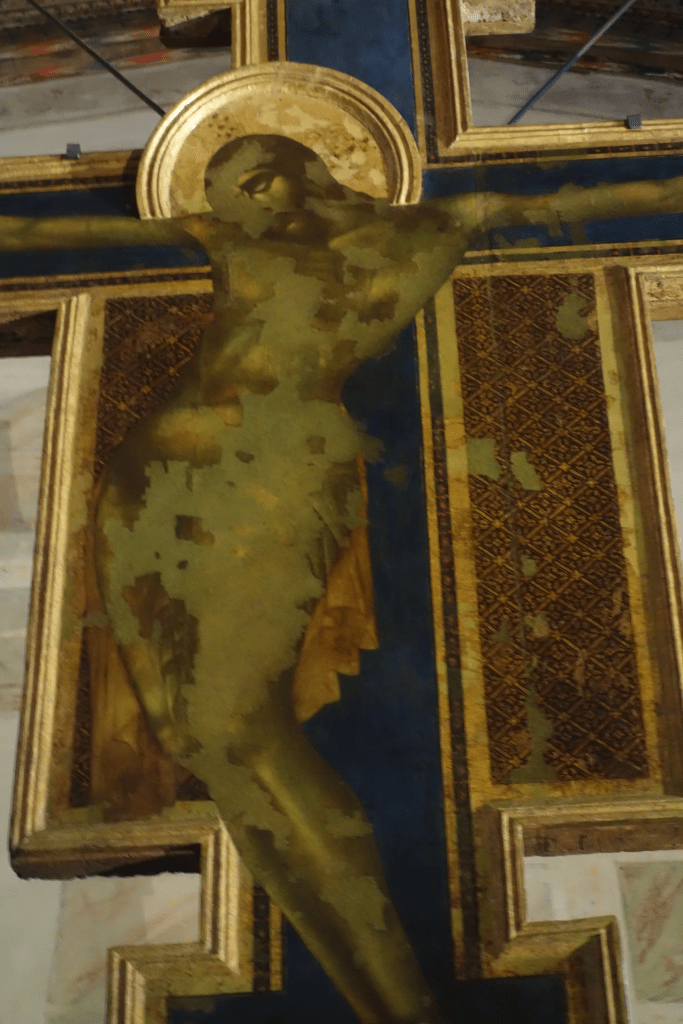
This was a picture I took in the Church of Santa Croce of a crucifix painting that unfortunately was damaged from the flood. I thought it beautiful that they still display it as a testament to Florentine history, both medieval and modern.
Final Thoughts
What stood out to me after I had read through Dr. Ghigi’s work was the full depth of the history I was stepping into by participating in this archaeological program. It blew me away that these normal people, students and faculty alike, just happened to be in a place where their actions generated enormous consequences. This article peeled back more layers of FSU and Florence’s relationship, showing me that this partnership was intense even from the very first months. I found incredibly moving how quickly people volunteered to help, and despite the differences between these two communities, both understood how important it was for these items and city to be saved.
Hopefully I am able to resume my research documentation soon, and I look forward to updating you with my final blog post! Ciao!

