By: Tessa Wiegand
Throughout my time so far on the island of Utila, Honduras, I have began to understand the value of obtaining qualitative research rather than quantitative. As they are very different, each can play different roles in and hold their own value in data collection. With my research, I am able to gather and filter it myself, as oppose to trying to standardize and measure it.
My collection of research consists of both interviews and observations. Throughout this, I have found myself setting aside time to create meaningful questions and organize them in a way that will contribute to the focus and direction of my question. I then have been planning my time accordingly in order to obtain interviews and observations in a way that is authentic and not rushed. These are my ways of taking “active roles” in my research. To me, taking “active roles” means personalizing my research by building connections with my interviewees beforehand and make sure I actively listen and eliminate any uncertainty I have during the interviews. Another way I am taking an active role in my data collection is by physically being a part of some of the conservation efforts. For example, throughout my time in my internship, we have been diving to the coral nurseries and cleaning them once a week. While it is not yet time to plant them, this allows them to continue to grow properly and healthy.
A gap that I have noticed between my personal perspective, the perspectives of the community I’m engaging with, and the theoretical perspectives found in my preliminary research is the difference between a presumed understanding of conservation and what it is like in the real world and experiencing it. Before living on Utila, my knowledge stemmed mostly from reading articles and studying other research that focused on a broad perspective of conservation efforts. While being here, through my interviews, I have realized that everyone’s perspectives and opinions are shaped by their own experiences and roles in their interactions with the community and the marine environment. Some people view it strictly through the environment, while others considers tourism effects and everyday life. Personal perspectives add value that isn’t found in academic literature. Comparing all of these have helped me to see that conservation is much more complex than what is seen from afar. Also, I have recognized that understanding both research and real experiences in the community is necessary to fully explore my research question.
My process for documenting data is setting up interviews with different people who are both taking action in, viewing, or experiencing conservation efforts. I document and notate the interviews by audio recording them so that I can listen back on them and not miss any details or points that I may need or find useful. In addition, I actively take notes during the interviews so that I can reflect at the end on any questions, comments, or misconceptions I may have. To reflect on data, my process involves making sure I don’t leave at the end of my internship with any uncertainty or misunderstanding that I could easily fix while I’m here. To begin organizing my data so it is ready for analysis, I am going to write out important points that I find in each interview and possibly annotate each one as well.
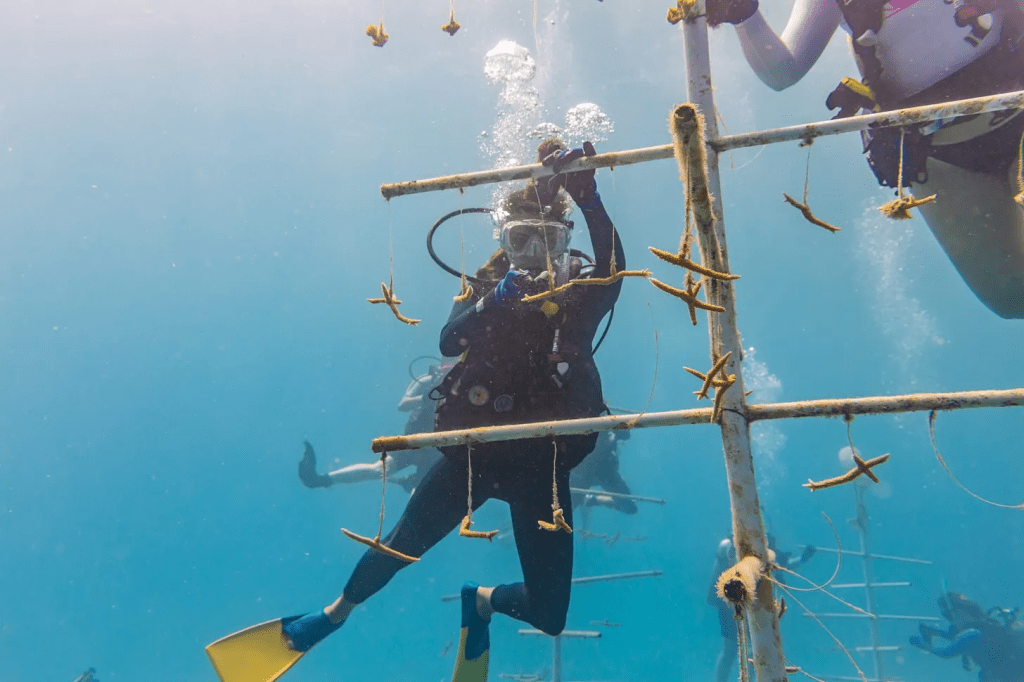
Coral nursery cleaning

