By Janna Lelis, Florida State University
Last Sunday, I landed in Huaraz, Peru to start my volunteering with Seeds of Hope. I landed at the local airport in Huaraz, which is about a 30-40 minute drive from the city center. My seat on the airplane didn’t have a window, so I had no idea what to expect. When I stepped out of the airplane through stairs that directly put you on the runway, I was met with the most stunning view. You could see Huascaran, the tallest mountain in Peru, along with the mountains that create the valley. Huaraz sits between two mountain ranges – Cordillera Blanca to the east and Cordillera Negra to the west. I knew that this officially marked the beginning of my two months in Huaraz.
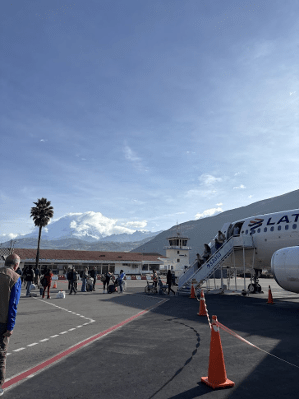
The view from the airport!
What research and professional skills are you eager to use and develop?
In preparation for this project, I conducted literature reviews in order to learn more about the context of multilingual education, TESOL research priorities, and the Peruvian education system. Finding high-quality academic sources, developing strong academic writing skills, and performing data analysis and synthesis are areas that I want to continue improving on throughout this project that will follow me to graduate school and future career opportunities.
As I continue my international volunteer experience, two skills that I am actively developing are flexibility and confidence. Being in Huaraz provides the best Spanish immersion experience because there are relatively few English speakers in the area. I attend ten hours of Spanish class a week and regularly use it around town and in the classroom, which has helped me build my confidence in language abilities. As a teacher, it is important not only to prepare lesson plans, but also to remain flexible because the energy and needs of each class can vary from day to day.
This project consists of qualitative research, which means that its data collection procedures are usually conducted through methods such as interviews, surveys, and focus groups. I’ve come up with a list of interview questions, but I’ve had to narrow down questions that relate to my project, specifically motivation to learn and teach English. Since many of my prospective research participants are primarily Spanish speakers, I will need to remain flexible and adaptive in communicating with them in Spanish, even as I continue developing my own language proficiency.
What resources will you make use of while working on this project (both at FSU and beyond)?
FSU’s CRE (Center for Undergraduate Research and Academic Engagement) and the directors of the IDEA Grant program have been really helpful overall in providing me support for my project and ensuring that I’m on track. I am also grateful to have the support of my mentor, Dr. Carlo Cinaglia, who has helped me brainstorm and organize every stage of this project.
After conducting interviews with my research participants, I will have to transcribe and possibly translate them in order for them to be coded. I have done qualitative coding before, but I am interested in exploring coding softwares such as NVivo, which FSU provides for students.
I hope to present my completed research project at a conference and to continue developing it further to submit to a publication. I think that FSU does a great job at encouraging its scholars to share and promote their research.
How will this project build on your previous experiences/knowledge, and how will it expand your experience/knowledge?
English teaching has become a popular way for people to find opportunities to travel and live abroad. Additionally, as globalization continues to connect the world more than ever before, learning a second language has become increasingly valuable in the job market, making multilingualism both a social and economic investment. Programs such as Fulbright and Peace Corps in the United States encourage its citizens to engage with other cultures to promote cultural diplomacy. Local organizations also benefit from these programs because they depend on volunteers and they directly serve these marginalized people.
I believe this project will help me expand my knowledge in how English learners, particularly in Huaraz, view the value of learning English and how the TESOL field can improve and accommodate their needs. This raises important questions: Is this due to a lack of motivation, limited opportunities for practice, insufficient resources, or ineffective teaching methods? Through this project, I hope to better understand the challenges these learners face and identify ways English instruction can become more accessible and effective for them.
I am also interested in examining how the impact of community service extends beyond students’ participation in the Seeds of Hope program. Several former students who are now attending university continue to volunteer at Seeds of Hope, reflecting the lasting influence the organization has had on their lives. Their continued involvement demonstrates the significance of the program not only as an educational resource, but also as a supportive community that encourages long-term personal growth and service.

