By: Colton Heine
Tourism is a more complex topic than you might think, lets talk about it alongside my research project.
One last blog before I am gone, as this is even being written in between packing, and I wanted to discuss the personal and community impact of what this project entails. Tourism is an interesting topic within itself, as it can be thought of in several manners. For one, there’s the motivation that drives people to travel to certain locations. As found in a 2024 study of South African tourism, researchers Jarè Struwig and Elizabeth A. du Preez note that other than income, factors such as race and travel experience do not impact a person’s chosen destination (Struwig and Preez). The largest purpose of travel comes down to relaxation and notoriety of destination, and several research articles demonstrate the potential dangers of this trend. A great example of this is found in “The Impacts of Tourism Industry on Host Community”, which highlights some pros and cons of the industry as a whole. The main takeaway from this journal is that it comes down to two factors to ensure that tourism is not detrimental to a country or locale, the leadership of a given place, and what this research will be looking into, the tourist themself. If tourism en masse cannot be stopped due to the motivation of relaxation then there needs to be a shift in what people engage with during their travel. There are a whole host of subjects that are widely debated within the lens of tourism, but I will be focusing on one factor within this whole inter-connected web of issues: How local experiences may impact a person’s view on “ethical tourism”.
That whole intro was all to lay the foundation for what this blog post’s actual focus will be, beginning with who is directly involved in this research? The most direct participants will be any employees from the company I’m interning at, as they will give me the qualitative data through the three collection methods: surveys, observation, and interviews. The whole goal is to gather and eventually present their views as they potentially change throughout their time in Rio de Janeiro alongside the local events they participate in. Those events then involve the indirect participants, anyone interacting with the employees/tourists while they are there. It doesn’t matter if it’s a tour guide or local, any interaction is influential in some way. As a result of this research, I hope it can aid someone in thinking about touring in a more beneficial way. Supporting local restaurants and businesses, embracing alongside respecting the culture of wherever you travel to, and avoiding tourist traps and outside companies are some of the vital steps I hope will come across.
My personal connection to this experience in general stems from my love of travel itself, and especially the sense of being able to be more involved in a community and feel less like a tourist in a responsible way. Speaking personally, during the 2020 pandemic, right as things such as travel were beginning to reopen, I had the chance to visit Morocco for two months while it was only open to very few countries and you had to be vaccinated. During that period we were some of the few people there, and we got to fully immerse ourselves in Moroccan culture and scenery. This method of being a positive impact in a community is what I believe all tourists have a duty to fulfill in some manner when visiting foreign places, and it’s what I strive to do whenever I travel somewhere. I believe not enough people think this way, and would even go as far to say certain companies exploit that lack of belief so to say. This research aims to gather what may shift a person’s view to not support the cycle of third party companies and experience the places they travel through local and community means. So many articles I have read paint tourism in a negative light, but that’s not all of them. There is a very real impact tourism has on economies, and that should shift to the individual, community level too. All it requires is administrative reform and personal awareness to make tourism a more beneficial concept, and though I can’t make a direct impact on the former, I can at least contribute to the latter.
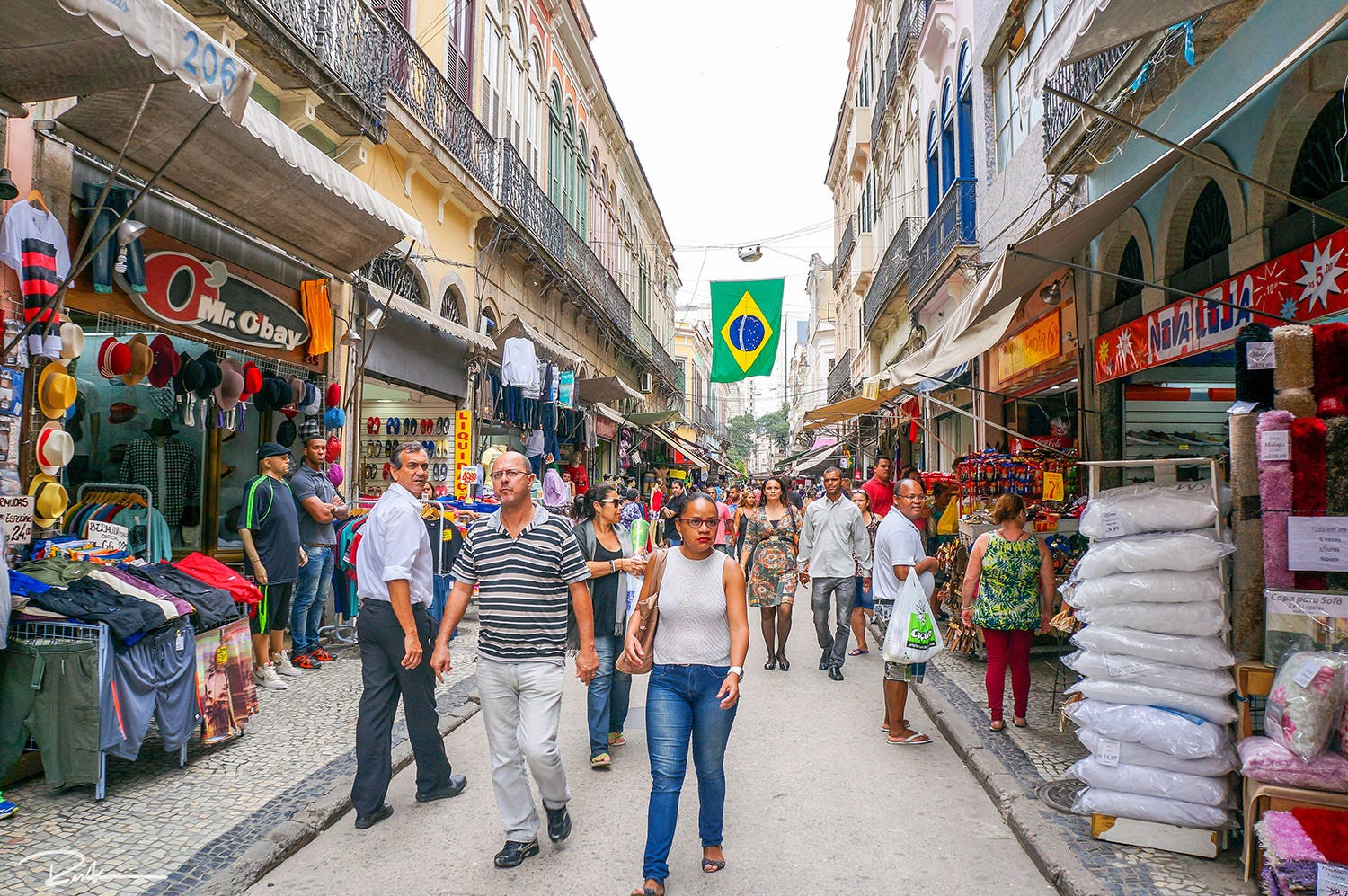
Rua da Alfândega, Rio De Janeiro. A popular local shopping center.
My personal progress so far has been mainly on the side of shadowing and meeting those I will be working with during my time in Rio. Since I have not left yet, I am still at the stage of reaching out to people in Rio through email, but I intend to work more closely with both my co-workers and locals to ensure that I am able to find the most impactful and local engagement opportunities. I believe that I will be involved with many of the people at Kopernik again in the future as I have worked (not in a literal sense as I will be this time) with them before. They all believe in volunteering and engagement as core principles of the office already, so it’s as little as taking that approach abroad to create a meaningful impact.
Citations:
Struwig, Jarè, and Elizabeth A. du Preez. “The Effect of Income on the Relationship between Travel Motives and Destination Choices.” South African Journal of Economic and Management Sciences, vol. 27, no. 1, 2024, p. a5286. AOSIS,https://doi.org/10.4102/sajems.v27i1.5286.
Zaei, Mansour Esmaeil, and Mahin Esmaeil Zaei. “The Impacts of Tourism Industry on Host Community.” European Journal of Hospitality and Tourism Research, vol. 1, no. 2, 2013, pp. 12–21. ResearchGate,https://www.researchgate.net/publication/357736048_The_Impacts_of_Tourism_Industry_on_Host_Community.

