In my research project with Lyons Buckley, I am excited to learn more about Alzheimer’s disease pathology, and the role synaptic stability and plasticity has in resisting key features of Alzheimer’s. Neuroscience is a relatively new subject to me, as I just started taking neuroscience classes as electives in addition to my regular biochemistry coursework this year. I have absolutely loved the subject so far and find the brain fascinating. This project will greatly expand my current knowledge and experience in the lab and with neuroscience-based projects, and I am very excited to delve beyond my normal scope of work. As is commonly said, university is the place to explore your interests, and the chance to work with new people will also be good for my education.

Currently, I believe my greatest weakness lies in my inexperience with grants and the more formal structure of an organized research project. So far in the lab, I have spent most of my time doing wet lab work or occasionally writing protocols and presenting at research conferences, but I have never applied for a grant. While I am unfamiliar with this area of research, I am very willing to step forward and learn the skills needed to succeed. These skills probably include time management and collaborative skills. This project will have a specific time frame to be completed in, and many of the protocols will take weeks of our time, especially when we must differentiate stem cells into CA3 hippocampal neurons.
Luckily, I am very familiar with the protein we will be working with, α-actinin-2, having spent a good portion of the last year purifying its phospho-mimetic variants. I will hopefully get the chance to use my previous experience in the lab and knowledge of α-actinin-2 to our advantage. Other skills in my repertoire include writing and formatting protocols, which I am already putting to good use, and presenting, which will be beneficial when the research showcase rolls around.
To summarize the background information on this project, early synaptic dysfunction and dendritic spine loss lead to the clinical symptoms observed in Alzheimer’s disease and include cognitive decline. Synapse loss correlates very strongly with cognitive impairment, meaning it is important to understand early synaptic pathology. Synaptic loss is linked to soluble amyloid-β (Aβ) oligomers, which affects synaptic signaling and destroys dendritic spine structure. α-actinin-2 is a protein heavily involved in dendritic spine organization and thus has a role in synaptic stability and plasticity.
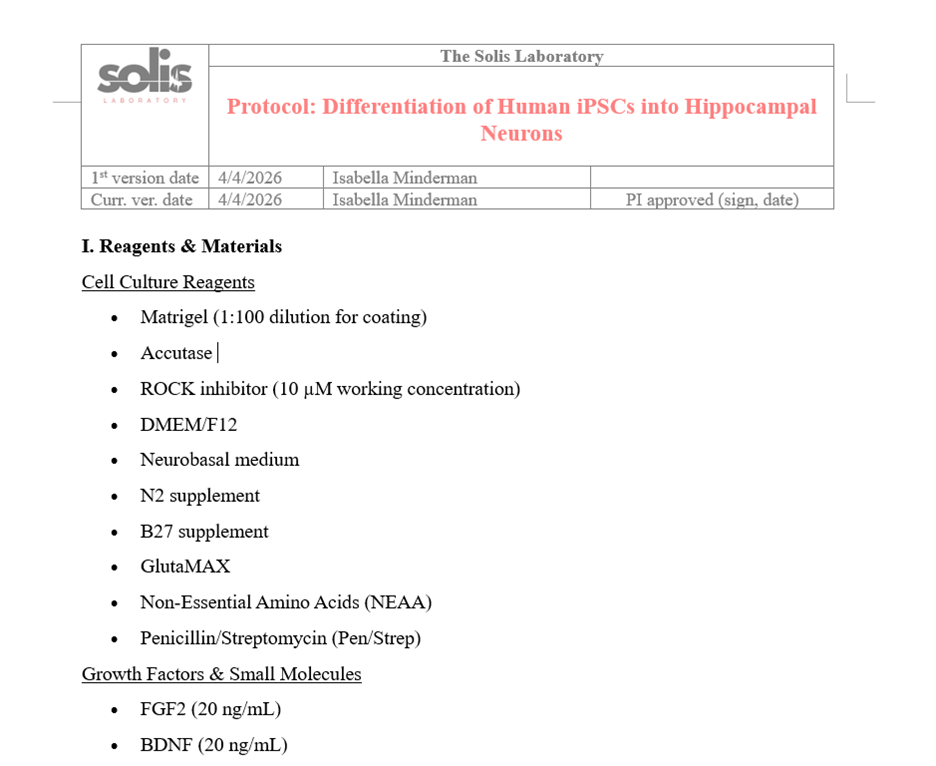
I look forward to the coming months! Attached is a photo of a protocol I have been working on in preparation for stem cell differentiation.
At the end of this project, I hope we will have successfully differentiated stem cells into CA3 hippocampal neurons, successfully treated those cells with Aβ oligomers (a key feature of Alzheimer’s disease), and gathered enough data to be able to broadly discuss how Alzheimer’s pathology affects synaptic stability and resilience. This IDEA Grant project done in the summer will precede another project in the fall, where I will test how phospho-regulation can act as a protective cytoskeletal mechanism in human hippocampal neurons during early Alzheimer’s disease. It is then that I will put skills learned during this IDEA Grant to good use, as I will need to learn from multiple professors and graduate students, defend my honor’s thesis, and have to build upon the base of knowledge this project should present.

