By: Danny Faust, University of Missouri Kansas
My name is Danny Faust and I’m incredibly excited to be a Tyler Center Fellow. I’m originally from St. Louis, Missouri, but moved to Kansas City, Missouri to attend the University of Missouri Kansas City (UMKC) to study political science. I am on track to graduate Fall of 2026 with a BS in Mathematics and Statistics and a BA in a Political Science. I’m deeply fascinated by all things political, geographic, historical, and fantastical. I have research interests in ethnic and civil conflict, elections and electoral politics, and American-Canadian political development. I’ve had the great privilege to conduct research alongside two professors at UMKC: Dr. Beth Vonnahme and Dr. Greg Vonnahme. This research has focused on topics within American politics, namely rogue political candidates, elected officials in the Kansas City metro area, and the ongoing Myanmar Civil War.
Outside of academics, I am an avid fantasy enjoyer with special love for the Lord of the Rings and the world of Middle Earth. Complementing this interest in Lord of the Rings is my passion for drawing maps. A hobby I developed in middle school, it is a relaxing way to meld my love of fantasy with politics and geography.
When I’m not at school, I can often be found occupied by one of my three cats: Miko, Randall, and Weston. After graduation, I hope to pursue graduation studies in political science as well as pursue research opportunities in my previously stated interests of elections, civil conflict, and Canada.



From Top to Bottom: Miko, Randall, Weston
My project focuses on English-language physical election material related to the upcoming Quebec provincial election. This project aims to focus solely on election media related to American political themes, American political figures, and American-Canadian relations utilizing a mixed methods content analysis focused on how Quebec political parties and their representatives leverage American politics to garner domestic support. Simultaneously, this project seeks to compare and contrast Montreal and Quebec City with one another as well as their areas of high single party affiliation.
For this project, I will be employing a scoring system intended to highlight how the various political parties wield American talking points in their English-language messaging. The fieldwork component of this project will see me explore both Montreal and Quebec City taking pictures of physical election media like pamphlets, brochures, signs, billboards, newspaper ads in various parts of Montreal and Quebec City. Upon return to the United States, the content analysis portion of this project will begin where I’ll dig in deep into how Quebecois politicians, political parties, and political actors are utilizing American themes in their domestic messaging.

Flag of Canada
My first exposure to Canadian politics was through YouTube where I’d listen to various Canadian YouTubers discuss politics, mainly American on their channels. Every so often, these channels would delve into topics on Canadian political culture and political events. I’m not sure what exactly interested me about Canada, but years later, I grow more fascinated with the subject daily. Now, I get to take this fascination and yearning to learn to Canada.
At present, I will be departing the United States on September 24th for Montreal. I will then immediately hop on a bus to Quebec City where I’ll spend the first five days of this project. Then, on September 29th, I’ll take a similar bus from Quebec City to Montreal where I’ll conduct a similar analysis from my base camp in Quebec’s largest city. This will conclude on October 6th, the day after the provincial election wraps up and when I’ll board a plane back to the States and the hard work will begin!
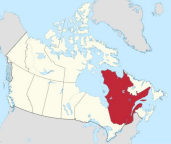
Map of Quebec
The value of research abroad is immense for my own personal and professional ambitions as well as for broadening the niche, but growing field of American-Canadian political research. I’m immensely excited to do research abroad, both given the content of the excursion and the ability to do so during undergrad. This project would not be anywhere near the same without the fieldwork component. I’m going to be hands-on, experiencing the Quebec provincial political system in a time of great political stakes. This is a once in a life opportunity and I cannot wait to touchdown in Canada.
Flag of Quebec
As previously mentioned, I cannot contain my enthusiasm to go abroad. The chance to broaden political science scholarship on a topic that fascinates me in a place that intrigues me. Being able to conduct this research in a manner that lends credibility to my research ability and hopefully provide reassurance and fulfillment for the four years of undergrad that are soon coming to a close. I have a number of hypotheses for what I expect to find, best summed up as progressive and liberal Quebecois will almost certainly utilize the divisiveness of the current American administration to push their domestic agenda forward. As for conservative and Quebec sovereigntists, that angle becomes a bit murkier and something I look forward to seeing in-person.
I have worries about the potential lack of physical electoral media. In this digital era of ours, so much messaging now takes place both in traditional digital media and in the various new media information streams. Certainly a dearth of physical media would provide discouragement, but hopefully other avenues would present themselves if that be the case. Engaging in the everyday life of a resident of Quebec City or Montreal is how I plan to best spend my time in Canada. Where would an office worker most expect to see election media? In the various metro stations they might wait at and near the coffee shops they may frequent. Thinking like a resident and like a political strategist is how I plan to best utilize my limited time in Canada. I can’t wait to get started and show my fellow Tyler Center fellows what it’s like in Quebec this Fall!

