By: Isabel Ball, University of Missouri–Kansas City
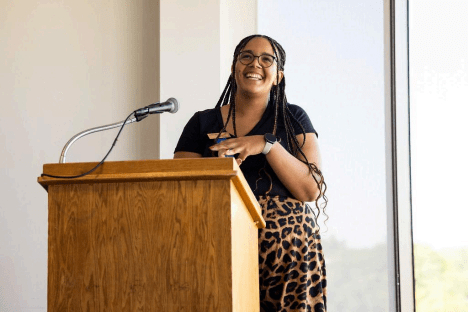
Hey everyone!
My name is Isabel Ball, and I just finished my first year pursuing a Bachelor of Music Education at the University of Missouri–Kansas City (UMKC) Conservatory. I’m originally from Missouri, and if there’s one thing you should know about me, it’s that I love music and I love teaching. Those two passions are what led me to music education and continue to shape just about everything I do.
When I’m not in rehearsal, practicing, or studying, I enjoy spending time with friends and family, traveling, and exploring new places. I also love dragging my younger sister along on shopping trips. She absolutely hates it, which somehow makes it even more entertaining for me. I’m also a big believer that life is more fun when you say yes to new experiences, which is probably how I ended up moving across the world for the summer.
As I’m writing this, I’ve already begun my journey abroad. For the next eight weeks, I’ll be living in Florence, Italy, where I’m completing a global internship through AIFS. I’m working with a local company called Labsitters, whose mission is to help students develop practical English language skills. English is taught throughout much of Italy’s school system, but many students don’t have regular opportunities to use it in real conversations. Through my internship, I get to work directly with students while learning what education looks like in a completely different cultural context.
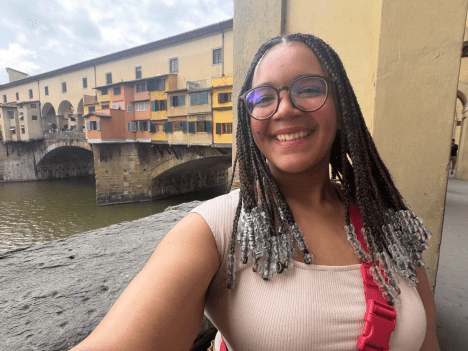
Picture taken along the Arno River near the Uffizi gallery while I was exploring my new home!
Alongside my internship, I’ll also be conducting an international research project examining how musical canon is represented in live classical performances in Florence, Italy, and Kansas City, Missouri.
Now, if you’re not a music major, the word “canon” might sound like something that belongs on a pirate ship. In music, however, canon refers to the composers and works that have become widely recognized as the most important, influential, and frequently performed. Think names like Bach, Beethoven, and Mozart. My research asks a simple question: Why are some composers still performed constantly hundreds of years after their deaths, and does that look different depending on where you are in the world?
To answer that question, I’ll be attending a variety of live performances, including orchestral concerts, chamber music performances, and solo recitals. I’ll document things like the repertoire being performed, the ages of the composers represented, and information about the performers and conductors. Later this fall, I’ll collect the same information from performances in Kansas City and compare the two sets of data.
I became interested in this topic because I’ve always loved the stories behind the music. As musicians, we spend countless hours learning notes, rhythms, and techniques, but I’m often just as interested in the bigger picture. Why did this piece survive while others disappeared? Why do certain composers show up on almost every concert program? Who decides what becomes “important” music? The more I thought about these questions, the more curious I became.
Florence felt like the perfect place to explore them. The city is deeply connected to the history of Western art and music, and simply walking through the streets is a reminder of how much history surrounds you. What has surprised me most, however, is how present music still feels in everyday life. Within my first few days in the city center, I came across multiple live performances while simply walking around. Now, these very well may have been aimed at tourists, but they were still fascinating to encounter. At one point, I stopped to listen to a musician playing “Hallelujah” on a stringed instrument, and just a short walk away, another performer was singing an aria from Carmen. Whether intended for tourists or locals, these performances demonstrated how music continues to be woven into the city’s cultural atmosphere. Kansas City, on the other hand, has a vibrant and active arts scene but developed in a very different cultural environment. Comparing the two offers a unique opportunity to examine whether musical canon is shaped primarily by local history or whether classical music has become a more globalized tradition.
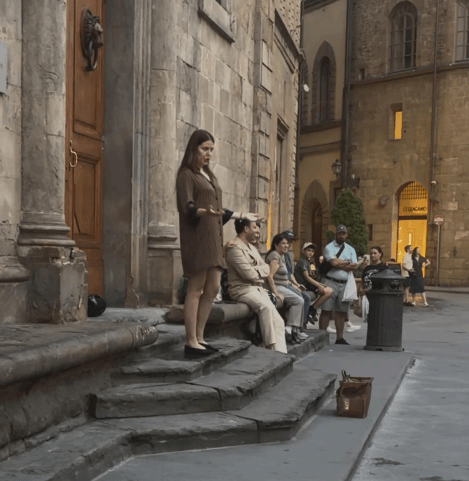
Woman performing aria from Carmen
One of the reasons I’m especially excited about this project is that it combines so many of my interests. It allows me to explore research, music, education, and international experiences all at once. As a future middle school band director, I think it’s important to understand not only what music we teach, but also why we teach it. The repertoire we choose shapes students’ understanding of music history, culture, and whose voices are represented. I hope this project helps me become more thoughtful and intentional in those decisions.
Looking further ahead, this project is also helping me explore possible future academic paths. While I know I want to spend the beginning of my career in the classroom, I’m still figuring out
whether I might eventually pursue graduate study in musicology, music administration, educational leadership, or something else entirely. Research gives me the chance to test those interests in a real-world setting and learn more about the kinds of questions I enjoy investigating.
As excited as I am, I’d be lying if I said I wasn’t a little nervous. Living abroad for the first time, navigating a different language, balancing an internship with research, and figuring out Italian grocery stores have all been adventures so far. (Why are there so many types of pasta? And why do all of them somehow taste better than what I buy at home?)
Still, I’m looking forward to learning as much as possible over the next two months. I’m excited to experience Italian culture, attend incredible performances, meet new people, and hopefully come away with a deeper understanding of how music connects communities across different parts of the world. More than anything, I hope this experience helps me grow as a teacher, musician, researcher, and person.
I’m incredibly grateful to the Tyler Center for Global Studies for making this opportunity possible, and I’m excited to share more about my research and experiences throughout the summer. Thanks for following along on my journey!

