By: Maya Parfitt, William & Mary
Hi, my name is Maya Parfitt, and I study ancient Mediterranean archaeology and religion at William & Mary. I’m so grateful to the Tyler Center for giving me another fellowship – last year, I got the opportunity to do archaeological fieldwork in Greece with the Naxos Quarry Project (NQP) and also explore my own interest in the people who worked in Naxos’ ancient marble quarries (who you can learn about here). This summer, I have a wider focus – I’ll be conducting research on ancient Greek craftspeople and their religious practices for an honors thesis I plan to write during the upcoming academic year.
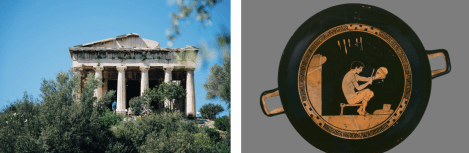
Left: Temple of Hephaestus, god of metallurgy, in the Athenian Agora. Right: Drinking cup with a painted scene of a helmet-maker.
Usually, the first thing we wonder when faced with a historical artifact is the function that it served, whether practical or symbolic. It typically takes more thinking to consider their broader, and ostensibly less immediate, connections. One of these connections is between the artifact and the artisan who made it – from a stonecarver, to a potter, metalsmith, or carpenter. During the last decade or so, there’s been rising scholarly interest in the people who crafted the objects that archaeologists discover and museum-goers get to see on display. This is an exciting shift, because Greek artists are generally less studied in comparison to their creations. There have already been investigations into their social standing, economic power, methods of creation, and community formation, but it’s the religious beliefs and ritual practices specific to their livelihoods that are of particular interest to me. How was ritual connected to the act of creation in different mediums? What practices did craftspeople engage in, and why? This topic is relatively underexplored, but it can give deep insight into the day-to-day lives and self-conceptions of Aegean artisans – a majority of whom were non-elite.
Another thing to note is that dominant approaches to ancient Greek religion assume that the city-state provided the framework for all practice. But many scholars have expressed that this can detract from our understanding of personal religious experience and expression, which is not always connected to the civic sphere. “Craftspeople” as a category encompasses a wide range of skills and specialties, almost entirely dependent on the material that an individual
worked with. Corinthian potters worshipped the god Poseidon because his earthquakes could reveal new clay beds to utilize. Naxian quarry workers sought protection from Otus and Ephialtes – twin giants known for moving mountains – because extracting and transporting heavy marble was life-threatening. An Athenian bronzesmith created a curse tablet to jinx his competitors in the trade. Such specificity does not fit neatly into the traditional city-state model.
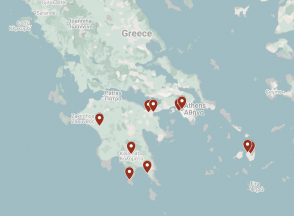
Pinned sites on my research map!
With all of this in mind, I’ll be spending six weeks in Greece – traveling to Naxos, Athens, Corinth, Sparta, and Olympia – to collect evidence for my thesis. My goal is to create two databases of primary and secondary sources that I can analyze during the summer and draw on throughout my writing stage. This will involve detailed documentation of archaeological sites and artifacts in museum collections, and gathering literature at the Blegen Library at the American School of Classical Studies. My return to Naxos also means that I’ll be joining NQP for another season of archaeological fieldwork, which will help to reinforce my investigation skills before going solo. I’m writing this just a few days before my departure, both eager and nervous – I’ve never taken on a project quite as big as this before, but I know that the process will be worthwhile. One of my favorite things about archaeology is that it puts you in a unique position to connect with people who are long gone. In my case, I have an opportunity to interact with humans from over a thousand years ago, to try and understand what they felt and what they experienced. How special is that?
I look forward to writing my next update – until then, χαῖρε (be well)!

