By: Na’Riyah Mckinney
I did not choose this topic, this topic chose me. The way things tend to choose you when they have been sitting in your chest for long enough that ignoring them starts to feel irresponsible.
My grandfather heavily influenced the way I understand the world. And one of the most significant things he gave me was the habit of questioning. Not in a rebellious way. In a curious way. He would look at something, a rule, a system, an outcome, and instead of shrugging, he would ask why. He passed that directly to me. I did not realize until much later how rare and how powerful that gift actually was.
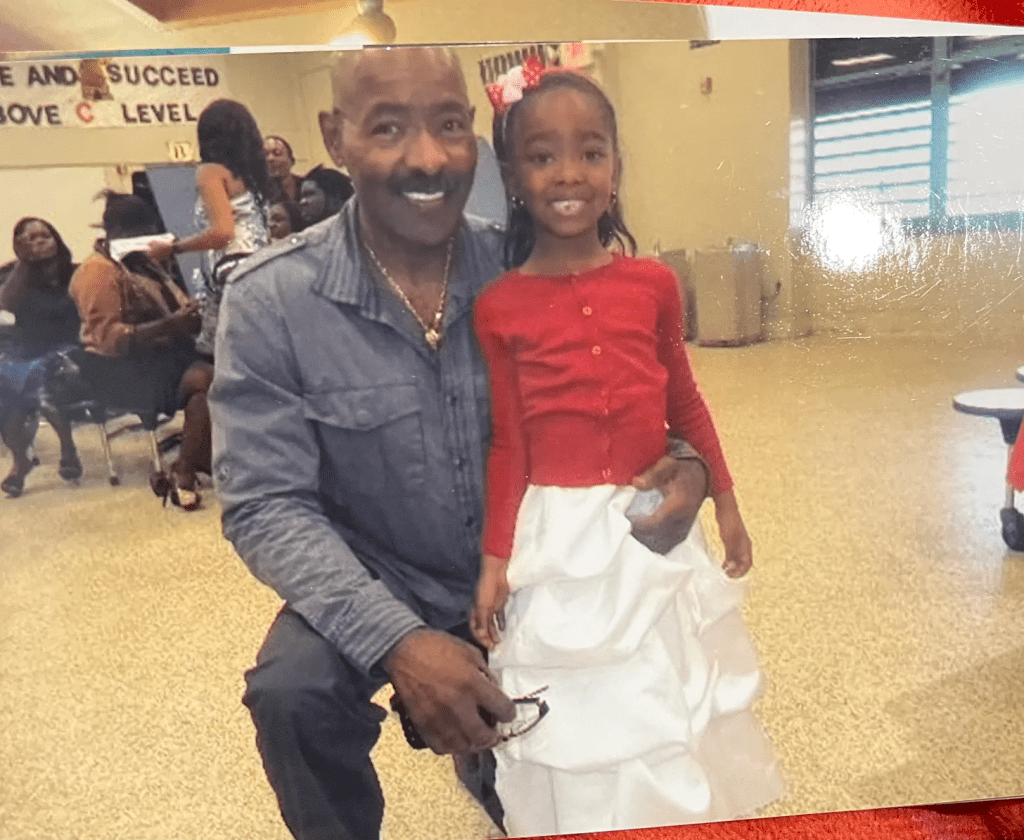
That questioning needed somewhere to go. It found speech and debate.
If my grandfather handed me the instinct, speech and debate handed me the framework. Suddenly I was not just asking why in my head; I was researching it, building arguments around it, standing in front of rooms and making the case that political decisions and social outcomes were not coincidences. They were connected. The things I had watched my family navigate — they had histories. They had legislation attached to them, and once I understood that, It was embedded in me.
That is the moment I fell in love with research. Not research as an academic exercise, but research as a form of accountability. A way of following the paper trail back to the source.
That love led me, eventually, to The Women’s Fund Miami-Dade, where I currently serve as an Advocacy Intern and where I will be spending this summer conducting the research at the heart of my Capstone project. The Women’s Fund is a nonprofit organization that advances gender equity through policy research, community engagement, and legislative advocacy in Miami-Dade. When I say this placement feels like the right room at the right time, I mean it completely. This organization operates at the exact intersection of everything I have been working toward: race, gender, policy, and community. Being embedded here is not just a professional opportunity. It is a continuation of a conversation I have been having my whole life.
My Capstone research centers on something I felt long before I could articulate it: the indirect effects of broad policies and laws on Black women, from the Progressive Era to the present day. The core of the argument is — a law does not have to say your name to hurt you. Structural racism, the web of policies, institutional practices, and embedded norms that collectively produce and sustain racial inequality, does not always announce itself. It works through omission. Through exclusion. Through the patient accumulation of decisions made in rooms that certain people were never invited into.
The Progressive Era labor reforms that carved out domestic workers from federal protections. The New Deal legislation that bypassed agricultural laborers at the precise moment Black women were concentrated in both of those categories. The maternal mortality crisis that today kills Black mothers at rates two to three times higher than those of white women. Not because of biology, but because of a healthcare system shaped by a century of exclusionary policy. None of these laws said Black women out loud. But they did not have to.
I saw the consequences of this before I ever read about it in an academic text. I saw it in the lives of the people my grandfather raised me alongside. I saw it in my own family. I am investigating it now because I believe that tracing the mechanism of harm is the first step toward dismantling it and because someone has to be willing to draw the line from then to now.
To carry out this inquiry, I will conduct semi-structured interviews with policy advocates, social workers, and academic researchers, alongside deep analysis of historical and contemporary policy documents. I am going into this with open hands and specific questions. I want to sit across from people who work inside these systems every day and ask them to name what the data cannot always capture; the gap between what a policy promises and what a community actually receives.
I am excited in a way that feels grounded rather than naive. I know this work is heavy. Researching ongoing harm as a member of the community being harmed is not a neutral position, and I am not pretending it is. But I also know that I am not the first Black woman to walk into a difficult room and decide to stay anyway. I come from a long line of women who did exactly that with far fewer resources and far less institutional support than I have. That is not lost on me.
Miami is a city I am entering with full attention. It is electric and complicated and unequal in ways that mirror the very dynamics my research is trying to understand. I plan to show up to this community the same way my grandfather taught me to show up to everything; with my eyes open, my assumptions checked, and a genuine desire to learn more than I teach.
I am not arriving as someone with answers. I am arriving as someone with good questions, a solid foundation, and the patience to follow the evidence wherever it leads. That is what global scholarship means to me. Not the performance of curiosity, but the real thing. The kind that started in a living room with a grandfather who refused to stop asking why.