By Sophie Works, Florida State University
Hi everyone! My name is Sophie Works, and I am a third-year honors student pursuing a dual degree in Russian (Slavic) Studies and International Affairs with minors in English and Museum Studies. I’m a member of the Honors, Scholars, and Fellows House Undergraduate Research Advisory Board, FSU Libraries Digital Research Incubator 2025-2026 cohort, and alumni of the Global Scholars 2025 Cohort. I’m also an FSU Student Star as well as the recipient of the Winthrop-King Russian Summer Scholarship 2026 award, Bess H. Honors Thesis and Conference Presenter award, and Edna Ranck International Study 2025 award. I’m from Tampa, Florida, and thanks to the generosity of the Tyler Center for Global Studies, I’ll be returning as a repeat Tyler Fellow awardee to conduct research on Russian Orthodox iconography in Tallinn, Estonia.
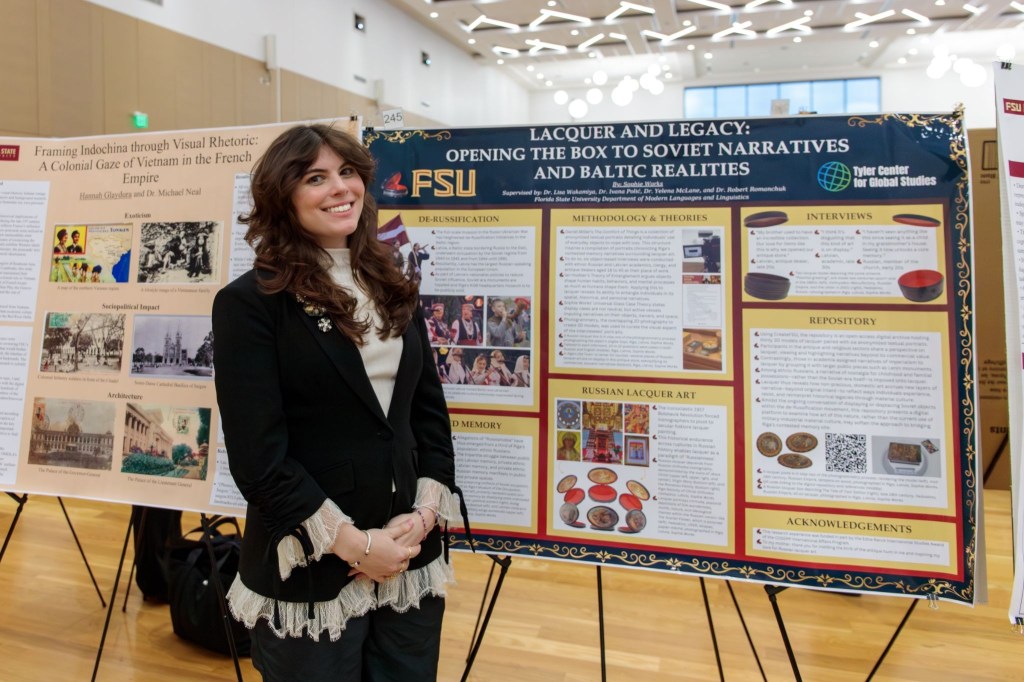
Sophie Works presenting her 2025 Tyler Fellowship and Honors in the Major research poster at the 2026 Undergraduate Research Symposium, photograph by Noelle Enright
My project, which serves as my second Honors in the Major Thesis, focuses on Orthodox communities in Tallinn, Estonia. In Tallinn—where most Orthodox spaces lack sustained, accessible ethnographic or digital documentation—my project will record multi-scene icons actively displayed and revered by local communities, with special attention to their spatial placement and role within everyday liturgical life. In the wake of the 2024 schism of the Estonian Orthodox Church from the Moscow Patriarchate in response to Russia’s full-scale invasion of Ukraine, Orthodox communities in Estonia are navigating a period of institutional and devotional reorientation. Yet, scholarship on Orthodox icons has remained largely focused on historical production rather than contemporary practice, particularly in the Baltic region.
By examining why certain icons, especially multi-scene icons, are emphasized, repeatedly venerated, or spatially privileged, this study investigates how communal needs intersect with ancient compositional logics to produce devotional hierarchies at a moment of transition. To do so, I will conduct interviews which will ask clergy and parishioners how they identify their community’s spiritual needs and how particular icons are understood to respond to those needs through their imagery, placement, and patterns of use. The project then develops a digital, museum-style catalogue that integrates this multi-scene compositional logic with contemporary devotional testimony, tracing the trajectories of these icons from Byzantine inspiration, to creation, to circulation, and to present-day use. An example of a multi-scene Russian icon is below.
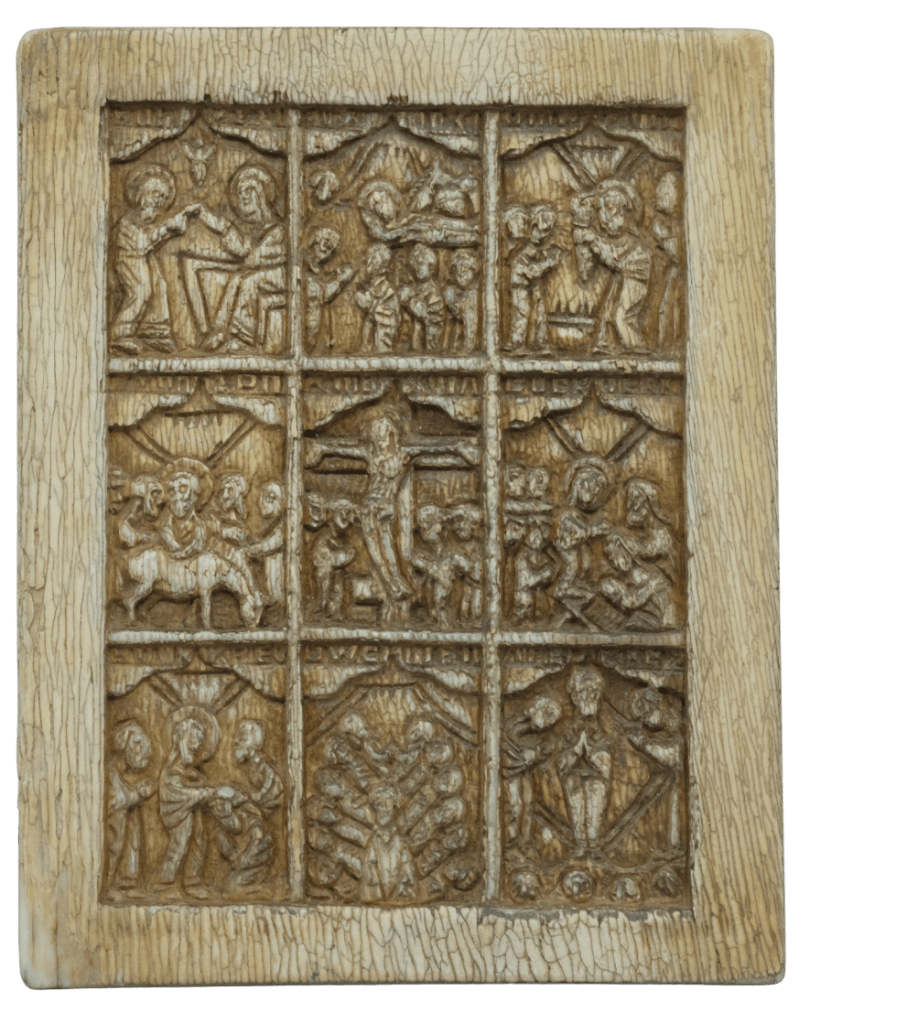
Unknown artist, Nine Church Feasts, 16-17th centuries. Icon, horsebone carving. Russian Empire. Blick-Harris Study Collection, Kenyon College, Gambier, Ohio.
Multi-scene icons—often small, credit-card-sized grid-like compositions that condense Old and New Testament narratives into a single visual field—generate meaning through careful selection, hierarchy, and arrangement rather than scale. Although the format originated in Byzantium, its expanded use in Russia reflects later theological, monasteric, and liturgical shifts in Orthodox devotion which redirected devotional attention toward images as mediators of sacred presence. By the late sixteenth century, the visual logic of the iconostasis, a floor-to-ceiling wall of icons that line the back of Orthodox cathedrals, was increasingly condensed into portable icons, producing compositions shaped by monasteries, patrons, and artists for personal use. For reference, an iconostasis from my previous Tyler Fellow project on Russian lacquer art in Riga, Latvia is pictured below.
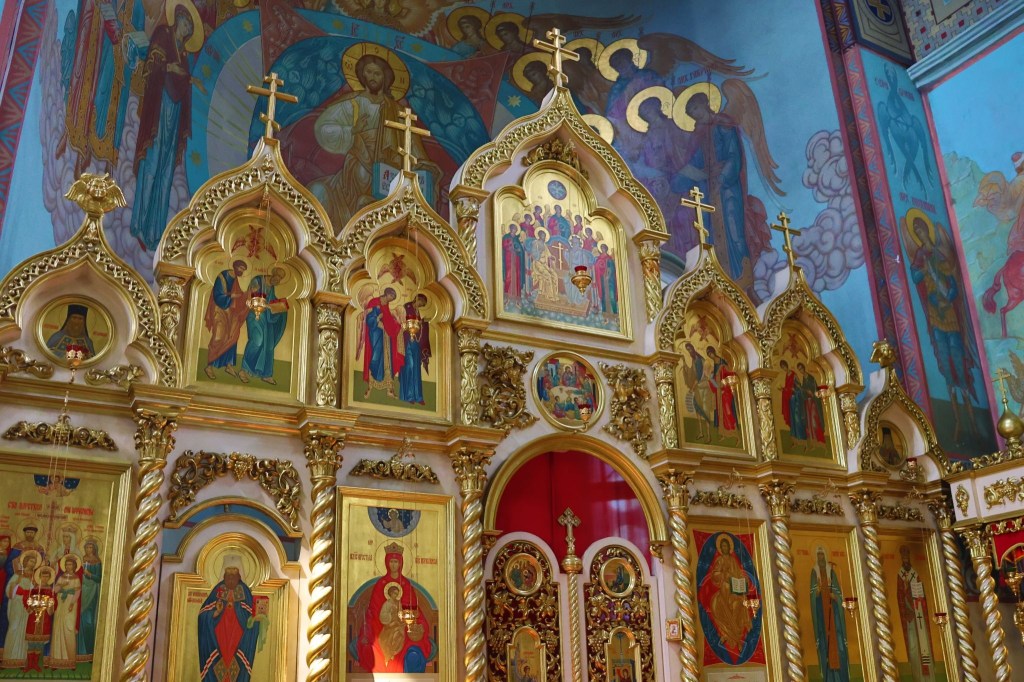
Iconostasis, built from 1876 to 1883. Gold, egg tempera on panel. Nativity of Christ Cathedral, Riga, Latvia. Photograph by Sophie Works, Riga, Latvia.
To carry out this project, I will combine ethnography, object-based interviews, photographic documentation, and compositional analysis of similar icons (i.e comparanda). An example of comparanda is pictured below.
For this methodology, I will be concurrently enrolled in American Councils’ Advanced Russian Language & Area Studies Program (RLASP) for eight weeks at Tallinn University. So, in combining my Russian language acquisition with my investigation into multi-scene icons, I will have two months worth of immersion in Tallinn to understand the devotional practices surrounding icons in the region.
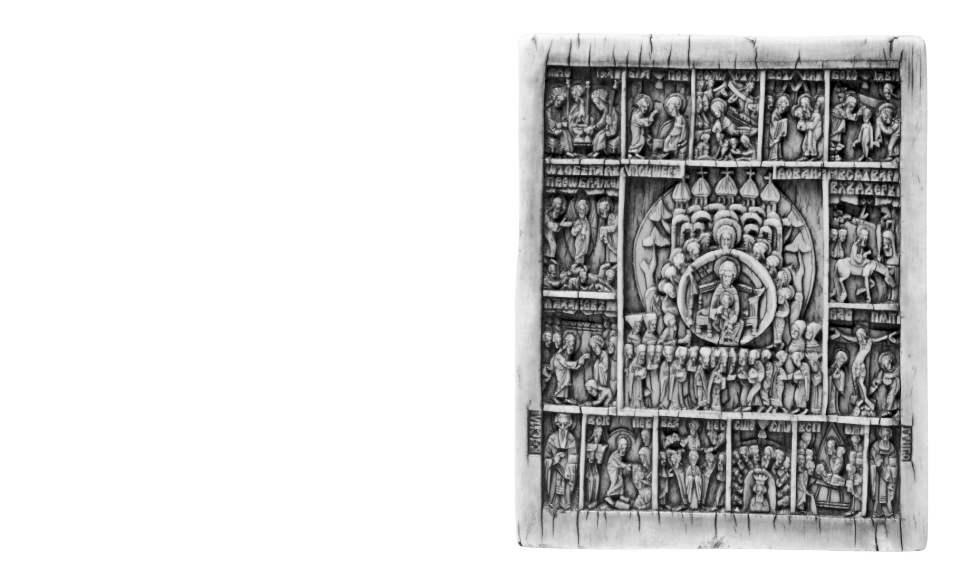
Unknown sculptor, Afonasii Isakov (patron), “In Thee Rejoices,” Feast, Scenes, and Saints, 17th century. Icon, ivory carving. Russian Empire. Walter’s Online Collection, Walter’s Art Museum, Baltimore, Maryland.
The analytical foundation for this study is a research paper that will be completed in my Spring 2026 graduate Byzantium course. The paper establishes the compositional logic of sixteenth- and seventeenth-century Russian multi-scene icons as an evolution of post-Byzantine frameworks. In doing so, the paper utilizes The ‘Painter’s Manual’ Dionysius of Fourna, written in 1909 by Greek monk Dionysius of Fourna and translated by Paul Hetherington. The Painter’s Manual is used widely by Russian iconographers to know what should and should not be included in the depiction of a particular scene. With this in mind, the manual acts as a helpful visual guide for identifying scenes, their figures, objects, and highlighting what is and is not present.
By the end of this project, I aim to better the digital documentation of icons and their devotional Orthodox communities in Tallinn. Additionally, there is little literature on Russian iconographic ivory and bone carving practices, especially in English. So, both my digital catalogue and thesis will help fill this gap.
Long-term, I plan to earn a Ph.D. in Russian and Slavic Studies to challenge institutionalized scholarly and commercial narratives by curating accessible collections of slavic material culture and its stories. I intend to preserve and investigate the trajectory of these objects and their narratives to inspire emotional connections through the material plane. Thank you very much for reading, and I will see you in the next blog post.

