Hello everyone! This is Hayley Schermer again with an update on the research project I’m conducting with Ella Vizzini, focused on how exercise influences sleep patterns and menopausal symptoms in postmenopausal women.
While we haven’t begun collecting data just yet, there’s been a lot of exciting progress behind the scenes. Over the past few weeks, we’ve been ordering materials we’ll need for the study—like OURA rings and saliva collection kits. To ensure a proper fit for the OURA rings, our lab’s primary recruitment representative took the time to measure ring sizes while women were being evaluated for eligibility for the main study we’re branching off of.

We also received some great news: one of our two IRB submissions has officially been approved! That approval allows us to begin recruiting participants who are already involved in the main study at the research lab I assist in. We’re still waiting on approval for a second IRB application, which would allow us to recruit additional participants who may not qualify for the metabolic study but still meet the criteria for ours. Hopefully, this will expand our reach and give us a more diverse group of postmenopausal women to work with.
As we get closer to the start of data collection, I find myself growing more excited about the next steps. One of the techniques we’ll be using for hormone analysis is an ELISA, or Enzyme-Linked Immunosorbent Assay. I’ve heard about ELISA tests before, but I’ve never had the chance to run one myself. This hands-on experience will be completely new to me, and I’m really looking forward to learning how it works.
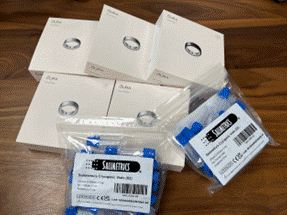
I’m also eager to dive deeper into the capabilities of the OURA ring. We plan to focus primarily on the data it provides related to sleep stages—how long someone spends in light, deep, and REM sleep—but the ring tracks so much more, including heart rate, energy expenditure, and body temperature. While we haven’t finalized whether we’ll analyze all those metrics, it’s exciting to know that the data is there if we want to explore further.
This study is particularly meaningful to me because it builds on the population I’ve already spent time working with—postmenopausal women. I’ve learned a lot from assisting in our lab’s main study, but this project gives me the chance to deepen my understanding of menopause. Through surveys and direct interaction with participants, I hope to learn more about what menopausal women are truly experiencing, especially regarding sleep quality and how movement might play a role in improving it.
Right now, we’re still in the early phases, but we’re laying the groundwork for what I believe will be a smooth and meaningful study. We plan to study 10 women, and since we only have five OURA rings, we’ll need to be strategic about scheduling and sharing materials. Ella and I anticipate some overlap in participant timing, so we’re already thinking ahead about how to stay organized and efficient. Creating a clear schedule once recruitment begins will help ensure that equipment is available when needed and that everything runs as smoothly as possible.
Thanks for reading! More to come soon.
-Hayley Schermer
 HSF House Blogs