Hello everyone!
My name is Hayley Schermer, and I am a junior at Florida State University. I am a cell and molecular neuroscience major on the pre-health track with hopes of attending medical school after I finish my undergraduate career. My research partner, Ella Vizzini, and I have recently been given the great privilege of conducting research on menopause through the IDEA Grant Program and the Dezso and Fanny Julius Scholars Fund.

Menopause is a time during which a woman’s hormones change significantly. Estrogen and progesterone are the primary hormones produced by a woman’s reproductive system throughout their lifetime, at least until this period of their life. During menopause, the body stops producing estrogen and progesterone at such high levels, as they age and their fertile window closes. Menopause is commonly associated with symptoms such as depression, anxiety, hot flashes, and poor sleep. My research partner and I were interested to see if exercise can reduce these menopausal symptoms and promote better sleep. Research on exercise has been found to have improved sleep in other populations, so we wish to analyze the effects on a population notoriously known for sleep issues.
This upcoming Summer, Ella and I will be gathering data on ten postmenopausal women over the course of six weeks to determine how both sleep quality and menopausal symptoms change in response to a four-week exercise program.
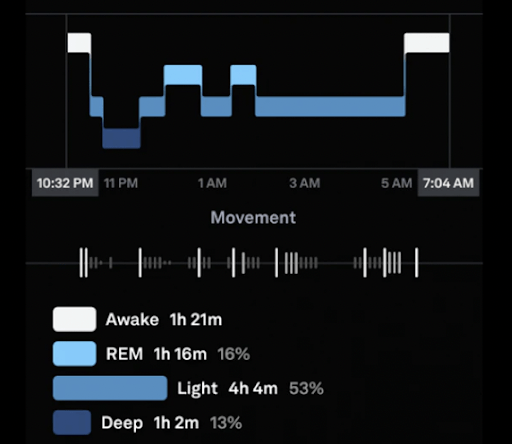
To analyze changes in sleep quality after the exercise program, participants will be completing the Pittsburgh Sleep Quality Index (PSQI), providing saliva samples before and after the program, as well as wearing an OURA ring throughout the entirety of the six-week study. The saliva samples will allow us to measure their levels of both cortisol and melatonin, which are extremely important hormones in regulating circadian rhythm. Cortisol and melatonin within our bodies fluctuate throughout the day, making us feel more awake or more tired (Figure 1). Additionally, the OURA Rings will give us information about their sleeping patterns throughout the night, including how long they were in each stage of sleep and other information that could be related to sleep quality, such as heart rate and temperature (Figure 2).

My partner and I are extremely excited to start our project soon, beginning with the recruitment of our ten participants! Afterwards, we will start with collecting their baseline sleep data, hormone levels, and surveys to get a starting point to compare our final results to at the end of the study. We believe that this research has great potential to help women across the world reduce the negative symptoms associated with aging and menopause. We are eager to share our findings with the community in an effort for individuals facing these symptoms to know of ways to reduce them. I am also personally, extremely excited to share what we find at the Presidential Showcase this Fall.
With that being said, stay tuned! There’s more to come soon.
-Hayley Schermer
 HSF House Blogs