Hello!
A few days ago, I made my way back home to Tampa, Florida, from London. I’ve been gone for three months total, which was plenty time to see the sights, take in urban green spaces, and understand how the UK integrates ecology and agriculture into the everyday livelihood. For these couple of weeks between the start of classes and my UK travels, I plan on seeking out urban green spaces in Tampa. Although I’ve grown up here, I have never intentionally sought out integrated agriculture, and I think it would be a good final piece to completing my Capstone data collection phase. As of right now, my Capstone project will still be covering urban green space in the UK, and I plan on having Tampa and Tallahassee acting as my constant variables, so that I can compare integrated ecology strategies between the UK and the US more effectively. At the end of this blog, I’ll add my current project outline; it should give a better idea of my end goal.
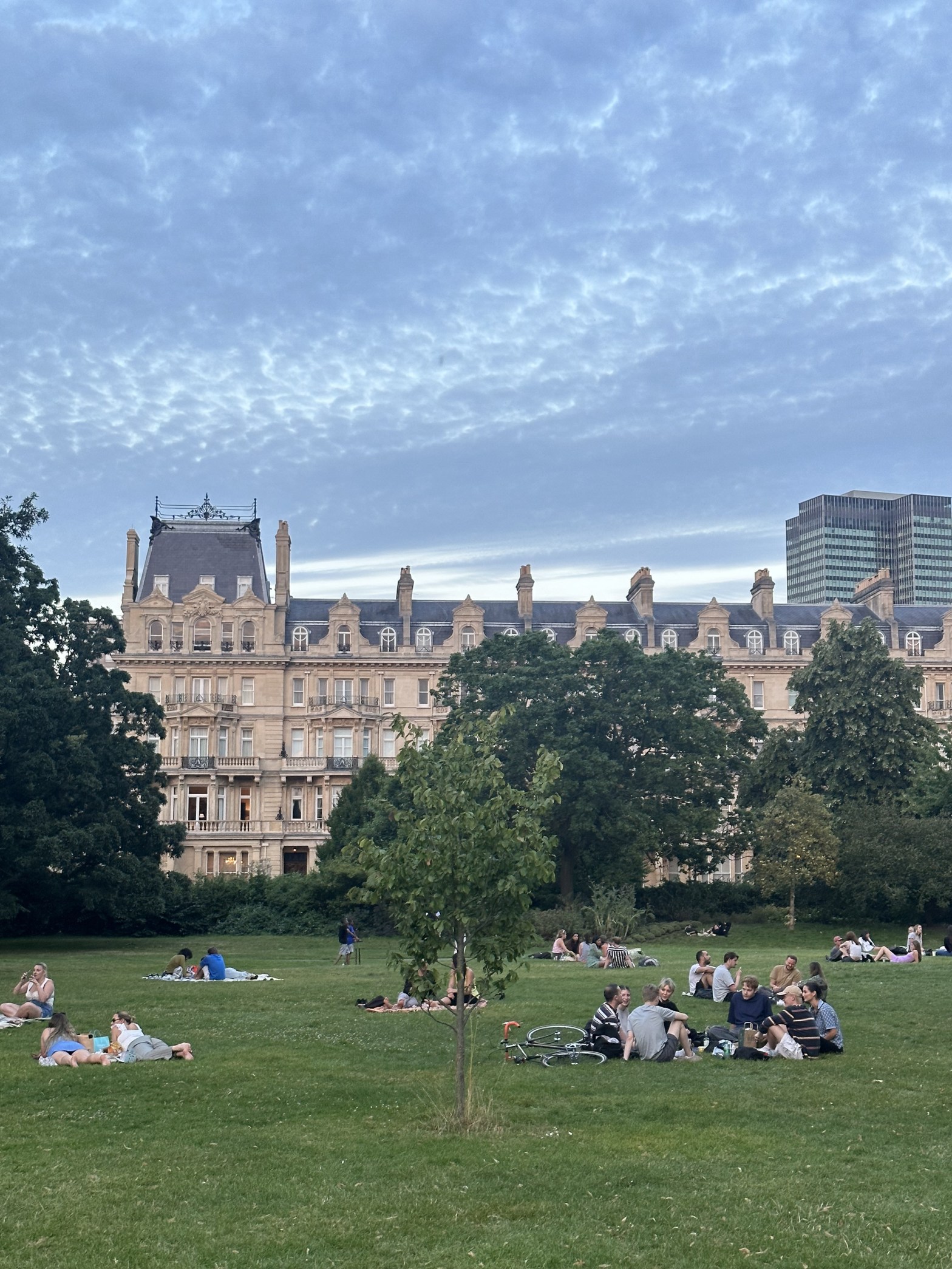
Before even exploring Tampa green spaces intentionally, I already have noticed a fundamental difference between, from my experience, the structure of green space in the UK vs. the US. I’ve covered this briefly in the past, however, I can now confidently claim that in the US (Tampa), urban green spaces are typically created with the intention of tourism, and is usually very human-oriented. For example, if you simply search “urban green spaces in Tampa”, a trip advisor website may show you that a top nature-center in Tampa is the aquarium, the zoo, or bayshore boulevard, which are three establishments that severely lack native wildlife and ecology. However, in London, urban green spaces were displayed as having goals of conservation, human serenity, and wildlife preservation; Richmond Park, for example, ensured that one could find deer in the middle of the city. By intentionally exploring urban green spaces, I hope I can find more common places than maybe I previously perceived. I want to try my best to be unbiased; I loved London, and so naturally, I fear I hold prejudice against Florida’s environmental efforts.
As class time approaches, I want to think about how I can integrate ecology into FSU’s campus. So far, something I’ve learned is that wildflowers and native plants are one of the best methods of incorporating wildlife into urban areas. Specifically, I’ve been studying one method of urban conservation called “botanarchy”, where one plants native wildflowers in empty lots around their community/city. Botanarchy is a common practice in larger cities, such as both Tampa and London, however, it’s not often found in Tallahassee. By the end of the Fall, I would like to establish a system between FSU Sustainable Campus, students, and FSU regulations in which people are allowed to plant seeds and foster local ecologies throughout empty spots on campus. This might look like the cultivation of native plants in an abandoned building site, or the promotion and distribution of native seed collections for free to students. Overall, I think by focusing on native plants and urban green space structure, true change can happen. The following is my outline for my Capstone project, which I think may better encompass my end goals.
Introduction
I’ve always wondered why “nature” always seems to be an isolated, non-human category of space. Growing up, in order to “be in nature”, you either had to drive eight hours north to the mountains, or find an obscure, 10 square-mile state park that was an hour away; it’s as though we treated nature to be a privilege, something that is lucky for still just being around. Although I triple major Environmental Science, Geology, and Biology, I still find the relationship between humans, nature, and communication very interesting, outside of the scientific aspects of ecology and climate change– in my opinion, communication and the incorporation of nature into our everyday lives is the most important facet of reducing climate change. All this being said, that is why for my Summer 2024 experience, I decided to study the incorporation of nature, ecology, and greenery into human life in the UK, as opposed to the US. Going in, my intention was to study these incorporation methods, compare them to everyday ecology in the US, and concretely identify the differing methods and strategies that allows the UK to have a lesser impact on climate change, once more, as opposed to the US. In order to do this, I spent the first third of my summer on a conservational, small-holding farm in Lanlivery, Cornwall, and the last two-thirds within FSU’s London Study Abroad program. By doing so, I was able to learn a lot about UK farming methods, UK conservational infrastructure, and UK urban green space. This experience was greater than studying methods and strategies through textbooks or journals; I was able to immerse myself in logistical and sociological impacts of these facets, which gave me a better perspective on ecological incorporation that I could have ever imagined.
Literature Review
Something that’s important to remember, as I’ve learned about in the Spring Global Scholars colloquium, is that the 17 United Nations Sustainable Development goals stand as a very effective and tangible reference when considering international AND local conservation. While staying in Cornwall, I learned that the most efficient local conservation strategies prioritized human living conditions; meaning, similarly to the 17 goals, basic human needs were met and advertised in a way that also led to sustainable impacts. Specifically, the family I stayed with created a system where local residents could pick up food for free that nearby stores, cafes, and restaurants wanted to get rid of at the end of the day. This allowed that firstly, people could pick up food for free, therefore meeting their basic needs, and secondly, that there was effective food waste prevention. Ultimately, human and conservation needs must interact in order for contribution to be abundant.
Methods
Going in, I knew there was going to be a lot of information to take in. I was going to two different parts of a very distant country, only knowing that my main goal was to study conservation, urban ecology, and climate change in general. However, once I got to the small-holding farm of Cornwall, I realized that my best strategy would be to utilize naturalistic observation as my main method; I would observe where I could find integrated ecology, how humans interacted with it, and how it may apply to the lifestyles of people back in Tallahassee/Florida. In London, I took similar methods- I sought out urban green spaces, city-wide environmental policies, and the patterns in which humans interacted with environmental outreach. Overall, I stand by the idea that these methods have allowed me to take in the culture and English interactions with environmental policies and local ecology, which is something that I couldn’t achieve simply by reading and studying these interactions alone.
Discussion
My experience shaped my understanding of climate change and conservation, because I was able to immerse myself in the day-to-day life of English citizens, and truly realize that there’s a lot more to preventing climate change than just the science and political aspect. I was able to understand that promoting local ecology boils down to the intricacies, in that facets such as local infrastructure, community funding, and human-animal interaction are some of the main reasons that a country/large community may or may not care about conservation. I love the science of ecology and climate change, however, there must be more connection between people and the impacts themselves of the science, and although this connection may not be the part of conservation that piques my interest or comes the most naturally to me, it needs to be addressed and prioritized in order to create change.
Conclusion
After taking in my English experience, I’ve realized that the best way for me to apply my new knowledge to FSU would be through advocation. Specifically, integrated ecology and human-nature interaction are greatly needed on/around FSU campus, and there are many opportunities for this to happen. For example, empty lots around campus hold the perfect opportunity for native, pollinator-promoting plants to be grown, as long as local laws may permit temporary, moveable dirt lots to be placed on top for growing. Another example is bird houses; many local small bird populations have the opportunity to grow and thrive in lesser-populated areas on campus, if local laws permitted non-invasive bird houses to be installed. Ultimately, I want to promote the growing of native plants in empty areas around Tallahassee, and based off what I’ve seen in England, this is one of the most important strategies that local governments have taken in reminding people why local ecologies and conservation practices are important.
 HSF House Blogs