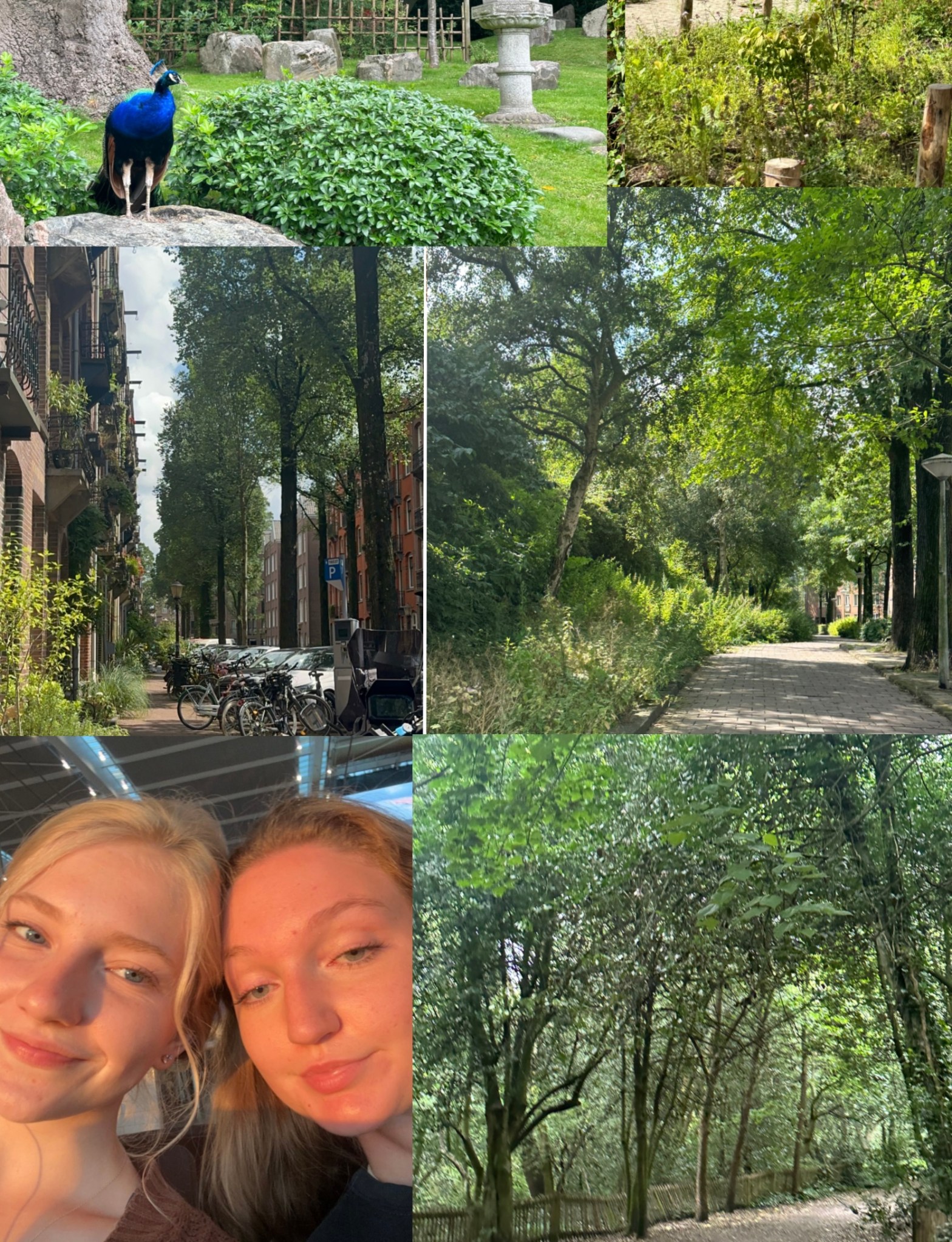
“Hallo” from Amsterdam! This past weekend, my friends and I decided to spend a couple nights over the English Channel in Netherlands, in hopes to experience some of the sights and sounds of Amsterdam. Despite the trip itself being beautiful and wonderful, I also made sure to observe and seek out some of the conservational efforts that the Dutch partake in. As of right now, my Capstone project will focus on the UK, however, I thought it may be interesting to at least take note of the integrated environmental strategies of a city in continental Europe, as well. I started my observations by aimlessly strolling throughout the outskirts and city center of Amsterdam, taking photos, videos, and notes of the architecture and design of the buildings and residential areas. In addition, whenever we went out for food, souvenirs, or ticketed events, I took note of the consumable products, and how establishments regulated waste. Lastly, I (tried my best to) observe how tourists and native Dutch people responded to the treatment of waste and conservation, so that I may better understand the relationship between environmentalism and the consumer basis.
Ultimately, I’ve drawn three conclusions from my observation and notes. Firstly, Amsterdam design and architecture doesn’t go out of its way to make room for local ecology; however, without question, ecology must fill in all the empty and available gaps. Meaning, in the streets of neighborhoods, there were tall trees placed in spaces between entrance sidewalks, there were mini gardens in the spots where streets bent into sidewalks, and long vines were intentionally accumulated between townhouses. This integrated ecology allows for birds, bees, butterflies, dogs, cats, and humans to all live in an unbothered, synchronous state. As I’ve mentioned before, nature isn’t something that should be isolated or distant from human living areas, but something that should be integrated, and encouraged without question.
Secondly, there seems to be a mutual understanding between the people and environmental efforts. It’s very easy to find advertisements and promotions toward environmental activism sprinkled throughout regular commercialization. In addition, paper and recyclable waste strategies are very widely accepted without as much protest as one might find in the states, or even in the UK. For example, every single straw, bottle, utensil, or bag I received was of recyclable material; no establishment tried to give out the less sustainable option. Although this may be due to an enforced regulation, I didn’t personally perceive any pushback. My third conclusion is that I would like to focus my Capstone project specifically on how design permits integrated ecology to be possible in human living spaces. I’ve been pondering this subject for a while now, but this visit affirmed my previous belief that integrated ecology is the most effective perceivable way for people to actually care and work toward sustainability. For the past month, I’ve been taking a class through FSU called “Design and Human Experience” which focuses on how design impacts human spatiality, whether it’s through architecture, color theory, disability accommodations, etc. This class has given me background knowledge and resources that I believe I can put toward this Capstone project, and ultimately, bring integrated ecology back to FSU campus and the local Tallahassee area.
 HSF House Blogs