Background
Hi everyone, our names are Connor, John, and Sequoia and we are one of the two group projects in this year’s IDEA Grant pool. Our project seeks to better understand one of the underlying biological causes of cardiovascular disease, the number one cause of death in the United States. A common theme among individuals with cardiovascular disease is elevated levels of reactive oxygen species (ROS), which literature has suggested may damage the vasculature and contribute to the disease. These harmful ROS molecules are produced in our bodies in several ways, but a large portion of it is produced by an enzyme called the NOX enzyme. By blocking the activity of this enzyme using pharmaceutical agents (and therefore lowering ROS levels), we can compare someone’s vascular health both with and without high ROS levels.
Techniques and their challenges
We will measure these things utilizing a technique called microdialysis, which is a technique rather unique to Dr. Hickner’s lab, as it is only practiced in a handful of labs across the country. Using this technique, participants’ ROS concentrations and rates of blood flow can be directly measured. Essentially, how it works (pictured below) is that we first insert a small, semi-permeable probe into the leg muscle. This probe has a network of very thin tubes through which we pump in a solution containing water and a few pharmaceutical agents. The liquid passes through the muscle, and eventually comes out the other side of the probe into our collection vial. By analyzing the contents of this vial, we can assess someone’s vascular health directly.

Although microdialysis is a fantastic technique, it does present its array of challenges, mostly stemming from the fragility of the thin probs and tubes. During a study visit, it is not uncommon for a blockage to occur in the tubes. This can be due to the participant simply moving or sitting a certain way, where their muscles may squeeze and contort the probe. However, through lots of experience assisting with other projects in the lab, we have learned many ways to troubleshoot when a probe malfunctions and fix the issue. Additionally, since the visits are 4 hours long, there is some margin for error. The key is just to remain calm and focus on the issue, as there is ample time to find a solution.
Once the solution is collected in the collection vial (for which we take a sample every 15-20 minutes over the course of the 4 hours), we use this device (pictured below) called a fluorometer to measure the ROS levels. One of the components of our solution is a compound that reacts with the ROS molecules in the vial to make them turn a red/pink color. The fluorometer shines a light through the vial, and essentially reads how much color is in the solution. So, a relatively clear solution (containing low ROS) will yield a very low number on the fluorometer, while a more colored solution (containing high ROS) will yield a higher value.
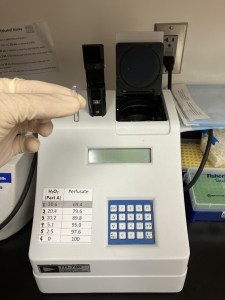
Again, the technology of the fluorometer is crucial for our microdialysis technique, and without it, our technique would not be possible. However, with its advanced technology, comes a high price tag. So, this is one of our oldest machines in the lab. It works, no doubt about it, but at times it has malfunctioned in the past, particularly when calibrating it (before measuring our samples). But, similar to the issues with the microdialysis probes, we have lots of experience fixing these issues when they arise.
Over our experience, we have learned that in research, especially in using complex scientific techniques like these, not everything will always go smoothly or according to plan. Sometimes, you just have to “roll with the punches” per se, and focus on troubleshooting and fixing the problem.
What has gone great so far
The Hickner Lab already has a large list of people willing to participate in clinical research, so we have been going through that to see who would be eligible for our study. While we have been compiling our list of participants for the study, we have also been practicing the study procedure on ourselves as a refresher of the techniques and to be efficient with our time during the study visits. This has been composed of conducting BIA (Bioelectrical Impedance Analysis) tests, HRV (Heart Rate Variability) tests, and other tests related to the study.
This has been a great way for us to maintain our procedural skills while also having a much better perspective on what the participants will be feeling during the study visits. The picture below is a picture of Hayley Schermer, another undergraduate research assistant in the Hickner lab, who was willing to help us practice the BIA test. This test assesses body composition divided into multiple categories of water-mass, muscle-mass, and fat-mass by percentage. This tool is luckily one of the easiest to set up, shortest to run, and least problematic compared to the other techniques used in the study. Overall, we are looking forward to the study visits and are excited to begin working with the participants!
 HSF House Blogs
Hi Connor, John, and Sequoia! Microdialysis sounds like a very interesting technique to assess someone’s vascular health, is it uncomfortable to have the probe in your leg muscle for a long time? I think rolling with the punches is good advice for every kind of research, but I can imagine working with human participants brings its own set of challenges, and practicing on each other to prepare is a great idea. Keep up the good work!
LikeLike