Nestled in Saint John the Baptist Parish, facing directly towards the Mississippi River, lies the big house of the Evergreen Plantation. An impressive structure, the Evergreen Plantation big house serves as a picturesque destination for many tourists in the area. It pulls on the ideas of romantic Antebellum architecture, standing proud and shining in the center of the property.
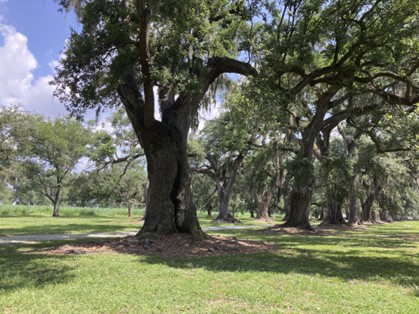
For my research, however, the big house doesn’t matter. What matters is the 22 surviving slave quarter buildings, located in the back of the residential areas of Evergreen. Two parallel rows of the buildings sit right by the sugarcane fields: eleven on one side and eleven on the other. The rows are separated by a pathway made of shell and gravel, oak trees adorning each side. Evergreen Plantation is notable for the sheer amount of surviving slave quarter buildings it has. While they are in different states of (dis)repair, the way that they’ve held up for the past few centuries speaks to the craftsmanship of the people who built those buildings. The enslaved people who built those buildings.
I was brought onto the Evergreen Plantation Project through the Institute for Field Research: a nonprofit, academic institute dedicated to organizing field schools for students interested to join. Evergreen’s field school is holistic, dealing with archaeology, history, and literature. The environment is fast paced: we only have five or so weeks to spend here (May 15th- June 17th) and have to make the best use of our time. The field school consists of six undergrads, a handful of graduate students, and volunteers from the local community. Dr. Jayur Mehta facilitates the archaeological aspect of the field school. He and another team excavated previously in this area, in 2021, and we are both uncovering new units and researching the areas that were excavated before to see how it all connects.
Nearly every day is a full schedule: We get into the field at 7am and assist the graduate students in archaeological work until noon. We break for lunch then, everyone gathering around the assorted coolers to eat the sandwiches they packed for the day and talk about what discoveries were made under whose supervision. Around 1pm, the undergrads pack up their things and leave the archaeology work behind to learn about African American history and literature. Monday’s and Wednesday’s classes are headed by Dr. Alisha Gaines, a professor under the English department at our very own FSU. Tuesday’s and Thursday’s classes are headed by Dr. Natalie King-Pedroso, a professor under the English department at Florida A&M University. These classes last until 2:30pm, though often the discussions we all get into end up sending us over that time. After that, we’re left mostly to our own devices, though we do occasionally gather together – students and faculty alike – to talk over dinner. Fridays, Saturdays, and Sundays are far more loose, consisting of occasional field trips as well as general rest days.
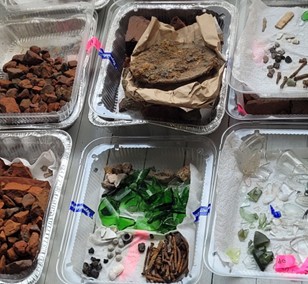
The archaeological work is tough, sure, but it’s also incredibly rewarding. I’m actively helping in the process of excavating – discovering new pieces of the past that aren’t even buried that far underground. In the span of me being here at Evergreen, I’ve already helped excavate over five new units, and in each unit we’ve found a wealth of different artifacts: ceramics, glass, even a few pieces of animal bones. Each and every piece that we as archaeologists are able to collect brings us closer to understanding the past in greater detail. In our specific area, we get closer to figuring out what the household lives of enslaved people on this plantation were – people who still have descendants in the neighboring towns to this day.
Strangely enough the part that I find the most difficult with this project is connecting with the locals. In Florida, I feel like I’m in my comfort zone. I know Florida – I know the locals in my hometown, and I know the town itself like the back of my hand. Out here, though? I know nothing more than what I’ve been told and the things I’ve seen for myself on late night walks along the levee nearby. The locals know infinitely more than I do, and I’m acutely aware of that fact. What right do I have to sit here: to talk and theorize about a history that they have far more of a right to know than I do? I’m doing work that I believe will help the community, but how do I truly understand the impacts of it the way they do?
Thoughts like these have been plaguing my mind since I stepped foot onto Evergreen Plantation, and these same thoughts highlight why it’s important for archaeologists to interact with and collaborate with the local community of a project they’re working on. Because they might not have the cultural context needed to truly understand and appreciate the impacts of the work they’re conducting, archaeologists often bring in members of the community to discuss how to proceed with site excavations, as well as discuss the potential context of different artifacts that are found. The project itself on Evergreen was started because Dr. Mehta contacted some of the locals in the area – locals who had heard stories from their ancestors about a church being located somewhere near the slave quarters on the plantation.
Through surveying the land and using a technology known as ground penetrating radar (GPR), Dr. Mehta and his team were able to find multiple places where the church was suspected to be at. Though they excavated already in 2021, this field school is both uncovering their old work and excavating more and more units every day. Locals and tourists alike come to see the progress we’re doing, and I’ve had some really enlightening conversations with a few people. It’s made me realize that even if I don’t have all of the context necessary to understand what this means to people on a personal level, I don’t have to. All I have to do is keep talking to people here in Wallace. When I learn from them, I gain a new appreciation for everything I’m doing and learning in this field school.
More information about the work done on Evergreen Plantation can be found at: https://www.evergreensurvey.org/.
More information about the Evergreen Plantation Field School (as it is run by the Institute for Field Research) can be found at: https://ifrglobal.org/program/us-la-evergreen-plantation/
To read an article written by Dr. Mehta about Evergreen Plantation, use this link: https://64parishes.org/buried-histories-at-evergreen-plantation
To access Dr. Mehta’s personal website, use this link: https://jayur.wordpress.com/

