By Maya Parfitt, William and Mary
Most of the site visits I chose for my research project this summer were straightforward – think Ancient Olympia or the Athenian Agora. In places like these, there’s a sense of infrastructure. Everything feels clearly delineated: neat signs and brochures leading the way to ancient architecture and artifacts I’ve already encountered during my coursework.
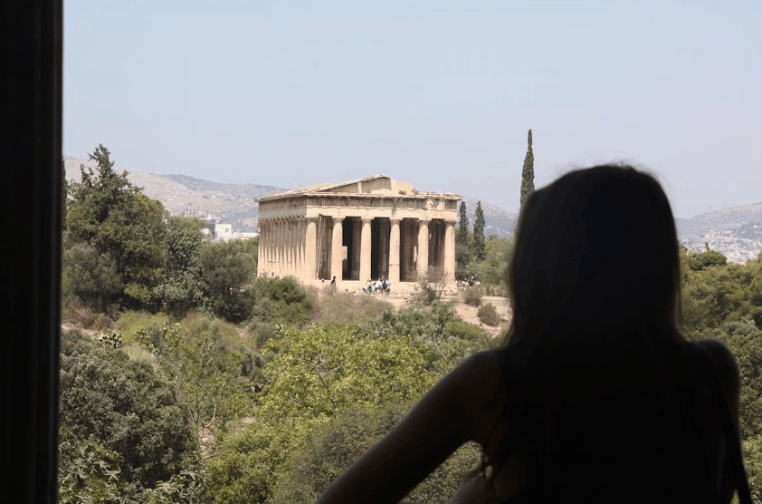
Looking out over the Athenian Agora
I did decide to throw myself into the deep end for one visit, though. A few months before coming to Greece, I read a newly-published article about relief carvings of Hercules in ancient Greek marble quarries, which touched on their potential relationship to the people that worked to extract stone. It makes sense – Hercules was a hero, after all. If moving large slabs of stone was my job, I would want to emulate his strength, or at the very least feel protected by him. There was one carving of the demigod in particular that fit my travel route the best, so I excitedly jotted it down, and resolved to see it for myself.
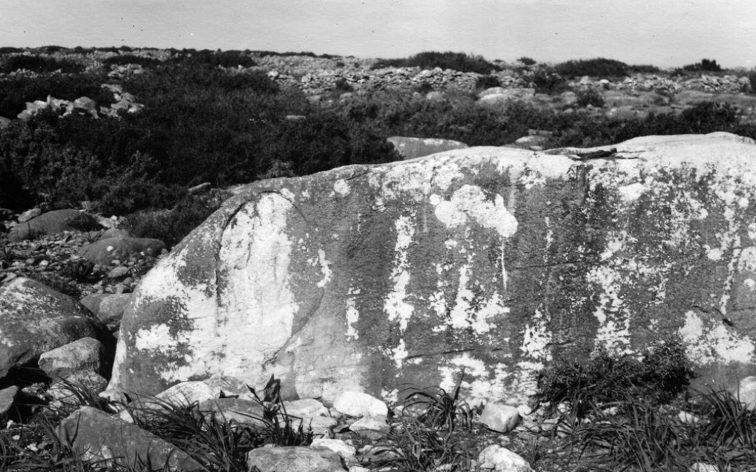
The Hercules relief in question (photo from Georgios Doulfis’ “Heracles Rock Reliefs at Quarries and Construction Sites in Roman Greece” in Ergasteria, page 139)
Fast forward two months or so, and I’m in the rural Peloponnese, staying in a village with a population of (at most) 15 people. During the time between my decision to see the relief and actually being in its vicinity, I was able to track down other publications that mentioned it. After reading as much as I could get my hands on, I realized a few things: first, there was no exact, recorded location for the Hercules carving. Second, all of the pictures of it that I saw were reused from the very first piece of writing it was referenced in, from 1906, by a British archaeologist named Arthur Woodward.
Every publication did, however, mention that the carving was somewhere near a cleft in the ground, referred to as “Vathy Mouzi” by locals. I felt like a detective – my site visit was starting to become a site search, and Vathy Mouzi was the strongest lead I had. Luckily for me, it was marked in Google Maps. Woodward’s publication quickly became my touchstone, because it had the best description of where the Hercules relief was in relation to Vathy Mouzi. So, with it downloaded onto my phone, I hopped into my rental car and set out.
After parking near an old Orthodox church, walking past a seemingly endless patch of cacti, and following a long dirt road canopied by giant spiderwebs, I noticed a section of the landscape where the line of vegetation was disrupted. I walked toward it, and a few minutes later found myself standing at the edge of the “cleft” I had read about – easily over a hundred feet wide – thinking it more akin to a giant, gaping mouth. I couldn’t tell how deep it was, but there was a small forest inside of it, with fully grown trees that did not reach the top. It was extraordinary. I thought of a line from a Euripides play: “Other toils [Hercules] hath accomplished, and last of all he passed through the mouth of Taenarus into the halls of Hades to drag to the light that hound with bodies three, and thence he never returned.” I was in the right place.
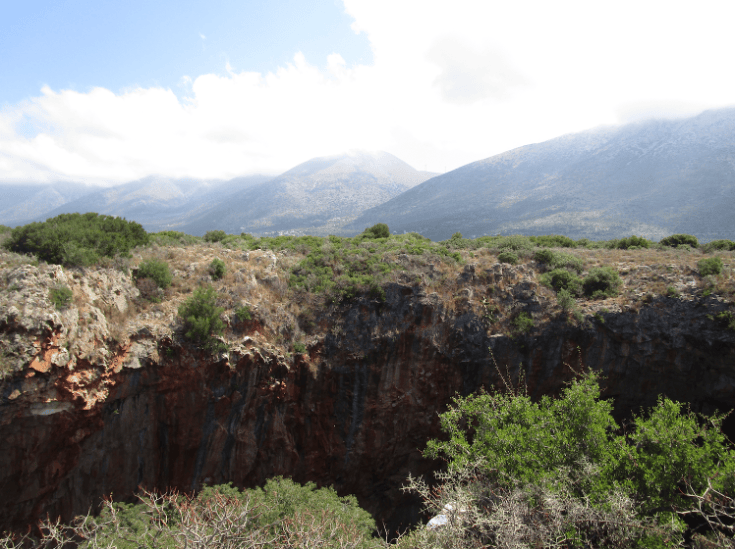
Vathy Mouzi – don’t fall in!
I recited Woodward’s directions aloud: “Almost on the lip of the hole on the north-west is a rock-cut relief, .67 m. high, representing Herakles.” It seemed easy enough, and a feeling in my gut that told me I was on the precipice of discovery. Dotting the landscape were hundreds of large, grey stones jutting out of the ground. I oriented myself and headed north-west.
I wish I could say that I found it – what a great blog post that would’ve made – but I didn’t. After three hours in the oppressive Laconian sun, double and triple checking every exposed surface of rock I could, and trying not to fall into what really did seem like an entrance to the underworld, I threw in the towel. What did I miss? Was the carving covered in vegetation? Was it weathered beyond recognition? Was there some other written source I should’ve cross-referenced? I wasn’t able to discern any traces of stone quarrying during my investigation, either – no tool marks or signs of extraction, which I had become familiar with while working on Naxos a few weeks prior. In the end, I had to let it go.
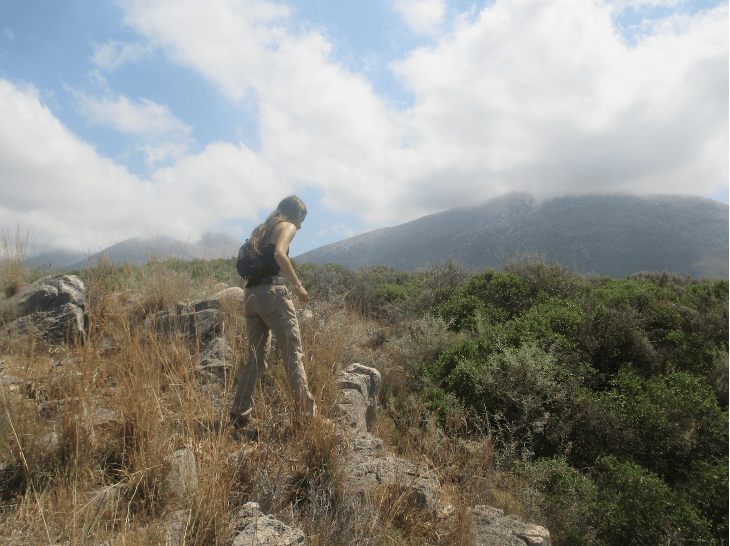
Searching for Hercules…
This is the side of research that doesn’t get much attention – the wild goose chases, the dead ends, and having to kill your darlings. How I wished to come back home with a majestic picture of myself next to the hero. Or, more importantly, with a piece of solid evidence to include in my thesis. But this is the significance of firsthand experience (which I am deeply grateful I got to have): it teaches you to keep an open mind. While the Hercules carving remains an enigma to me, I would be remiss to say I didn’t gain something from it. My search wasn’t just valuable because of what I was looking for – the process is what truly made it worthwhile. I had the chance to critically examine scholarship, to discover where lines of thinking originated, to give myself room to ask questions. These skills were vital to me as I visited other sites and museums, spent hours in the library, and spoke to experts this summer, and they will continue to be as I work on my thesis during the academic year. Searching for Hercules taught me what some of the more conspicuous pieces of material evidence I encountered on my trip could not: sow seeds, and something will grow from them.

