By Luis Carvajal Picott, University of Texas at Austin

Photo Taken in Singapore Changi Airport (SIN) | Oliver Royal (left), Luis Carvajal Picott (right).
In applying for the Tyler Fellowship, my research question was clear: How does China employ “soft power” through the use of language – in particular, Mandarin – in Thailand and Singapore? “Soft power” is a concept from political science that refers to influence that comes through attraction rather than compulsion. Think of language programs, cultural centers, scholarships, and television dramas.
At home in the US, that concept always comes packaged with a certain level of anxiety. The growing influence of China abroad is typically framed as an increasingly dangerous threat, a long-term effort to win the world over. I traveled to Southeast Asia expecting that story to be told. Instead, over [number] weeks of interviews with government officials, academics, and ordinary citizens in Bangkok, [other cities], and Singapore, I found the story told by those living next door to China to be quite different.
First, the professors surprised me. Time after time, when speaking to these scholars, they very politely challenged the assumption, put forth by Washington, that the rise of China is threatening. Of course, the professors had respect for China’s power, and they were no fools when it came to dealing with Beijing. However, it was described not as a threatening power but one of many in an international landscape that needed to be negotiated carefully. [Insert a quote or a name.] To someone living next to a big brother for centuries, China is not a story; it is geography.
Nowhere did this become clearer than in Singapore. I have learned that Singapore is a diverse nation, but what you learn in books and what you experience firsthand is often quite different. The ethnic Han Chinese are the majority population, but there are also Tamil Indians, Malay and Arab Muslims, and residents of all the countries in Southeast Asia. Mandarin is one of four national languages, but it is not spoken by everyone, and it does not hold the same significance for everyone. [Insert some details here of a conversation with a Mandarin-speaking Chinese Singaporean.] Mandarin can be a heritage language for many Chinese Singaporeans, but for others we spoke to, including representatives of the Tamil and Muslim populations, it became clear that the implications of a rising China would be felt in the regional balance and even their place in Singapore’s delicate multicultural mix. Sometimes in just one day I heard opinions that conflicted with each other, and each of these was colored by the background of the individual expressing his or her opinion.
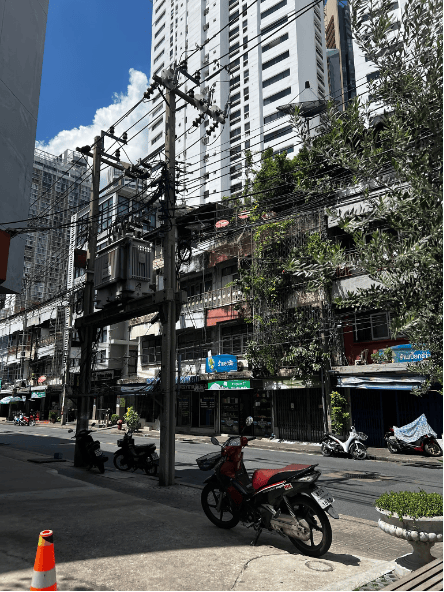
Photo Taken by Luis Carvajal Picott in Bangkok, Thailand.
This was the case in Thailand as well. The concerns there did not focus on Chinese culture or language, rather, the focus was on the neighborhood and economics. Our interlocutors would mention the situation with the neighbors, tension with Cambodia along the borders, and the shift of economic routes towards China. [Insert particular quote from interviews.] The Mandarin language was regarded by the respondents as a useful tool for doing business and attracting tourists, but the main concerns focused on issues of security and economic interests. In Thailand, China does not represent an ideology, it represents an economic reality.
A common thread kept reappearing throughout both of these countries: China was no longer a wanted enemy nor an appreciated ally; it was simply there, big and unavoidable, and people made decisions in relation to it. Some were wary, others hopeful and others were simply practical. The one big thing that I got from my research is that influence can only be true when there is a willing recipient, and the recipients are far from being passive objects. They have their history, opinions, and much more nuance than “spheres of influence” maps account for. I believe this is true even when it comes to my specific topic: when we discuss global politics at a distance, we have to consider not only the actions of those with power, but also the experiences of people like us.
In academic terms, this trip gave me more than what I was learning from my textbooks. Lectures on soft power are very clean-cut, but it became messy, personal, and contradictory on the job, and I discovered that one has to be open about the theory but flexible enough to let the facts alter their views on it. Some of the skills gained in this trip would never have been learned in the confines of a library. How to adjust my behavior despite who I am talking to, how to talk in Mandarin with the people who matter, and how to respond and think on my feet when things go wrong such as interviews being delayed or cancelled by the people we are interviewing.
Through this project, I want to demonstrate that my interest in language is genuine; it’s not a mere addition to my résumé, but rather a tool for analyzing people. Having analyzed international relations through Mandarin, I understood that IR is also about relationships between people. As my future plans go, I aim at [next step of yours: language study, MA thesis on your topic, graduate school or career as an analyst/policymaker/diplomat/intelligence officer/etc.]. It was my first experience in such activities, and now I cannot get enough of it.
From being determined to learn how one language makes its influence upon a region, I returned home with an understanding that more important is “who listens, and what is heard.”

