By Wren Atteberry, Austin Community College
My name is Wren Atteberry, and I’m from Texas; more specifically, I was born and raised in Austin. I was expected to be a high school graduate in 2026, but I earned my diploma last year, and now my studies continue at Austin Community College. I am currently in a general studies program because I plan to transfer into university next fall, but that does not mean I’m unsure of what I would like to study. I say this because I have a dedicated passion for natural sciences, particularly physics and environmental science. Thus far, those topics have significantly impacted my life, not only in terms of my education, but also as to how I spend my free time, and what activities I enjoy participating in. Consequently, when I am not outside experiencing the goods that nature has to offer, then I am most likely enjoying a video game or researching various topics. I characterize myself as a man of science, but with that said, I know my passion is technological human advancement, whether that be sustainability for our planet or leaving Earth and colonizing elsewhere in the solar system.
My proposed research topic and question examines whether male call characteristics predict the probability of female visitation in strawberry poison dart frogs (Oophaga pumilio) and whether microclimatic conditions regulate this relationship. These calls from male strawberry poison dart frogs are known as advertisement calls because they attract females and essentially sell them the idea of mating together, but they also function in a way that deters other males, which is a territorial response influenced by the desire to reproduce. In order to be successful in this project and obtain accurate data, I must use an audio device to record male strawberry poison dart frogs’ calls and a thermohygrometer to identify local microclimatic conditions like temperature and humidity. Those two tools will provide the necessary data to differentiate between call characteristics of males. However, to determine reproduction probability, a female visitation must be observed, or there must be alternative proof that a male has already been successful.
I was compelled to conduct this research because I’m very concerned about the sustainability of our planet and how the survival rates of organisms within our environment will be affected. I have felt this way for as long as I can remember, so given the opportunity to investigate and explore the tropical rainforests of Costa Rica, I feel that I have an obligation to gather information as to how important species are faring despite changes to climates. The relationship involving reproductive success being regulated by microclimate conditions and call characteristics is tied directly to climate change. That is because if certain climatic conditions are not met, then reproductive success is harder. Thus, I am certain that studying how the strawberry poison dart frogs’ reproduction rates alter depending on characteristics of males’ calls and the local climate will further our understanding of how changes in climate, no matter how drastic or minimal, will have adverse effects on organism populations.
Regarding the specifics of my travels and where the studies will be conducted, I will be at Palo Verde Biological Station, Guanacaste Province, Bagaces, as well as La Selva Biological Station, Heredia Province, Puerto Viejo de Sarapiqui. As I am writing this, it is Friday, June 19th, 2026, which means I have been at Palo Verde for 3 days and will be leaving June 21st, and
from there I will be traveling to La Selva, where I will stay until July 4th. Whilst I conduct my research in Costa Rica, I expect to find a fresh perspective and a newfound intensity to my focus and work ethic because everything I experience here is brand new to me as can possibly be. Furthermore, I look forward to a variety of opportunities during my research abroad, but I am most excited to work alongside experts in a foreign context, and, even more importantly, to share my ideas with them while learning as much as I can. Along those lines, I expect to learn a lot about how I function independently without many of the conveniences that I am accustomed to in the United States. Overall, I plan to be in the field for as much time as I possibly can. In doing so, I will be able to collect the necessary data for my research, and at the same time, I will be able to experience as much as possible within a complex environment that is new to me.
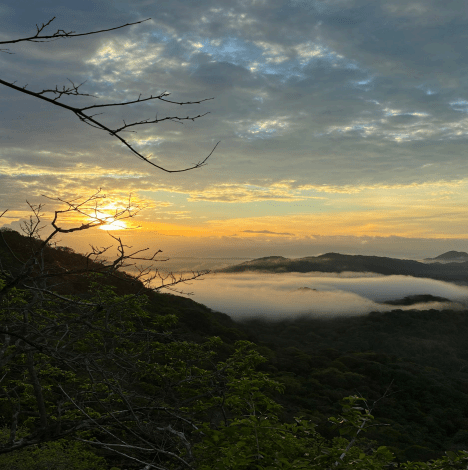
Image from a mountaintop within Palo Verde National Park.

