By Kaminta Hou, University of California San Diego
Hi! My name is Kaminta, and I am from Wilmette, Illinois, just outside of Chicago, but I currently attend UC San Diego. I am a Neurobiology major with a tentative double major in Medical Humanities. In my free time, I love chatting with friends and going on walks. Currently, I am super curious and passionate about health and healing particularly that of all people.
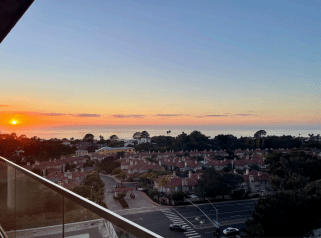
This is the view of the Pacific Ocean from my dorm which I will definitely miss this summer!
For my project, I will be conducting an ethnography on how Traditional Chinese Medicine (TCM) is conceptualized and experienced. Before this year, I did not even know what ethnography was, but I have since learned that ethnography is a qualitative research method in which researchers immerse themselves in the environment they are trying to understand. They spend an extended period of time observing, participating in daily life, and interviewing community members in order to understand the broader factors that shape people’s experiences. Ethnographers aim to learn from the perspectives of those actually living through the topic being studied.
I was drawn to the topic of Traditional Chinese Medicine for several reasons. First, I happen to know some Chinese, which will allow me to conduct interviews. Additionally, after taking a class on alternative healing systems and reflecting on some of my own experiences, I began to recognize some of the limitations of Western medicine. Although Western medicine has excelled in emergency care and technological advancement, it is not always patient centered. While the scientific method has given us incredible tools and treatments, Western biomedicine often focuses primarily on treating disease rather than healing the person as a whole. It is important to remember that cure does not always equal care.
In fact, by focusing so heavily on curing disease, we can overlook many of the social factors that influence health, such as insurance access, transportation, lifestyle, and community support. I wanted to learn more about how healing is understood and experienced in other parts of the world and to explore what biomedicine might be able to learn from those approaches.
Specifically, I am interested in people’s conceptions of health and healing, whether healing is experienced positively or negatively, what kinds of individuals choose to rely on Traditional Chinese Medicine, and how patients may combine both biomedicine and TCM in their healthcare journeys. I am excited to hear people’s stories and gain a deeper understanding of a non-American medical system.
Beyond the research itself, I am also hoping to strengthen my Chinese language skills. Although I was taught Chinese from a young age, it has become much less natural for me as I have gotten older and moved through college. I am looking forward to using the language more regularly and improving my confidence in speaking it. At the same time, I am also quite nervous about it. Especially in the beginning, I know that navigating communication challenges may be one of the biggest obstacles I face during this project.
To make the most of my global journey, I plan to explore as much as possible outside during my free time. This summer, I will be staying with my aunt, who is actually a history professor and is always eager to share her knowledge of China’s history and culture. Hopefully, we will take many trips to museums and historical sites, and I look forward to meeting some of her friends and learning through those conversations as well!

